How did this crisis happen? A breach at Piney Point puts area in environmental peril
The call that Manatee County leaders feared most came Friday. They learned that a leaking pond holding contaminated water at a former phosphate plant started to collapse.
A building environmental crisis began to spin out of control. First responders and engineers worked feverishly overnight to fill the breached gypsum stacks at Piney Point, an industrial site on the edge of Tampa Bay.
But it wasn’t enough. By Saturday, the possibility of an environmental disaster in Florida inched closer with the imminent collapse of a radioactive stack and the possibility of flooding from about 400 million gallons of polluted water.
On Saturday afternoon, Gov. Ron DeSantis declared a state of emergency to clear the way for resources that could be needed, such as additional pumps and cranes. The first call for evacuations went out Friday evening and continued into Saturday.
“The risk that we’re dealing with right now is an uncontrolled release,” Acting County Administrator Scott Hopes said Saturday.
“There’s a very thick liner — think of it as a soft swimming pool. [The engineers] rightly identified that that leak was in the base of the southeast corner of that pool, so now what you see is, you see that opening,” he said. “If that liner continues to unzip — because it’s probably at a seam — when that opens up, you will see the crevice where the breach has occurred continue to unzip and break that rock away.”
Crews are working to block the flow of polluted water flowing from the pond. And they are bringing in additional pumps that can send more water directly into Tampa Bay. Hopes said the idea is to put as much of that water into the bay to lessen the impact of a flood in case of a full breach.

Piney Point first became a looming crisis on March 25 when site operators spotted a leak. In the days since, the leak got worse, and leaders began to consider the worst.
“Unfortunately, the containment wall at the leak site shifted laterally, signifying that structural collapse could occur at any time,” Public Safety Director Jacob Saur said.
So, how did Piney Point get to this point?
Started in the 1960s
An environmental disaster has loomed at Piney Point for decades. It began in 1966 when Borden Chemical, a spin-off of the milk company with Elsie the Cow, built an industrial plant to process phosphate, a key ingredient in fertilizer.
Since then, the site has housed a steadily growing amount of contaminated material that’s now in danger of spilling into Tampa Bay.
HRK Holdings, LLC, acquired the Piney Point site in 2006 and has taken responsibility for disposal of the contaminated material. The company operates the property as an industrial site for lease. Several warehouses are on the southern rim of the property.
Even though phosphate processing plant became inactive in 2001, the large holding ponds collected millions of gallons of rainfall, adding to the problem.
Officials have said for years that the main danger at Piney Point is the amount of process water held on the site. Process water is a chemical byproduct of phosphate mining that is rich in nitrogen, phosphorous and ammonia. Because those nutrients can affect local water quality, that water must be cleaned before it is released. The leaking pond contains uncleaned water.
The byproducts
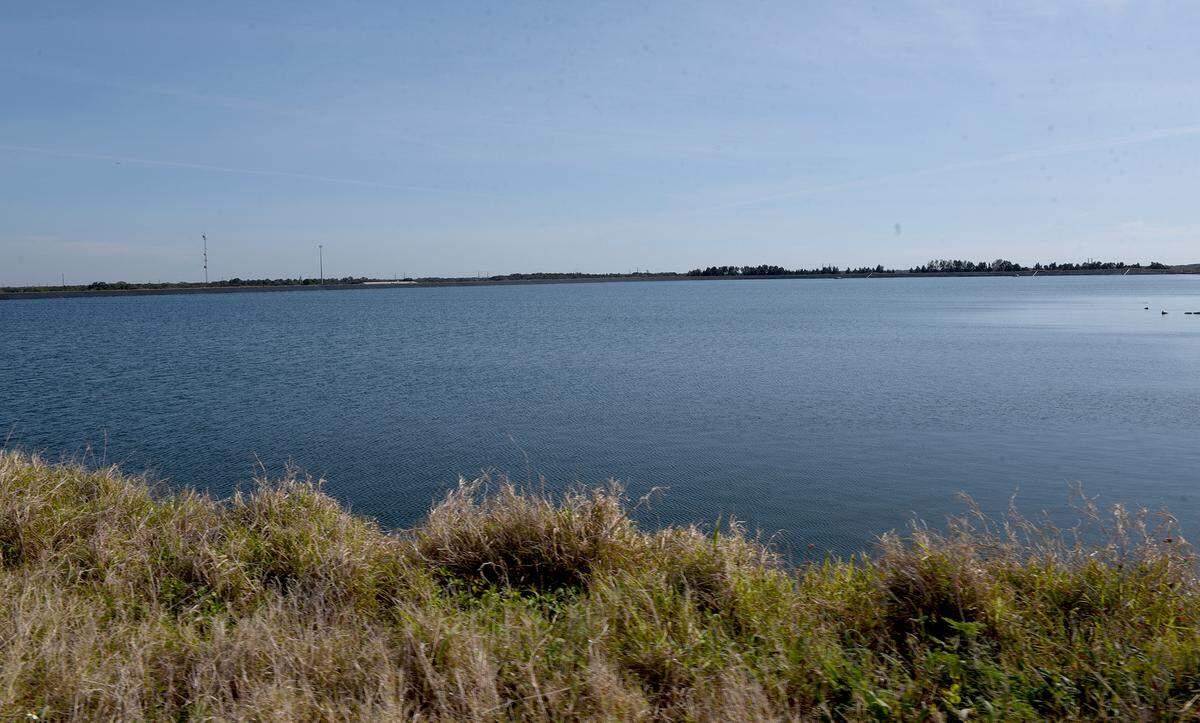
Three ponds of process water sit at Piney Point, located across the street from Port Manatee near the southern border of Hillsborough County. Each pond sits above a lined stack of phosphogypsum, another byproduct of phosphate processing.
The phosphogypsum stacks form a large hill — the highest elevation point in Manatee County — on the 676-acre Piney Point site. A collapse of the stacks would send the process water rushing into surrounding properties, including highway U.S. 41, Port Manatee and industrial warehouses in the area. The evacuation order that at first covered a couple dozen homes within a mile of the site is being expanded to another 300 households, according to the Manatee County Public Works Department.
The uncontrolled release of the water is a wide-ranging disaster that may take weeks or months to fully understand. Local officials said their primary concern was to assist and protect people who live in the immediate area.
The waterways
Piney Point sits less than three miles from three important waterways — Tampa Bay, Bishop Harbor and Cockroach Bay. No matter which way a collapse spills, the water is bound to drain into those waterways, polluting aquatic resources with nutrient-rich water that could lead to a harmful algae bloom.
Environmentalists have pointed to research that shows how the spill of that nutrient-rich process water is likely to have an impact on the environment. Many fear it could lead to red tide algae blooms that affect public health and local tourism.
Those concerns aren’t unfounded. In 2011, a tear in the liner on the gypsum stack sent 170 million gallons of process water into Bishop Harbor, an Outstanding Florida Water that has special environmental protections.
Manasota-88, an environmentalist group, criticized county officials on Saturday.
“The gyp stacks at Piney Point have been mismanaged for decades,” the group said in a statement. “The current crisis can be traced back to the absurd 2006 decision to allow dredged material from Port Manatee to be placed into one of the gyp stacks at Piney Point, something the stack was never designed for and should have never been allowed.”
Liner tear
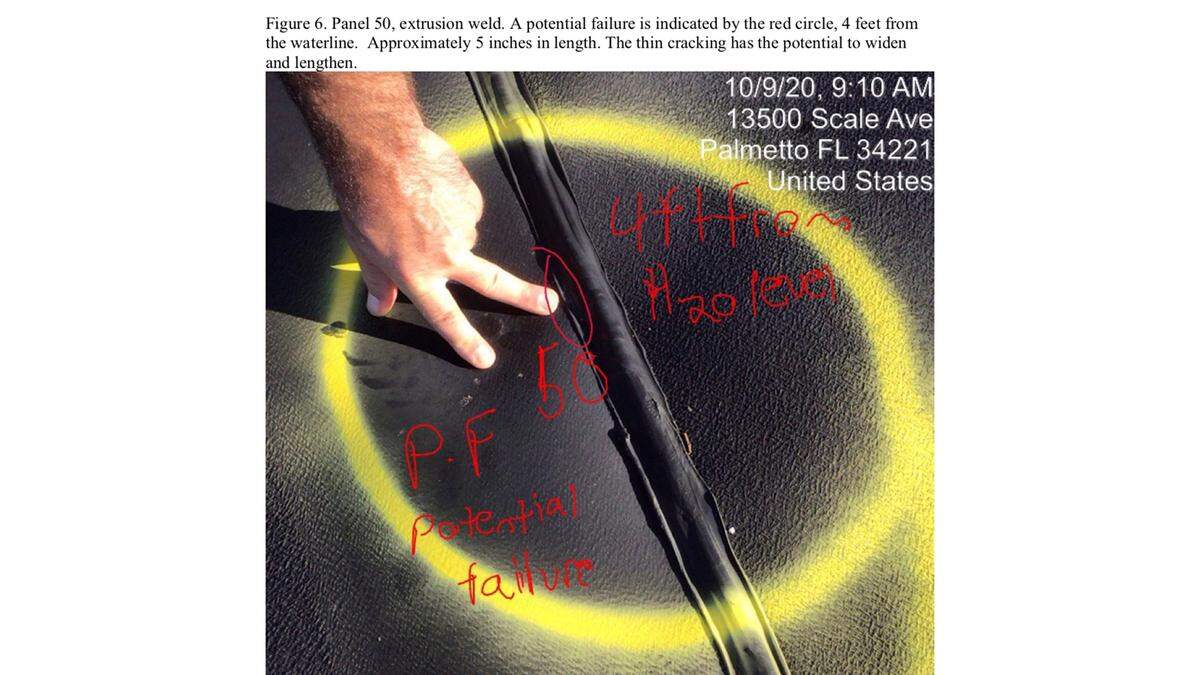
A liner tear could also be at fault for the entire collapse of the stack. The Bradenton Herald recently reported on a series of “critical” tears in the liner at Piney Point, which HRK staff reported to Florida Department of Environmental Protection officials between July and December.
Those liner tears were above the waterline and have since been repaired, but in a recent briefing with Manatee county commissioners, engineers confirmed that they believed the liner to be in poor shape and was the likely source of the leak.
The leak also destabilized the gypsum stacks, forcing FDEP to approve an emergency final order allowing HRK workers to begin emptying the leaking pond as quickly as possible. Engineers said they hoped to empty the pond to relieve pressure on the stack before the whole thing came crashing down.
As of Friday night, Piney Point was dumping about 30 million gallons of untreated water into Tampa Bay each day. By Saturday, 390 millions gallons remained in the pond, which once contained 480 million gallons.
Out of control?

Despite those efforts, the leak sprang out of control on Friday afternoon when site operators noticed that a seepage wall had breached, sending even more water out of the pond. That’s when crews began using fill material like soil and rocks to blockade the breach.
Those efforts weren’t enough to shore up the system. In a video update posted to Facebook Saturday afternoon, Commissioner George Kruse announced that engineers determined it was “no longer safe to be anywhere near Piney Point.”
“At this point in time, it’s an abundance of caution,” Kruse announced, referring to an updated evacuation order in the area. “The feeling is that this may go sooner rather than later, despite some valiant efforts to try to stem the tide of the water.”
What can be done?
The current crisis comes at a time when the Manatee County Commission vowed to take Piney Point head-on, despite the issue being primarily under FDEP’s jurisdiction. Previous county officials declined to take ownership of the problem, citing the exorbitant cost of a solution and the private ownership of the property.
In 2013, the county applied for a state permit to build an underground injection control well, which would send up to 1.5 million gallons of water per day about 3,500 feet below the ground surface. FDEP officials were in support of that option, but commissioners backed down after members of the public raised concerns about the well leading to potential issues in the future.
But the board reversed course in December, voting to make a resolution to the process water ponds its No. 1 priority in the Florida Legislature just months after site operators warned they were running out of capacity. Commissioners hoped to secure up to $6 million in funding to pay for a cost-sharing “emergency water treatment” program, with an injection well listed as their preference.
At a briefing Friday night, Manatee County legislators promised to secure the funds and resources needed to get rid of the environmental problems at Piney Point.

“This quarter-century debate about what to do with this property needs to come to an end. This has to end,” said state Rep. Will Robinson, R-Bradenton.
In a recent statement, the Florida Department of Environmental Protection also said it plans to hold HRK responsible for any failure at Piney Point.
“DEP is coordinating with local stakeholders and we began water quality monitoring of Port Manatee on March 30, 2021 to protect human health and safety, and to transparently communicate with the public as this situation evolves,” the department said in a statement. “DEP is dedicated to full enforcement for any damages to our state’s resources and holding HRK accountable for this event.”
Herald report Mark Young contributed to this report.
This story was originally published April 3, 2021 at 3:43 PM.