Piney Point leak may lead to total collapse. Manatee County declares local emergency
After learning that the leak at Piney Point could lead to a collapse of the gypsum stacks holding hundreds of millions of gallons of contaminated water, the Manatee Board of County Commissioners voted unanimously to approve a local state of emergency.
Even though millions of gallons of contaminated water have already been released into Tampa Bay, the catastrophic collapse of gypsum stacks holding process water is still a real possibility, engineers told the Manatee Board of County Commissioners on Thursday.
Site operators and engineers are working around the clock to avoid that disaster, they said in a briefing to the board. Because engineers believe the leak is near the bottom of the pond, the main focus has been removing as much water as possible in order to stabilize the stack.
The situation is rapidly developing, and the possibility of complete failure is still on the table, said Mike Kelley, a third-party engineer hired by HRK Holdings, LLC, the company that owns Piney Point.
“To make it very clear, it is a very critical condition. An uncontrolled release is a very real possibility at this stage. Getting the water off the stack is a priority,” Kelley explained.
The gypsum stacks are the highest elevation point in Manatee County. The threat of a complete collapse poses a threat to surrounding landowners, including Port Manatee, which is across U.S. 41 from Piney Point.
After site operators discovered a leak late last week, the Florida Department of Environmental Protection issued an emergency final order Monday afternoon, approving the release of process water directly into Tampa Bay. Since beginning a controlled release earlier this week, Piney Point has already dumped nearly 30 million gallons of water.
The 676-acre Piney Point site is holding 800 million gallons of process water, which is a chemical byproduct of phosphate mining. The water is rich in nutrients, like nitrogen and phosphorous, and typically undergoes a cleaning process before it is released into local waterways.
While Piney Point’s emergency release sent about 14.5 million gallons of water per day into Berth 12 at Port Manatee, Jeff Barath, HRK’s site manager at Piney Point, hoped to double that rate by using a second siphon pipe by the end of the week, but a mid-briefing update changed those plans.

Kelley let Barath know that the drainage siphon had to be shut down around 2 p.m. on Thursday after site workers noticed that the pipe sprang a small leak on Piney Point’s property. That leak was expected to be patched, with pumping resuming sometime Thursday evening.
“This is my community, too, and we are doing everything to prevent a crisis,” Barath explained.
According to Kelley, there is evidence to suggest that the leak that threatens Tampa Bay and the surrounding area is caused by a tear in the liner near the bottom of Piney Point’s 77-acre process water reservoir, the largest pond on the site. In order to repair the leak, they may need to empty all 480 million gallons.
“There is a potential where we have to drain it all if it’s at the base, but at this stage, that’s an unknown entity,” Kelley said.
Concerned about the startling updates at Piney Point, commissioners directed Acting County Administrator Scott Hopes to reach out to FDEP to make sure representatives are present for another update on the situation at their meeting Tuesday.
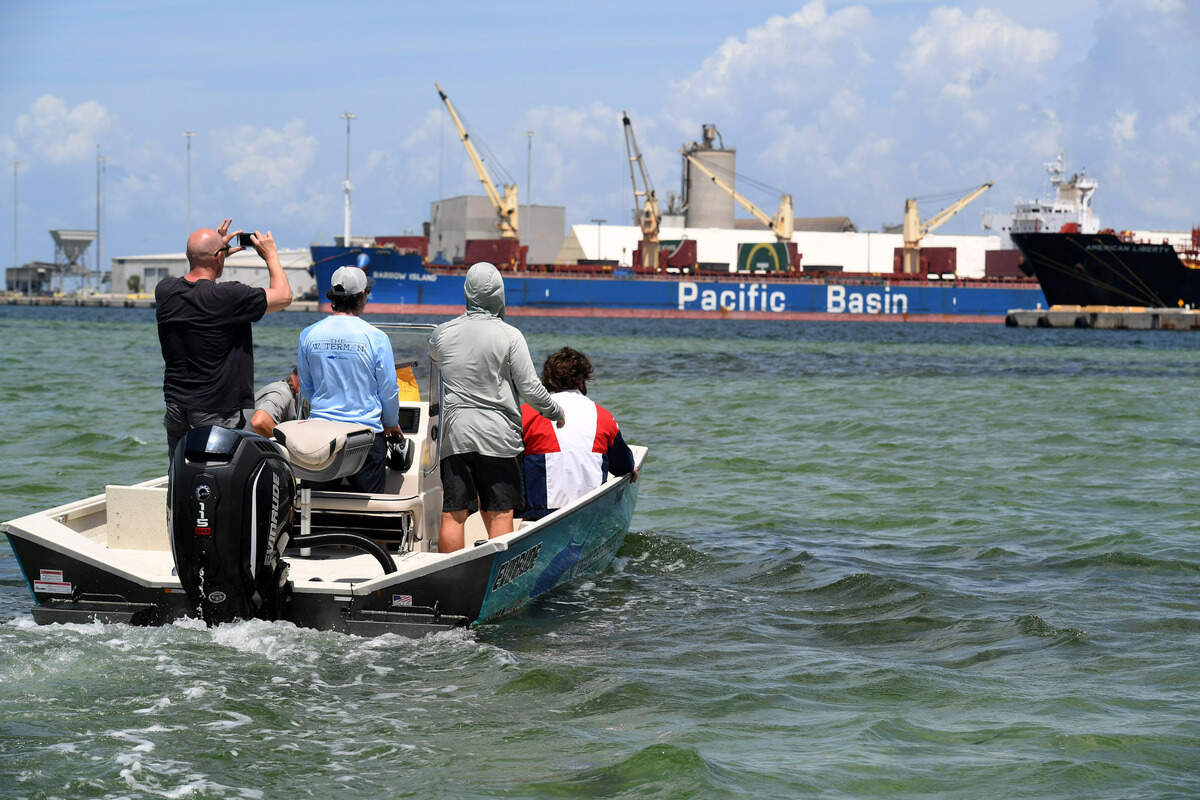
Local environmentalists have also expressed concern about the release of process water, which contains high levels of nitrogen. When excess nitrogen enters the water, algae can feed on those nutrients and form harmful algae blooms.
Algae blooms are known to lead to the destruction of seagrass and can also release toxic chemicals that are harmful to marine life.
The Suncoast Waterkeeper group provided boat tours of the release area near Port Manatee Wednesday afternoon. Rusty Chinnis, one of the group’s board members, said he noticed slight discoloration of the water in the area.
“It’s depressing, honestly,” Chinnis said. “Seagrass clarifies the water, but the algae shades it out and creates a problem with that.”
Brian Rosseger, co-owner of Lost Coast Oyster, fears that the release of process water into the bay could pose a threat to his business, which farms oysters near the mouth of Bishop Harbor.
“It’s terrible what’s happening, but this serves as a springboard for a discussion around the permitting of gypsum stacks in Florida because nobody can manage them effectively,” Rosseger said.
This story was originally published April 1, 2021 at 4:13 PM.