
Manatee County has been spared the worst of red tide. Beaches to the south are not so lucky
The shores of Manatee County have lately been relatively free of the effects of red tide. But as beachgoers venture farther south along the Gulf of Mexico, it's a different story.
On Monday afternoon, beaches from Lido Key to Venice North Jetty reported some dead fish, some respiratory irritation or a little bit of both. This is according to Mote Marine Laboratory's Sarasota Operations Coastal Oceans Observation Lab, or SO COOL for short, which gathers the conditions of 29 beaches from Caladesi Island to Marco Island.
The Karenia brevis organism is naturally occurring but when it accumulates in toxic amounts, it becomes red tide. It's obvious to tell when red tide is on a beach when itchy, watery eyes or scratchy throats become unbearable, or if dead fish litter the shore.
Vince Lovko, phytoplankton ecology scientist with Mote Marine, said this particular bloom is "unusual, not remarkable." By this, he means that although red tide is typically known to appear between late summer and early fall, this particular instance in Manatee and Sarasota waters isn't that strange. The first day of summer is Thursday.
"Certainly we are aware that red tide ... can happen any time of the year," Lovko said.
The trouble is knowing enough about K. brevis to predict when it's going to happen, or to stop it from happening altogether. He compared it to predicting the weather.
"We don't try to change the weather, but we do try to get better at predicting it," he said.
He suspects that the recent harmful algal bloom is actually part of a bloom that has persisted since November 2017.
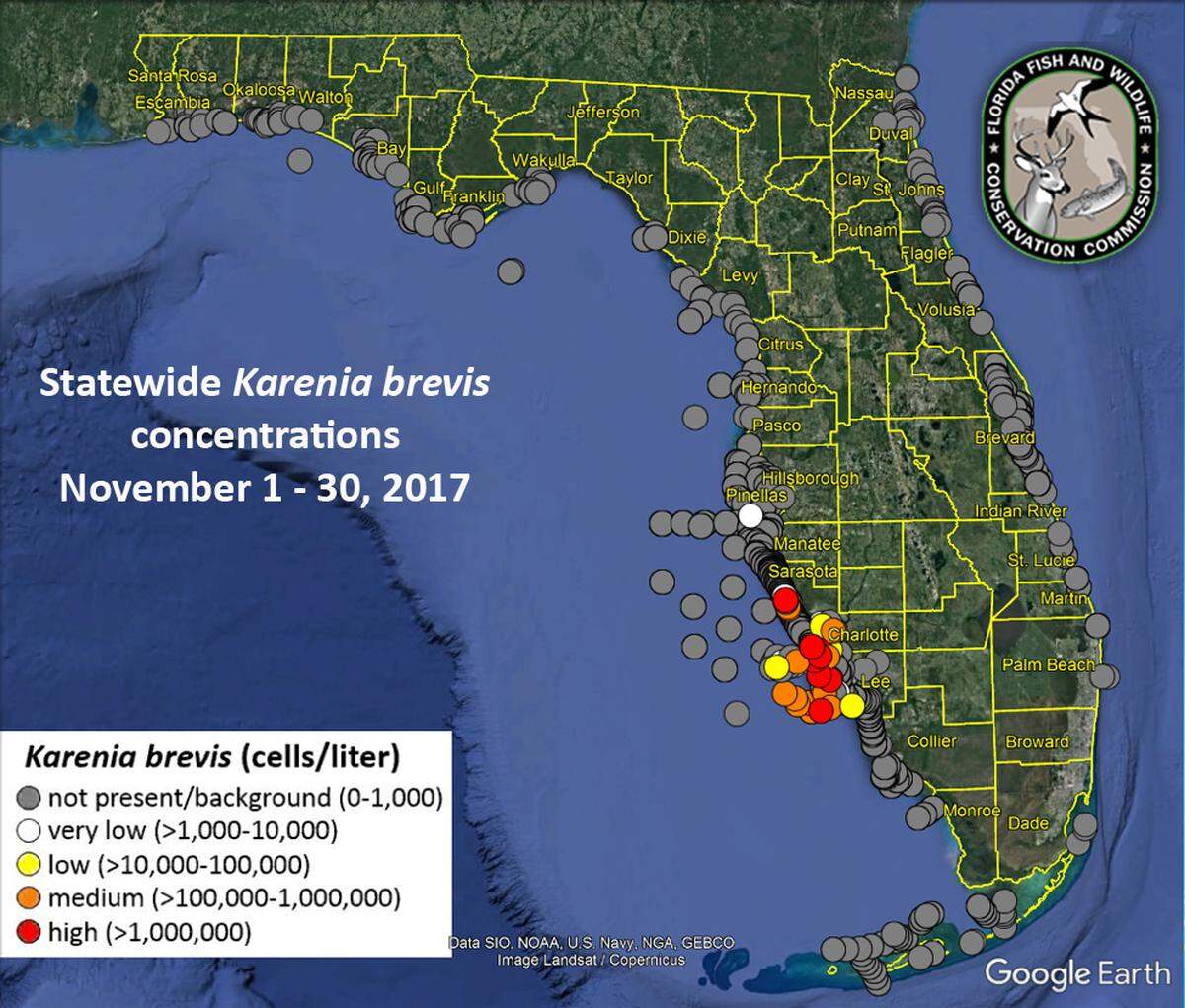
While Manatee and Sarasota counties have been blessed with a months-long reprieve, our southern neighbors have been feeling the toxic effects likely all this time.
The Florida Fish and Wildlife Conservation Commission's weekly red tide report put out last Friday noted that six samples taken from Manatee County had background to low concentrations, meaning there were anywhere between zero and 100,000 K. brevis cells per liter of water. Popular spots like the Rod & Reel Pier and Longboat Pass were affected.
Meanwhile, Lido and Siesta beaches were hit with medium red tide, and samples taken at Manasota and Blind Pass beaches had at least one million cells of K. brevis per liter of water.
Fish are the biggest targets of red tide because they are filter feeders. Lovko explained that it doesn't take much for red tide's neurotoxin to affect a fish, and a small amount can cause a fish to lose the ability to use its gills and suffocate. The toxins can accumulate in the fish's gut and work its way up the food chain.
Even marine mammals like manatees can be affected by red tide, because small organisms called epiphytes, which are filter feeders, grow on their main diet: seagrass. It would likely take a strong occurrence of red tide to do a lot of damage.
Several whale sharks have been spotted off the coast of Anna Maria Island over the past week, and Bob Hueter, director of Mote Marine's Center for Shark Research, noted that this species could be affected.
"Red tide would be very damaging to whale sharks, as filter feeders," Hueter said. "I'm sure they would avoid it at all costs."
The University of South Florida's Collaboration for Prediction of Red Tides expects that the concentration of red tide near Lido Key could travel north alongside Longboat Key through Wednesday.
This story was originally published June 19, 2018 at 7:43 AM with the headline "Manatee County has been spared the worst of red tide. Beaches to the south are not so lucky."