‘Florida’s hero is Harry T. Moore.’ The fight to bring a Civil Rights icon’s story to life
READ MORE
It’s Harry Moore’s time
Civil rights activist Harry Moore and his wife, Harriette, were slain 70 years ago. Their killers are still unknown, but there’s a movement to honor the couple’s legacy.
Expand All
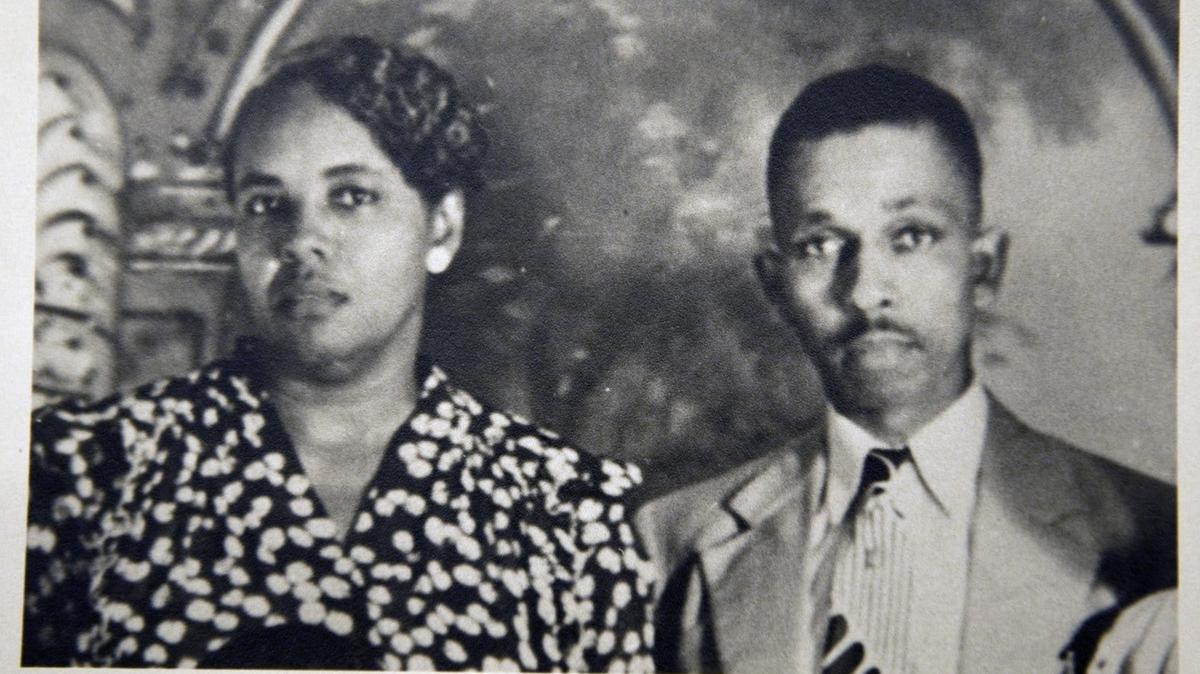
As Bill Gary sat on the steps of the reconstructed home of Harry and Harriette Moore, he couldn’t help but think about the meaning of Christmas.
The signs of the season were all around him: in yards decorated with the nativity scene, in the Harry T. & Harriette V. Moore Cultural Complex, where red ribbons encircled light poles like a licorice candy cane and, of course, the Moore home itself, where a wreath with a “Joy” inscription hung on the door and green garland and red bows adorned the banisters.
In the small town of Mims, Florida, however, Christmas means something different. On Dec. 25, 1951, the very home where Gary sat was ravaged by the explosion of a bomb planted under the Moores’ bedroom. Harry died almost instantly while Harriette succumbed to her injuries a few days later.
“Christmas was a time of great sadness,” said Gary, board president of The Harry T. & Harriette V. Moore Cultural Complex, Inc. “It started out as a time of celebration, of enjoyment, of being together and celebrating their 25th wedding anniversary, however, it ended with a bomb exploding.”
The couple was killed for one simple reason: Harry Moore had the audacity to demand equal treatment for Black Americans.
His death marked the first assassination of a U.S. Civil Rights leader — roughly 11 years before Medgar Evers, 13 before Malcolm X and 16 before Martin Luther King Jr. — yet his murderers were never apprehended, his contributions to the movement largely forgotten. Even now, as the 70th anniversary of their murder approaches and America continues its introspective look at systemic anti-Black violence, the Moores’ legacy — both in life and in death — serves as a reminder that history must not be hidden.
The main focuses of Harry Moore’s activism, specifically in voting rights, education and anti-lynching, remain issues in Florida today, and efforts are afoot to shine a light on his work. In a sense, he was the “Martin Luther King of Florida,” and not learning about his life could doom the state to repeat the same mistakes, says Ben Green, author of one of the first comprehensive books about the Moores.
“Florida has not paid much attention to its roots,” said Green, whose book, “Before His Time: The Untold Story of Harry T. Moore, America’s First Civil Rights Martyr,” chronicles the Moores’ life and death. “You don’t really know what a place is unless you really understand the history and what came before.”
‘Florida’s hero is Harry T. Moore’
During the final weeks of his life, the 46-year-old Harry Moore gave a speech in Tampa. Death had stalked him, yet Moore, forever known for his quiet confidence, appeared unmoved as he discussed what it would take for Black Americans to achieve freedom.
“Freedom is not free,” he said to an audience at an NAACP meeting. “If we want our complete emancipation, we must be willing to pay the price.”
At that time, Harry Moore was at the forefront of what would become the Civil Rights Movement. In the previous 17 years, he had taught Black children about their history and how to cast a ballot, registered more than 110,000 Black Floridians to vote and organized more than 70 NAACP branches across the Sunshine State — all the while spearheading dozens of investigations into unsolved lynchings. This work came at a price: The Brevard County School District fired him in 1946 for his activism, the NAACP would successfully oust him from his executive secretary position for being partisan in 1951 and, to many white Floridians, Moore was public enemy No. 1.
“He is as impactful as some of the people whose names just fall off our tongue, like a Medgar Evers in Mississippi,” said Tameka Bradley Hobbs, a historian and an associate provost at Florida Memorial University. “Florida’s hero is Harry T. Moore and he deserves to be put forward.”
Gary believes the NAACP could have done a better job uplifting Moore’s legacy. Hobbs, who hails from Harry Moore’s hometown of Live Oak yet learned nothing about him until college, points to the education system as the main reason for his lack of recognition. Green casts much of the blame on the state of Florida.
“Clearly the state of Florida, from the minute it happened or within weeks, wanted the story to go away as quickly as possible because it was hurting tourism,” Green said.
In reality, no one person or entity is to blame. It might’ve taken Moore’s death for the NAACP to recognize his influence, yet the very idea of the cultural complex came from the NAACP. And unlike Alabama and Mississippi, states where visitors flock to learn about the Civil Rights Movement, Florida’s tourism dollars are connected to beaches and sunshine. Meanwhile, the education system’s abbreviated timeline of Black American history — think slavery, emancipation then Civil Rights Movement — obscures the reality that, as Hobbs said, “there wasn’t a time that Black people weren’t fighting for their human rights.”
The truth of how they were killed is difficult not only for the state of Florida but also for the Moores’ own family.
Evangeline Moore, the youngest daughter of Harry and Harriette who arrived in Mims on Dec. 27 for a belated Christmas celebration with her family, struggled to cope with her parents’ murders. Not only did the holiday season change her mood, but it took her years to become comfortable discussing her parents, says her son Skip Pagan.
“As I was growing up, Christmas was always difficult for my moms and I never knew why,” Pagan recalled. Like most doting mothers, she showered her son with gifts and such, yet there was clearly a hole there that Pagan wouldn’t fully understand until the release of “Before His Time.”
“Because she was suppressing all of her feelings, she never really told me the story [of my grandparents]. I knew of things, I knew he was part of the movement but I never knew the full story until I was about 38 years old.”
If anything can be gleaned from Evangeline Moore’s experience, however, it’s that there is power in embracing your narrative. Several years of therapy eventually allowed her to deal with the trauma of her parents’ deaths. She then became one of the most dedicated protectors of the Moore legacy up until her death in 2015.
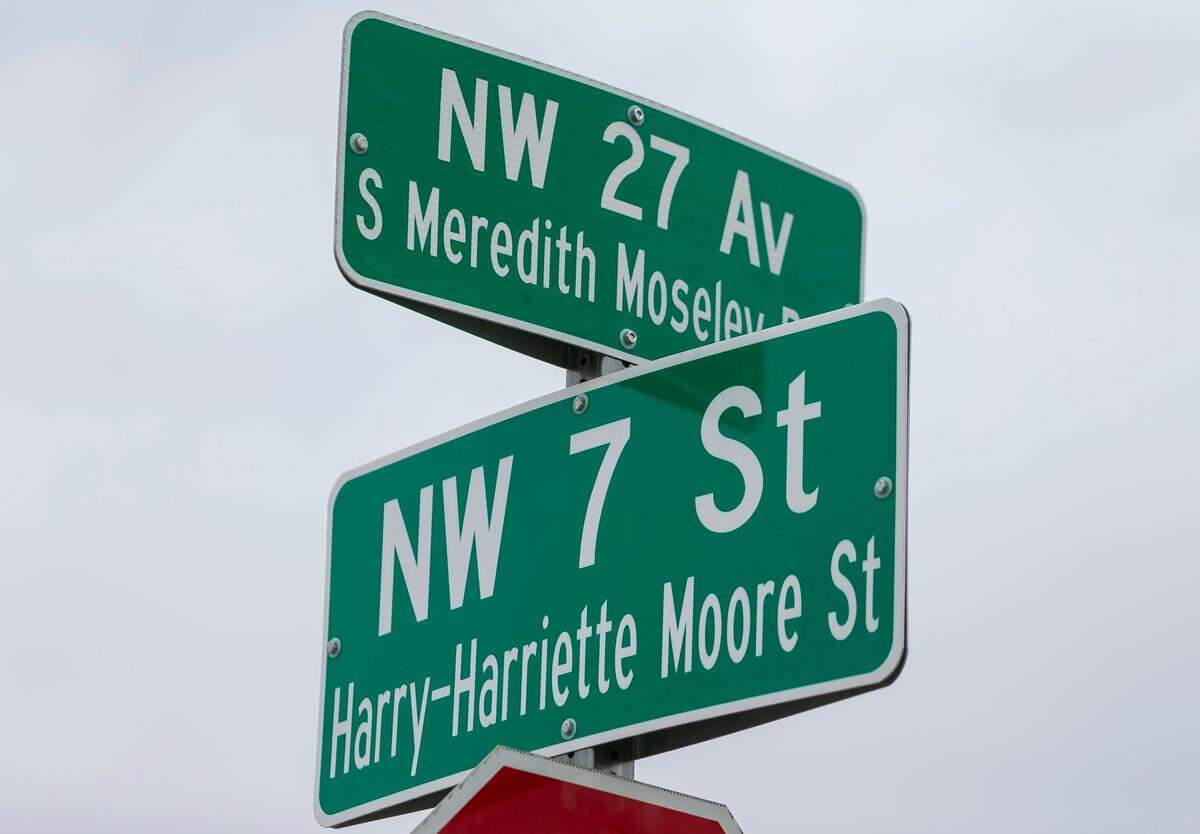
Evangeline Moore’s work, coupled with that of Gary, Green and others, has begun to pay off. Aside from the 2004 opening of the cultural complex, which features the Moores’ rebuilt home and a Civil Rights Museum, several other buildings in Brevard County bear the martyrs’ names, including the social service center in Titusville and the courthouse in Melbourne. In Live Oak, Douglas High School, Harry Moore’s alma mater, now bears a marker honoring his legacy. In Broward County, a portion of Northwest Seventh Street between Northwest 27th and Northwest 31st avenues was renamed after Harry and Harriette Moore. In Washington, D.C., the National Museum of African American History and Culture features an exhibit on the Moores.
A movie on the Moores’ lives entitled “The Price for Freedom” is scheduled to be released in 2022. And after years of denial, the Brevard School Board admitted this year to the Moores’ unjust firings in 1946 while implementing a curriculum to ensure that every child within the county knows about the Moores.
The renewed interest in his grandparents thrills Pagan, though he worries that progress will come at a price.
“History has shown that anytime people make that kind of a gain or anything close to that, there will be a backlash,” Pagan said.
‘We don’t talk enough about anti-Black violence in American history’
Anyone who requires a reminder that Florida is indeed the Deep South need only to travel to Mims. Just two miles away from Freedom Avenue, the street that leads to the cultural complex, a trio of Confederate flags are proudly displayed on a pair of businesses. Within one mile, a parade of Donald Trump banners, including one that reads “Trump 2024: The rules have changed,” sit prominently on a fence.
The name “Mims” was taken from a discharged Confederate soldier, and Trump won Brevard County by nearly 60,000 votes in 2020. Even the cultural complex itself, in its first year as a polling place, was a hotbed for Trumpism, with the former president accumulating more than 70% of all ballots.
Mims, in a sense, is a reflection of Florida’s past and present; a place where warring ideologies are separated by mere miles. Less than four months after the Brevard County School Board adopted The Harry T. and Harriette V. Moore Legacy Curriculum, Florida enacted restrictive voting laws and banned critical race theory. Although lessons on the Moores wouldn’t violate the state’s ban, Gary notes that Harry Moore’s life work revolved around what’s now called CRT, a concept that shows how the legal system has been used to subjugate Black Americans.
“The fact that he advocated, wrote letters and tried to convince the Justice Department and others to pass anti-lynching laws certainly is a legal matter that impacts the race of Black people,” Gary explained. “History is tied to [race] and you can’t really talk about history in the United States without really talking about the legal system because that’s what enforced segregation laws.”
Despite Harry and Harriette paying the ultimate sacrifice, the struggle that cost them their lives continues. The anti-lynching law has yet to pass, voting has gotten more difficult and teaching has become way more complicated, says Hobbs.
“Teachers around the state, both in K-12 and in higher education, feel like their livelihoods will be threatened if they continue to teach about Black history,” Hobbs added, calling Florida’s fight over CRT an attempt to “exacerbate the racial climate here in the state.”
With the first group of Brevard County eighth-graders to begin visiting the cultural complex come January 2022 as part of the Moores’ legacy curriculum, Gary wants to eventually expand the effort statewide. The decades that the Moores have dwelled in the shadows means some of the facts need to be ironed out, says Gary, and what better way to do it than at the place where their story ended.
Learning about the Moores’ demise could be the genesis of a more empathetic community.
“We don’t talk enough about anti-Black violence in American history: It’s a continuing thread in our nation’s history,” said Hobbs. She then drew the line from the forced enslavement of African people to the lynchings that maintained white supremacy to, most recently, the murder of George Floyd. “If people understood the history of anti-Black violence in America, they would understand the Black Lives Matter movement much more clearly.”
This story was originally published December 19, 2021 at 6:00 AM with the headline "‘Florida’s hero is Harry T. Moore.’ The fight to bring a Civil Rights icon’s story to life."