After 70 years, there’s no definitive answer to who killed Harry and Harriette Moore
READ MORE
It’s Harry Moore’s time
Civil rights activist Harry Moore and his wife, Harriette, were slain 70 years ago. Their killers are still unknown, but there’s a movement to honor the couple’s legacy.
Expand All
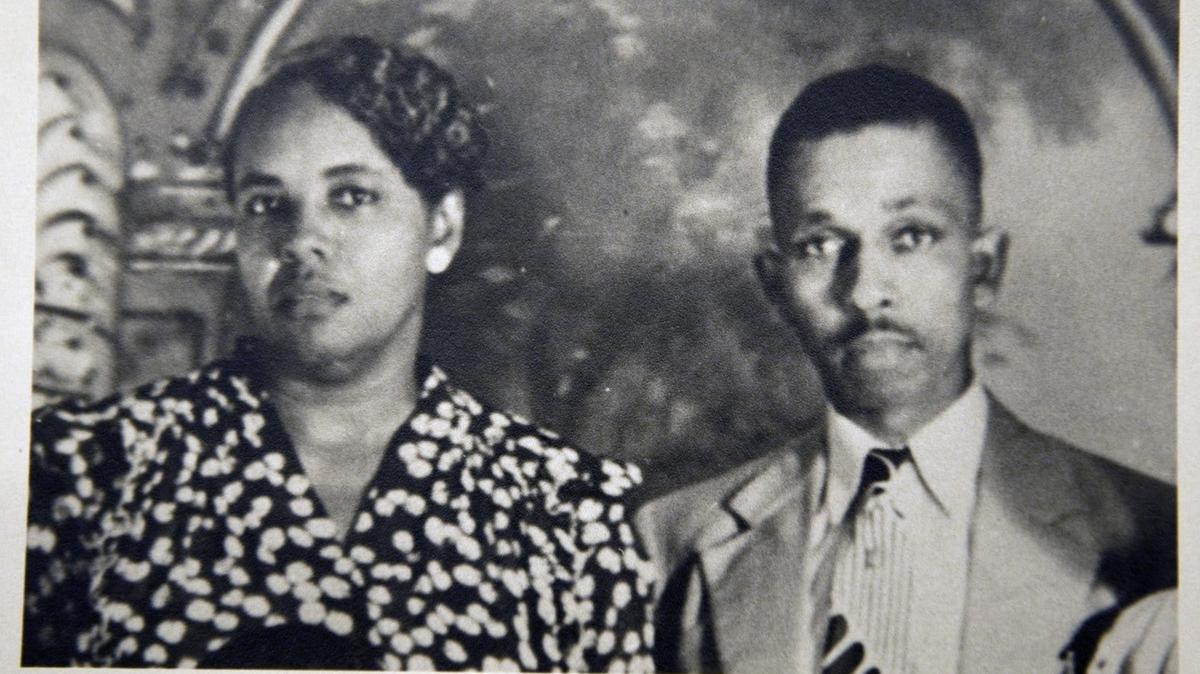
The question of who killed Harry and Harriette Moore remains one of the biggest mysteries in Florida history.
Five separate investigations by local, state and federal authorities, most recently the Department of Justice, which closed a cold case review in 2017, yielded a plethora of leads concerning the Dec. 25, 1951, bombing, the first assassination of a prominent civil rights icon in the U.S. But no one has ever been officially fingered as the killers, despite circumstantial evidence and a recent state probe that claimed enough evidence existed to secure a grand jury indictment against the Moores’ killers, had any of them been alive.
Many, such as Congressman Charlie Crist, believe the findings of his 2005 investigation, which he initiated back when he was Florida attorney general. The investigation, conducted as Crist ran for Florida governor, named four deceased members of the Ku Klux Klan as the likely orchestrators of the couple’s assassination: Tillman H. Belvin, Earl J. Brooklyn, Joseph Cox and Edward Lee Spivey.
But others, like Ben Green, author of the seminal text on the Moores’ life, “Before his Time: The Untold Story of Harry T. Moore, America’s First Civil Rights Martyr,” aren’t so sure.
“I don’t think we know,” said Green, who denies that there was enough evidence to decidedly name names. “I think it’s pretty clear that it was the Klan and there were clearly powerful people who wanted them gone.”
The truth is, Harry Moore had many enemies. His activism across different areas — lynching investigations, voter education and equal teacher salaries — made him an unpopular figure with white power brokers in Florida.
At the time of his murder, Moore was at odds with Lake County Sheriff Willis McCall. Moore repeatedly called for McCall to be suspended after his shooting of Samuel Shepherd and Walter Irvin, two innocent suspects now known as part of the “Groveland Four.” Moore also tangled with A. Fortenberry, a wealthy, longstanding Brevard County commissioner whom Moore helped oust through the work of his Progressive Voters League.
“His work on getting African Americans to be able to vote and his anti-lynching activity targeted him for assassination,” said Tameka Bradley-Hobbs, a Florida Memorial University professor who specializes in African-American history.
Despite the well-documented bigotry of its figurehead J. Edgar Hoover, the FBI’s initial investigation into the Moores’ murders was very thorough, said Green. Three of the four Klansmen posthumously named the Moores’ killers by Crist’s office — Brooklyn, Belvin and Cox — were among the FBI’s possible suspects, as was Fortenberry. There just wasn’t enough hard evidence to arrest anyone.
An informant claimed Brooklyn showed him a floor plan of the Moores’ home, but refused to take a polygraph before the Klansman died on Christmas 1952. Belvin, who died in August 1952, was home all Christmas night, according to his three children and wife. Cox committed suicide a day after the FBI questioned him a second time. And there was no proof that Fortenberry blamed Moore for his defeat, as some theorized.
Spivey, the fourth Klansman named in Crist’s 2005 investigation, was not originally on the FBI’s radar. He came forward in 1978, blamed Cox for the bombing and died soon after. Although McCall battled accusations of bankrolling the bombing, he wasn’t even a suspect until the Florida Department of Law Enforcement’s 1992 investigation. He denied any involvement and, at the advice of his doctor, refused to take a polygraph.
Though the specific players behind the Moores’ murders might never be truly confirmed, there’s no debate surrounding the Ku Klux Klan’s involvement. The FBI had zeroed in on the Orange County Klan, which Green described in his book as a “KKK stronghold.”
“Agents were discovering that Orange County was rife with law officers and elected officials who belong to the Klan, including one county commissioner and the city manager of Winter Park,” Green wrote, citing the FBI’s initial investigation. “… Apopka’s police chief, constable and night patrolman all belonged, as did one constable and a justice of peace in nearby Winter Garden.”
Similarly, Crist believes that there were Klansmen in local law enforcement who prevented the case from being solved.
“There were pretty strong ties between the local sheriff’s department and the KKK itself,” Crist said in an interview.
One of the biggest pieces of evidence supporting Crist’s claims came in 2007 when Harry Moore’s briefcase was found in a Brevard County barn. The briefcase had been given to then-Brevard County Sheriff Bill Williams the night of the murder, Moore’s daughter, Evangeline Moore, told The Washington Post.
“Now I have concrete evidence of just how involved local officials were,” she said during a press conference announcing the briefcase’s discovery. “It was not supposed to be anywhere but the courthouse, and obviously somebody gave it to somebody so it would never be discovered. It was a conspiracy, and I’ve known that for 55 years.”
This story was originally published December 19, 2021 at 6:00 AM with the headline "After 70 years, there’s no definitive answer to who killed Harry and Harriette Moore."