
Blue-green algae bloom in Manatee waters likely linked to Piney Point, scientists say
While toxic red tide algae continues to strengthen in the open waters of Tampa Bay, there’s another potentially harmful algal bloom that is catching the attention of residents closer to shore.
It’s called Lyngbya, and scientists say the blue-green algae is growing at an alarming rate in waters around Manatee and Sarasota counties — possibly because of polluted wastewater released earlier this spring from Piney Point.
That could be a disaster for the area’s fragile marine ecosystems, according to David Tomasko, executive director of the Sarasota Bay Estuary Program.
“It ranks up there with the 2018 red tide in terms of how bad it is for the health of the bay,” Tomasko said. “The Lyngbya is impacting a part of the bay that is already having to recover from that red tide. The last thing in the world we needed was this.”
Like red tide, Lyngbya is naturally occurring in Southwest Florida waters. But excess nutrient pollution can cause an abnormally large bloom. A bigger bloom in turn amplifies negative side effects from the algae, which can release toxins that hurt humans and marine life, cause fish kills and block sunlight vital to seagrass beds.
Lyngbya grows from the sea floor up; during a large bloom, it can smother seagrass beds at the ocean floor. Excess oxygen produced during a rapid bloom can also carry mats of the stuff to the surface, where it eventually decomposes and causes more problems.
As the algae decomposes, oxygen is sucked out of the water column, Tomasko explained. While bigger fish can simply swim away from impacted areas, smaller forms of sea life often die, he said.
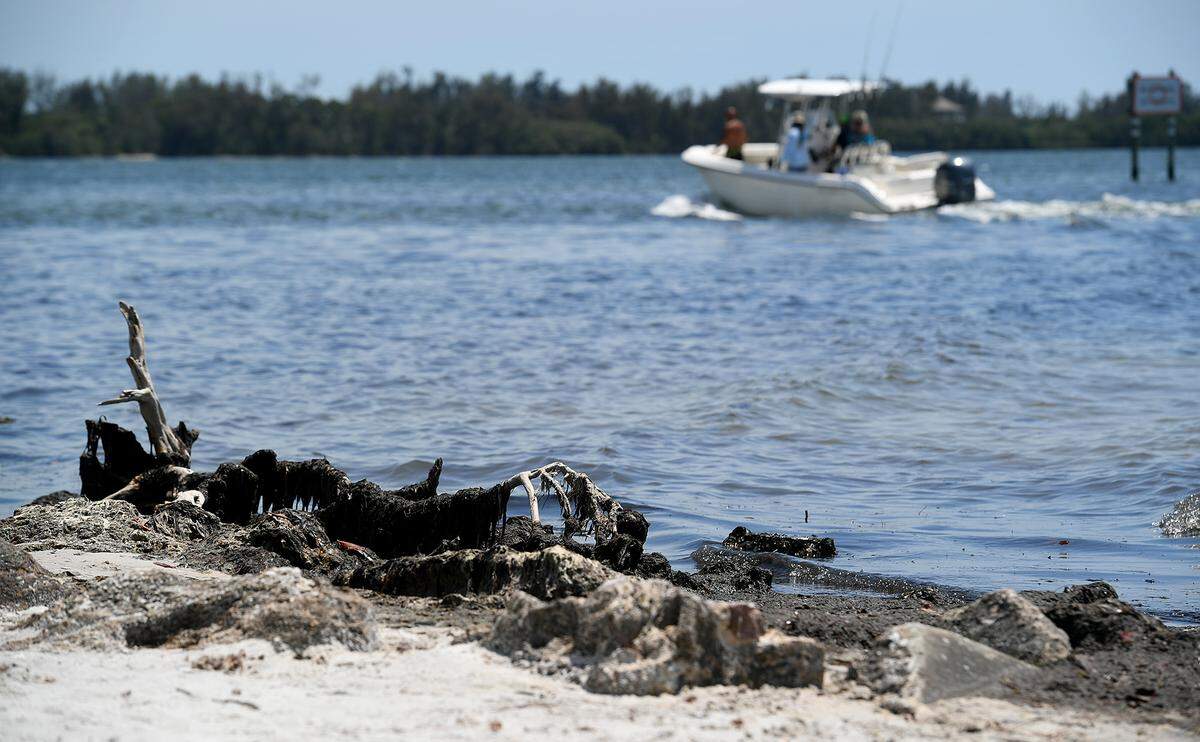
The decomposition process also discolors water and releases a foul, rotten egg-like odor. And the mats of dead algae often drift towards shore, where they stink up the coastline and create an unsightly mess that is sometimes confused with raw sewage. The algae is known to irritate human skin upon contact, so swimming near it is ill-advised.
The impacts of harmful algal blooms like Lyngbya on seagrass meadows are also a major concern.
“Anything that adversely affects seagrass meadows is going to affect our fisheries and the things that depend upon them,” Tomasko said.
Seagrass die-offs can wreak major havoc on marine ecosystems and impact species that depend on the seagrass meadows for feeding and breeding, from fish and invertebrates to sea turtles and manatees.
Area seagrass beds are already facing challenges. Tampa Bay Estuary Program recently noted a seagrass decline of 13% in Tampa Bay between 2018 and 2020, including 150 acres lost in the Manatee River. The problem is even worse in Sarasota Bay, according to Tomasko, which has experienced a loss of more than 20% of its seagrass since 2016.
Drifts of Lyngbya algae made an appearance near Robinson Preserve in May, where county staff put up barriers to keep it out.
Now its showing up at locations including Snead Island, Anna Maria Sound, Cortez, Holmes Beach and Longboat Key, according to Tomasko.
The Sarasota Bay Estuary Program is in the process of advising local governments, including Bradenton, Sarasota, Sarasota County and Holmes Beach, about how to deal with the algae bloom.
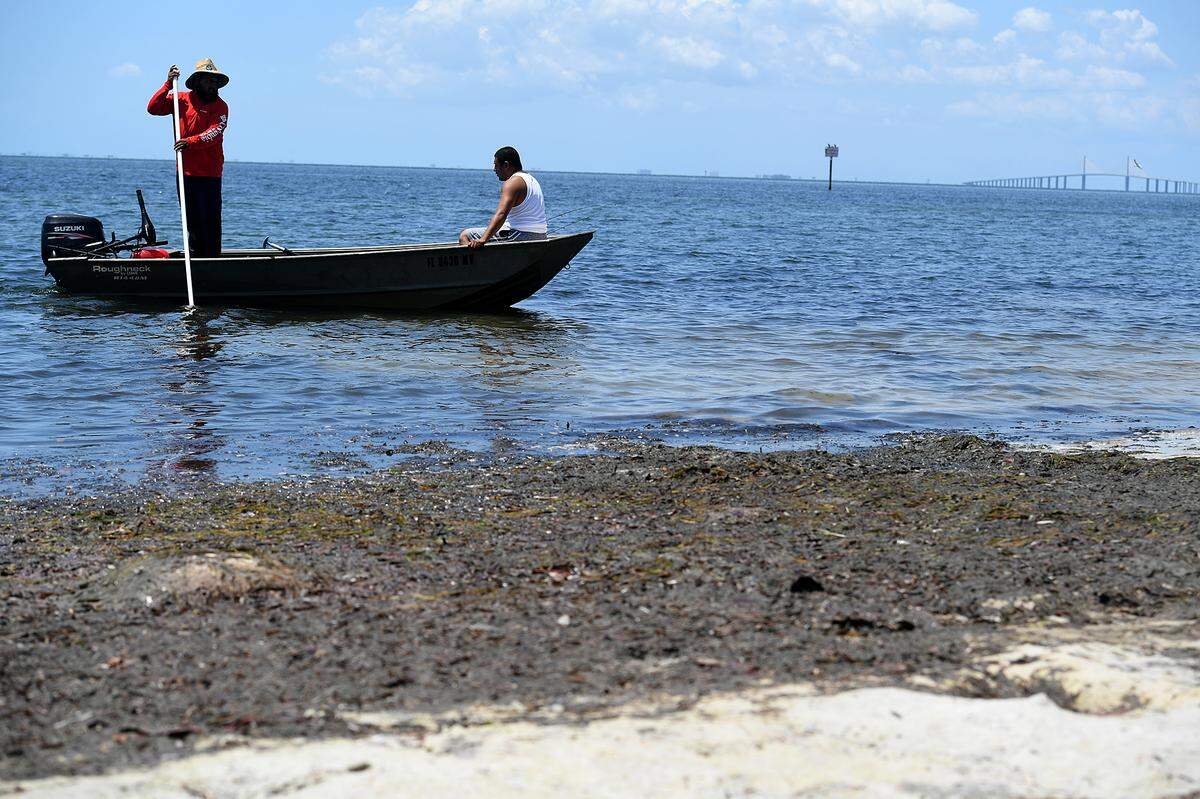
The best strategy, according to Tomasko, is to physically remove as much of the algae from the water as possible — especially in areas like canals and marinas.
“The state of Florida has a contract mechanism in place for local governments to remove this Lyngbya,” Tomasko said.
Tomasko also encouraged residents to remove the algae themselves as well as taking steps to prevent future harmful algal blooms by curbing household nutrient pollution.
Tomasko, who lives near Snead Island, said that he and other long-time residents have never seen anything like the current Lyngbya bloom.
Holmes Beach Mayor Judy Titsworth shared similar thoughts with the Bradenton Herald on Wednesday along with photos of discolored water and sheets of algae in Anna Maria Sound.
“I have lived on this sound for 58 years and never seen the bay so sick,” Titsworth said in an email. “I am uncertain if it can recover from this.”
Piney Point’s role in algae bloom
When 215 million gallons of nutrient-laden wastewater where authorized for release from the Piney Point industrial site in Manatee County in April, scientists feared it could fuel a mega bloom of harmful algae and damage one of Florida’s most important estuaries, Tampa Bay.
Preliminary findings shared by researchers with the University of South Florida suggested that Tampa Bay had diluted the nutrients without immediate repercussions. But now that more than one harmful algal bloom has developed in the area, scientists with the Sarasota Bay Estuary Program are concerned.
Both red tide and Lyngbya blooms can feed on nutrients present in the Piney Point wastewater — nitrogen and phosphorous.
While the complexity of ocean nutrient circulation leaves many unknowns, Tomasko says the blue-green algae bloom “is likely associated” with the wastewater release in April.
“We think there’s an extraordinary event that’s unfolding,” Tomasko said. “Circumstantial evidence would suggest that the Lyngbya blooms are occurring in the parts of southern Tampa Bay and northern Sarasota Bay that were expected to be influenced by the Piney Point plume.”
Tomasko’s hunch is partially based on similar events 20 years ago. In 2001, the Florida Department of Environmental Protection authorized another wastewater release from the Piney Point site due to a tropical storm, and Tomasko says algae blooms were quick to follow.
Tomasko cautioned, however, that there isn’t “perfect evidence” of a link between the events.
“Humans don’t cause red tide and Lyngbya,” Tomasko said. “But we probably have made it worse.”
In a statement regarding the algae bloom that was obtained by ABC7, Manatee County’s top environment official, Charlie Hunsicker, went further, stating: “Piney Point is a contributor to the problem.”
Hunsicker’s comment came in response to residents who mistook the algae, which has a brownish-green tinge when it washes up on shore, for sewage.
“Reports of the presence of wastewater around the shores of Snead Island are incorrect, Hunsicker’s statement said,” according to ABC7. “There are odors present from the biological decomposition of floating algae stranded along the shore generating sulfur-rotten egg odor. Sun-dried algae mats suspended from mangrove roots and dock pilings take on the appearance of soiled tissue paper.”
Hunsicker did not respond to a request for comment on Wednesday.
Red tide strengthens
North of Anna Maria Island, red tide algae continues to strengthen in lower Tampa Bay, according to the latest sampling data from the Florida Fish and Wildlife Commission.
Over the past week, Manatee County saw an increase in the number of water samples with significant levels of Karenia brevis, the organism that causes red tide. Several of the samples had bloom concentrations of the algae.
At bloom concentrations, negative impacts including fish kills and respiratory irritation are more likely.
A patchy red tide bloom is also affecting waters in Pinellas and Hillsborough counties, according to FWC.
Fish kills thought to be associated with red tide were reported in Manatee and Pinellas.
FWC is expected to issue its next red tide update on Friday.
This story was originally published June 10, 2021 at 7:26 AM.