Why did FWC euthanize the coyote rescued near PortMiami? There’s a petition to find out
UPDATE: Outrage over Miami’s euthanized coyote sparks policy review.
Lloyd Brown says his wildlife rescue center had everything ready for its newest patient — a coyote rescued off the waters near PortMiami Tuesday.
The exam area was prepared, the vet was in and the center was reinforced to make sure that the coyote — a species known for being “masters of escape” — could be accommodated, he said.
But the animal never arrived. Florida Fish and Wildlife Conservation Commission had decided to euthanize it— and no one told Brown, the director and wildlife rehabilitator at the Wildlife Rescue of Dade County in Homestead.
He was surprised by FWC’s decision. So were animal lovers.
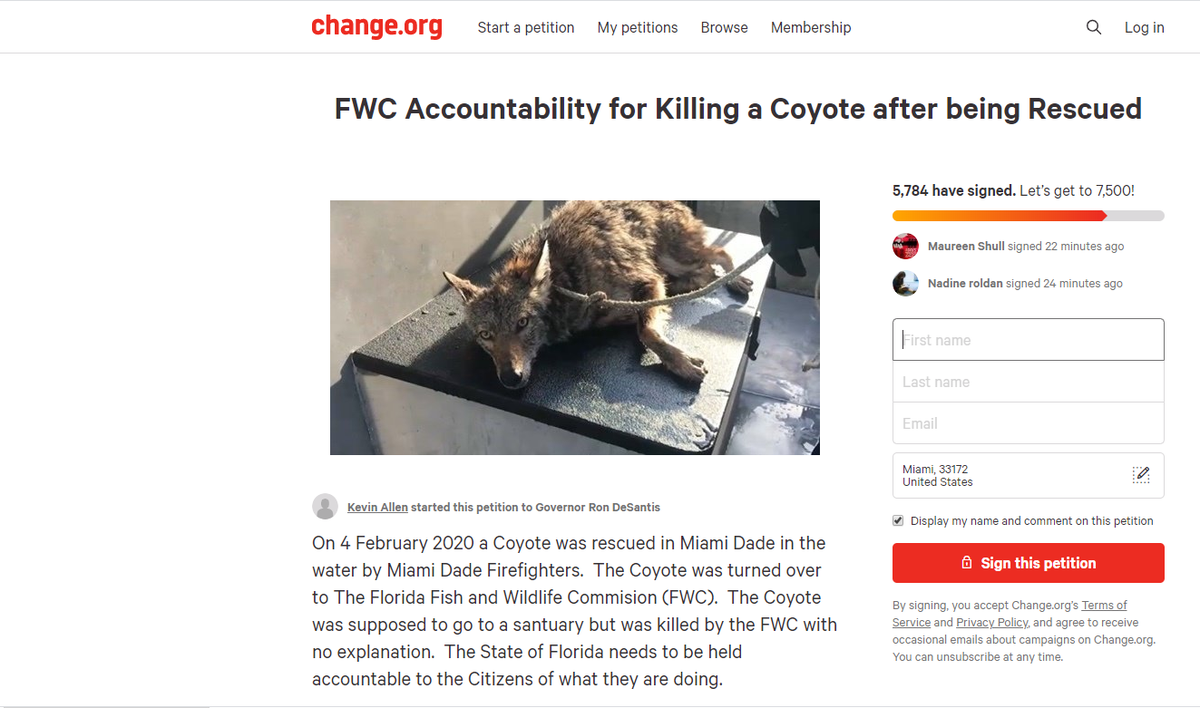
A petition soon popped up online, asking Gov. Ron DeSantis to hold the FWC accountable for its lack of transparency on the decision.
“The Coyote was supposed to go to a sanctuary but was killed by the FWC with no explanation. The State of Florida needs to be held accountable to the Citizens of what they are doing,” the Change.org petition states.
By Saturday morning, more than 6,000 people had signed it.
“Humanely euthanizing wildlife isn’t something we take lightly. We try to find a balance between managing wildlife and the needs of the public,” said FWC spokeswoman Susan Neel in an emailed statement to the Miami Herald Saturday afternoon. “We are looking into the chain of events that lead to this situation.”
FWC’s own website seems to make a case against euthanizing.
“Coyotes are native to North America, have been in Florida for many years, and will continue to make their homes around the state,” the FWC’s website reads.
Coyote’s are not exotic or invasive species. They are considered a “naturalized” species, which means they were not brought to Florida by humans. Instead, they naturally migrated to the state and can be found throughout Florida, according to the FWC’s website.
Brown says some people, particularly cat owners, might find coyotes a nuisance, but they help balance the ecosystem by controlling the population of rodents and smaller predators, such as foxes, opossums and raccoons.
“We were supposed to feed and take care of it,” Brown said.
Brown said the vet would have given it a check-up, vaccinated it and treated the cuts the animal had on its paws from trying to climb out of the water. Their biggest concern was if it had aspiration pneumonia. If it did, they would have treated it, he said. Eventually, they would have released it.
But they never had a chance, and people want to know why.
“This coyote was saved from peril only to be killed by the very agency sworn to protect wild animals? That’s horrific,” one petitioner wrote.
PETA is thinking the same thing.
“If this coyote was euthanized because he was “non-native” to Florida, one wonders how long coyotes must live in all 67 of the state’s counties before they’re considered native,” the animal rights organization said in a statement to the Miami Herald Friday. “Coyotes have been in Florida since the 1970s, and these resilient animals—who have become an essential part of the ecosystem—are here to stay.”
It continues:
“If the law tied the hands of the Florida Fish and Wildlife Conservation Commission, it’s time to take a long, hard look at that law.”
This story was originally published February 8, 2020 at 1:15 PM with the headline "Why did FWC euthanize the coyote rescued near PortMiami? There’s a petition to find out."