
‘Amazing’ sun flare was one of the largest solar radio events ever recorded, NASA says
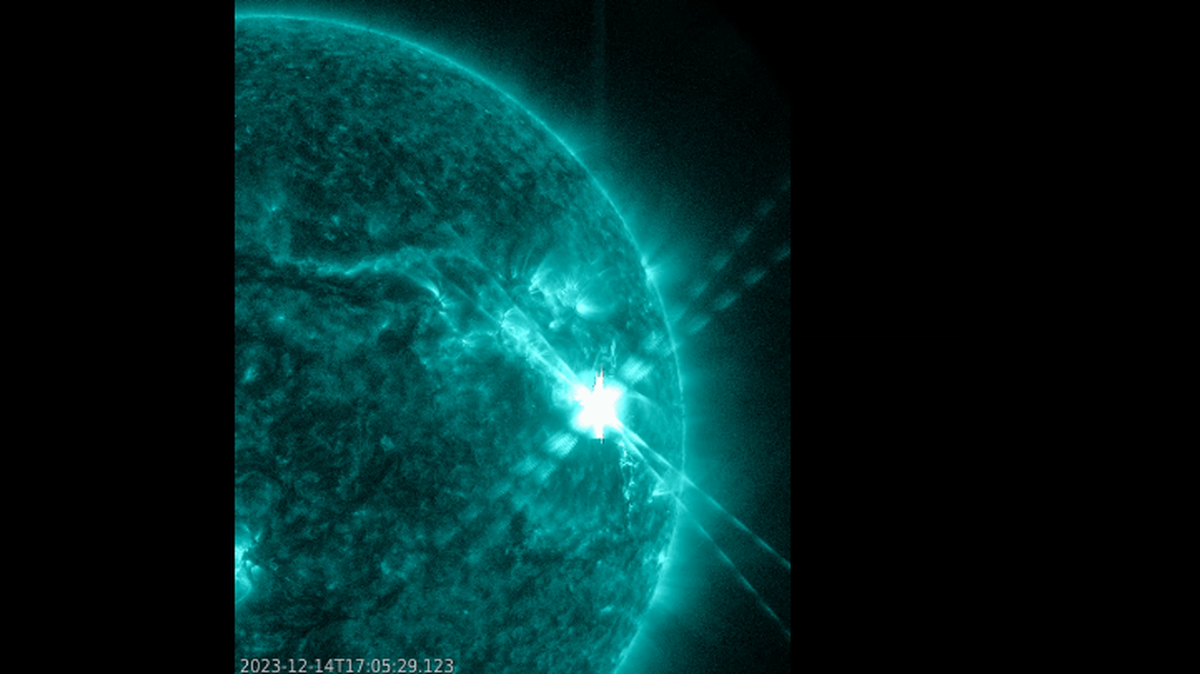
The sun spewed a massive solar flare and disrupted radio traffic from the Mid-Atlantic states to northern Antarctica, according to maps released by the Space Weather Prediction Center.
The “amazing event” on Thursday, Dec. 14 has been deemed “one of the largest solar radio events ever recorded,” the center said in a news release.
NASA reports the flare emerged from the far northwest corner of the sun and peaked around 12:02 p.m. EST.
Multiple “coronal mass ejections” were detected, resulting in the National Weather Service issuing a Geomagnetic Storm Watch for Dec. 16 and Dec. 17. Aurora viewing (northern lights) was expected as far south as New York and Iowa as the storm collided with Earth’s magnetic field, officials said.
Impact from the solar flare was largely felt on the side of the Earth that was facing the sun at the time, officials said.
“Radio communication interference with aircraft were reported by multiple NWS Center Weather Service Units (CWSU) co-located at FAA facilities,” NASA reported.
“These impacts were felt from one end of the Nation to the other. Additionally, SWPC is analyzing a possible Earth-directed Coronal Mass Ejection.”
Solar flares are “gigantic explosions” of radiation with a release of light that takes roughly 8 minutes to reach Earth, experts say. Earth’s atmosphere prevents the radiation from impacting humans on the ground.
“Flares and solar eruptions can impact radio communications, electric power grids, navigation signals, and pose risks to spacecraft and astronauts,” NASA says.
Scientists rate solar flares based on energy output, with X classes being “the most intense.” The Dec. 14 flare measured as an X2.8, but is far from the strongest recorded by scientists.
The largest in the past decade was a X8.2 recorded on Sep 10, 2017, NASA says.
This story was originally published December 15, 2023 at 8:22 AM with the headline "‘Amazing’ sun flare was one of the largest solar radio events ever recorded, NASA says."