
U.S. Air Force veteran credits life to Palmetto's Southeastern Guide Dogs Paws for Patriots program
BRADENTON -- When veterans experience traumatic moments, it's normal to spend days or weeks on a heightened sense of alert, nerves on edge with anxiety levels climbing.
For many, those symptoms fade when the environment changes from dangerous to safe, but for others they never do. That is the essence of post-traumatic stress disorder.
U.S. Air Force veteran Morgan Watt said he understands that dark journey. There was a time he thought suicide was the only solution -- until he met Foley, a 2-year-old goldadore trained as a service dog in the Southeastern Guide Dogs Paws for Patriots program.
"If it wasn't for him, I'd probably not be here to do this interview," said Watt.
It's a harsh reality for Watt's loved ones who watched him dive deeper into the darkness of depression associated with PTSD. While loved ones languish in the confusion and try to grasp what PTSD is doing to those they love, their hope lies in the moments when those suffering are once again grounded in reality.
Foley helps ground Watt providing a long-lost sense of normalcy.
Watt joined the Air Force in 1990, the same year former Iraqi dictator Saddam Hussein invaded Kuwait, leading to the First Gulf War. Watt was assigned to a security force and partnered with a canine for explosive detection and investigations. He compares his service to first responders who respond to traumatic cases where "you see things that can't be unseen."
Watt was reassigned to the Secret Service in 1994 in New York under then-President Bill Clinton, one year after the first World Trade Center bombing. He resumed bomb detection duties where "we were trained for hyper vigilance. If the dog didn't pick something up, you hoped you fulfilled your mission by having it blow up on you. You buy into it all. The red, white and blue and you know you are expendable and you are OK with that. It was go, go, go, all the time."
Watt suffers from terrible service-related migraines that took a turn for the worse in 2013. He said the headaches are like "an ice cream headache that never stops."
He takes medication to stem the pain and Foley has become a hands-on assistant.
"One of the things he wasn't trained for, he just does," said Watt. "He's trained to get my medications on command, but the first time a headache was coming on after I got Foley, I was just trying to figure out what was going on. Then Foley was there dropping my medicine bag in my lap. I couldn't believe that he knew before I did."
Foley is highly tuned to Watt's biorhythms and reacts to his emotions and pain. Three times during his interview, Watt's anxiety levels began to rise while talking about the past. Three times, Foley gave a slight whimper and rubbed up against Watt to bring him comfort.
"I never understood depression until I had it. I had sunk into the darkest depression of my life. Suicide was an awesome option for me because I didn't feel like I had anything left," he said.
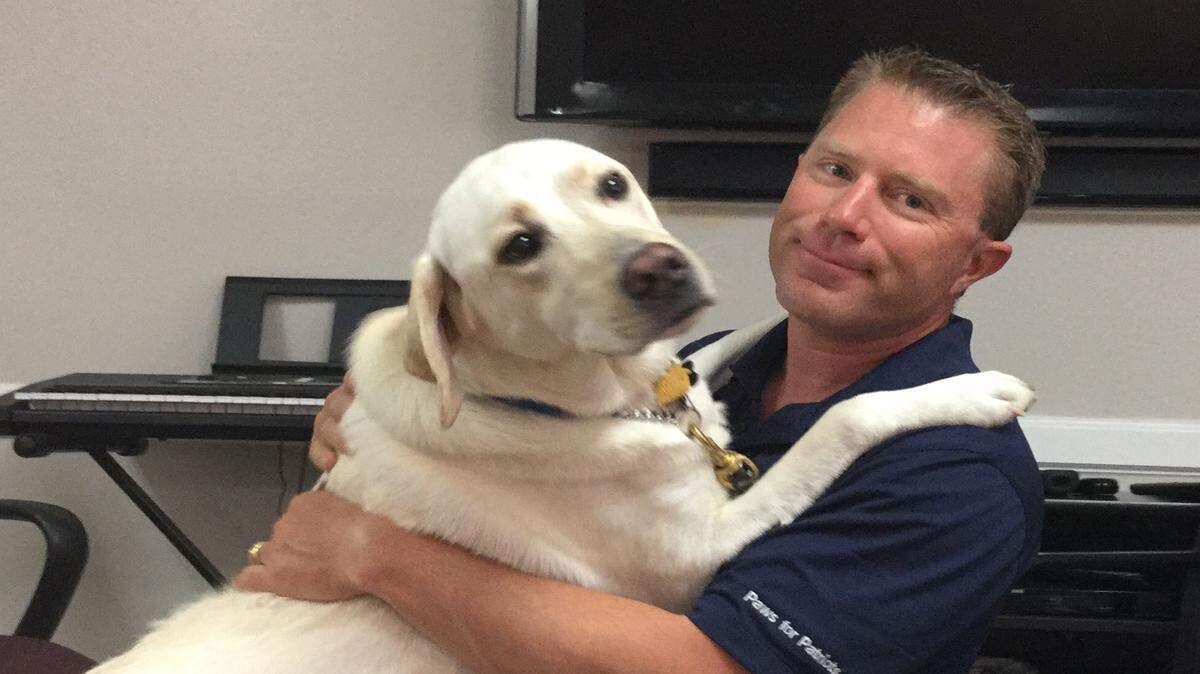
As Watt recalled those dark times, Foley instantly reacted by jumping up and literally gave Watt a hug with both paws around his neck.
Watt smiled and said: "This is how he keeps me grounded."
Watt applied for a service dog on the advice of his wife and within a month received a phone call from Southeastern Guide Dogs that a trained dog was available. A trainer worked with Watt and Foley for 10 days.
"It was an amazing match right off the bat," he said. "It's been interesting to look back over the last year at all those dark moments where I felt alone. With Foley, I don't feel like that when I'm waking up at 3 a.m. from a nightmare and not wanting to wake up my wife. I always have these pair of goldadore eyes staring at me. He's right there saying: 'Hey dad, let's get grounded. Let's go for a walk and everything's cool.'"
Watt said he started noticing mental and physical changes almost immediately after Foley entered his life.
"I've gone to feeling nothing to cracking up whenever he does something funny," said Watt. "The first time he made me laugh was the first time I've laughed in two years. He's able to tell me what's going on inside of me before I even know it. That's not something you get from counseling. That's what Foley does. I'm not alone. He's not judging me. All he's trying to do is say: 'Hey, I'm here with you.' There's nothing better than this dog and my wife."
Watt used to wonder if PTSD would be a life sentence, but the Paws for Patriots program changed his mind, not only for himself but for others.
"A service dog, particularly from Southeastern Guide Dogs, helps you to become present," he said. "It doesn't erase war or detract from what happened. In fact, it validates the experiences, but through a program like this one, you can heal."
Mark Young, Herald urban affairs reporter, can be reached at 941-745-7041 or follow him on Twitter@urbanmark2014.
This story was originally published November 10, 2015 at 7:29 PM with the headline "U.S. Air Force veteran credits life to Palmetto's Southeastern Guide Dogs Paws for Patriots program ."