Red tide found near Anna Maria Island. Piney Point’s dirty water could make it worse
Low amounts of the organism that creates harmful red tide have been detected in Manatee County, according to the Florida Fish and Wildlife Conservation Commission.
A handful of samples collected this week southwest of the Manatee River show low to very low amounts of Karenia brevis, an algae strain that causes red tide. Red tide is known to cause fish kills in the water and respiratory irritation in humans.
Red tide had previously been detected in Sarasota, leading the Florida Department of Health-Sarasota to place warning signs at local beaches. Now, traces of the bloom are appearing in Manatee County.
The threat of an all-out bloom is heightened by recent events at Piney Point, a former phosphate processing plant that was forced to dump 215 million gallons of contaminated, nutrient-rich water into Tampa Bay to avoid a more immediate disaster.
At the time, environmentalists and researchers said they were worried about how the leak could contribute to a harmful algae bloom like red tide. Some of the nutrients contained in the water dumped from Piney Point — nitrogen and phosphorous — are beneficial to algae organisms.
Samples taken near the discharge area did not contain red tide, FWC said. In a news release, the Florida Department of Environmental Protection said the red tide does not appear to be linked to the Piney Point leak.
“Based on results of water quality monitoring and utilization of Ocean Circulation Models, the red tide conditions in these areas are not thought to be a direct result of the Piney Point discharges,” the department said. “However, elevated nutrients have the potential to exacerbate these algal blooms, and increased sampling is ongoing.”
But local environmentalists fear that the worst is on the horizon, especially with increased nutrient levels in the bay.
“It’s very concerning. It’s very difficult to predict how this red tide might progress and, of course, we’re all hoping it’ll dissipate, but it’s really concerning,” said Justin Bloom, founder of the Suncoast Waterkeeper environmental group.
Bloom said his biggest fear is linked to a recent model published by the University of South Florida College of Marine Science, which predicted that the nutrients from the contaminated water are expected to flow south before entering the Gulf of Mexico.
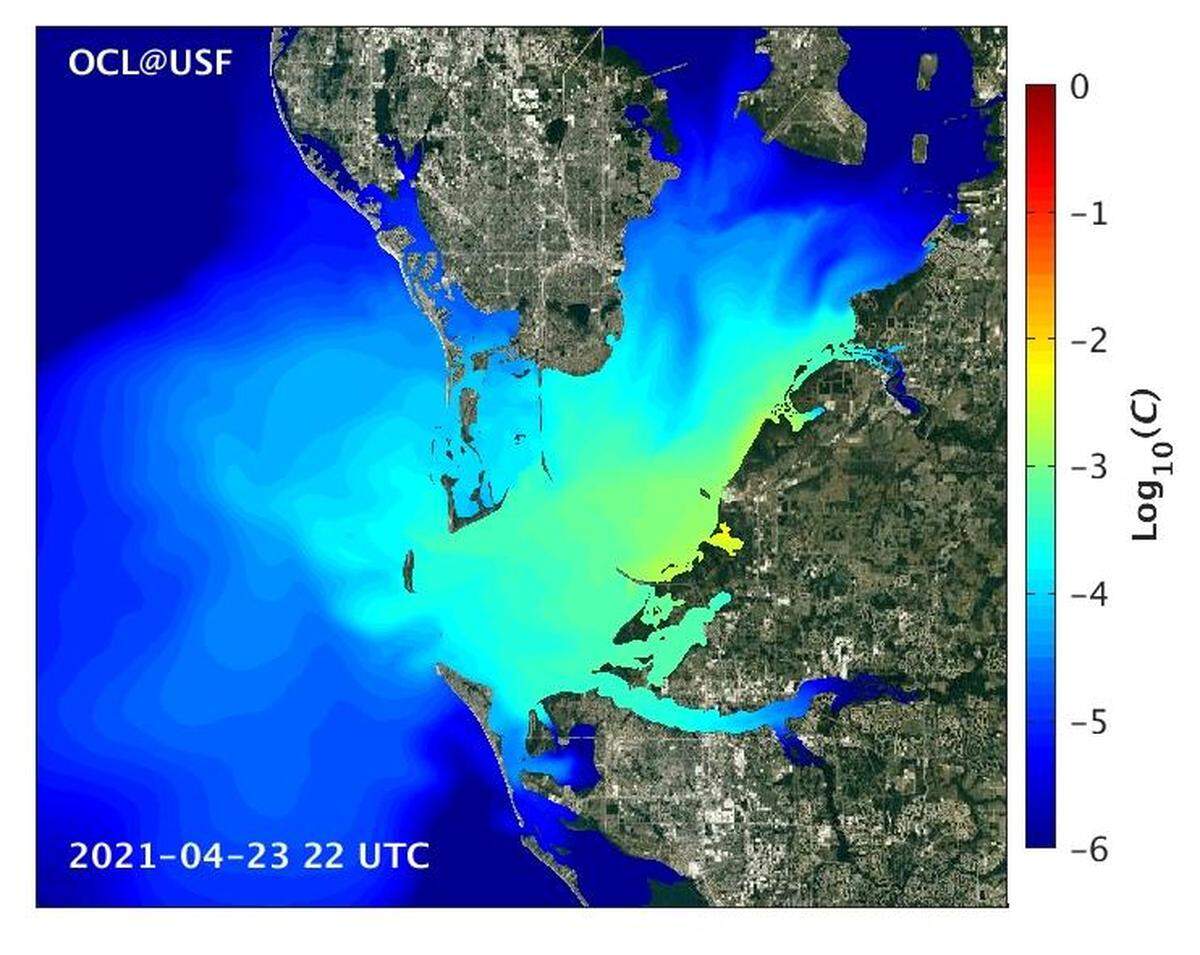
That model puts the nutrients on a crash course with where FWC researchers found traces of red tide. If the nutrients do make their way to the algae, it could be the start of a large bloom.
The Tampa Bay Estuary Program has also been tracking the effects of Piney Point’s contaminated water release. Ed Sherwood, the organization’s executive director, plans to meet with his team Monday morning to discuss the red tide situation and has his fingers crossed that it won’t intensify over the weekend.
“Any influx of nutrients into an estuary, there’s always a concern that algae will respond,” Sherwood explained. “Having red tide in lower Tampa Bay is not a good sign, and that’s something we’re keeping an eye on.”
Harmful algae blooms are a threat to marine ecosystems. When a bloom spreads, algae rises to the surface of the water, creating shade that prevents seagrass from getting the sunlight it needs. Algae also release certain toxins that can lead to fish kills and the respiratory irritation that humans experience.
FWC’s four samples of red tide were collected between the northern tip of Anna Maria Island and the mouth of the Manatee River. State officials said the red tide was observed at low to very low levels, which could produce respiratory irritation and fish kills.
In order to mitigate the effect of the contaminated water, the Florida Department of Environmental Protection instructed Piney Point’s site operators to pour the water into a deep channel near Port Manatee, which helped dilute the nutrients.
Water quality sampling in the area has become a priority for several organizations — including FDEP — that are hoping to determine what impact the leak will have on Tampa Bay’s environment.
The results of FDEP’s testing can be found at www.ProtectingFloridaTogether.gov/PineyPointUpdate.
This story was originally published April 23, 2021 at 2:47 PM.