Bradenton police officers are wearing body cameras. What rules do they have to follow?
Seeking to bolster transparency with the community, the Bradenton Police Department has begun rolling out body cameras to patrol officers.
As of Tuesday morning, 76 of the department’s officers had been equipped with body-worn cameras that are automatically activated in certain situations. Speaking with the Bradenton City Council, department officials provided more details about how the cameras are used in the field.
“On one hand, I think this is a game-changer for the city. I think it certainly puts us into not being able to question our transparency or what we’re willing to share,” said Police Chief Melanie Bevan. “On the opposite hand, it is going to take ... a toll on us but we’re going to do what we can to do it in the best manner possible.”
The department previously detailed the general guidelines of the body camera program, which is expected to cost $1.2 million. Bevan says 91 of her 123 officers will wear the cameras, including every patrol officer, school resource officer and special investigations detective. With the hardware now rolling out to officers, department staff provided more details about how officers will use them.
Officers are encouraged to turn on their cameras for almost every interaction with the public, Bevan said. Those instances include witness interviews, suspect arrests, car chases, property searches and more. Officers are directed to activate their cameras when responding to any dispatch call, as well.
According to Bill Korinek, administrator of the department’s body-worn camera program, the body camera system supports unlimited cloud storage, allowing officers to record most of their interactions without placing an additional financial burden on the department.
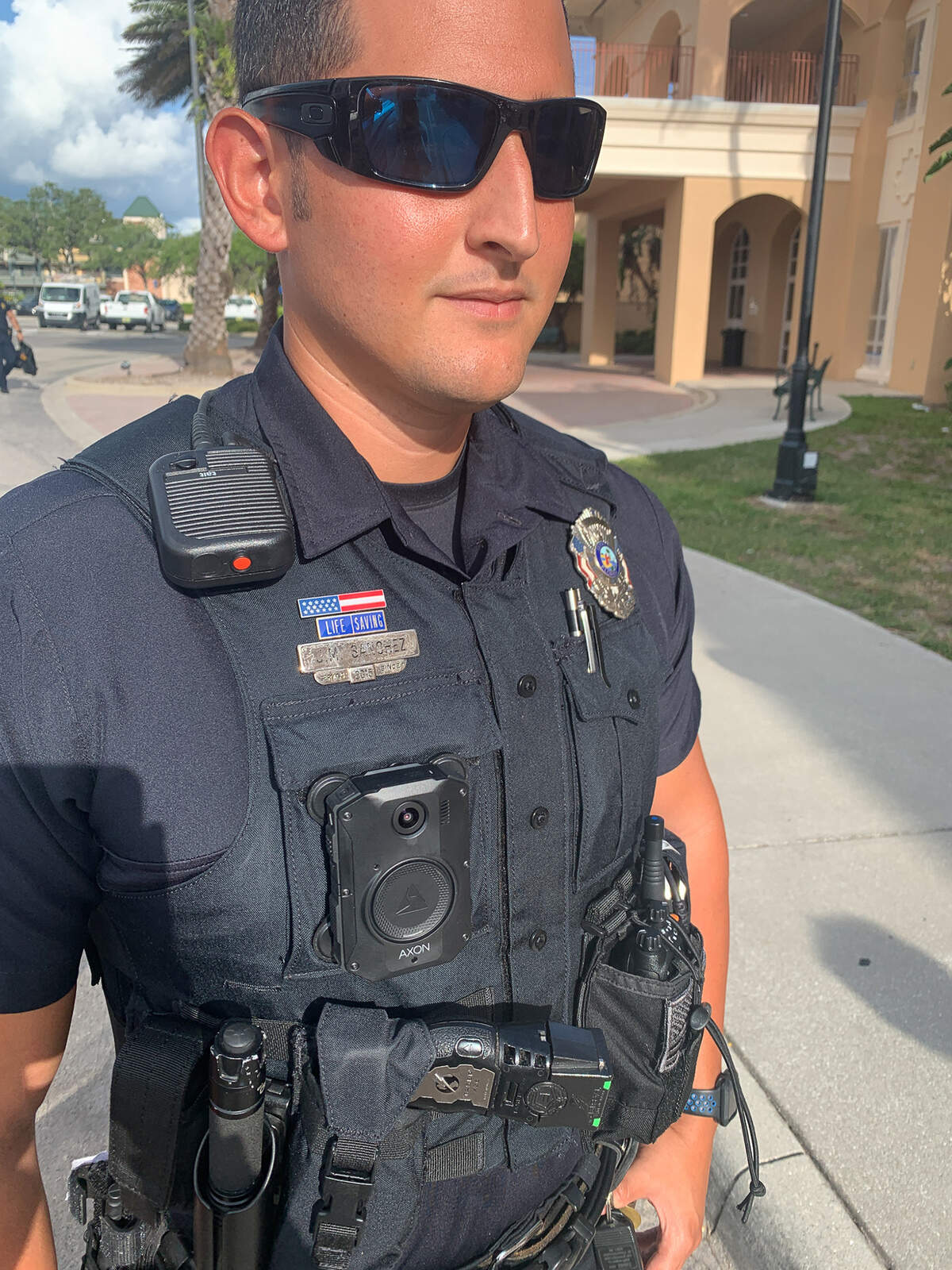
“They also have the latitude that if they’re out with somebody and they think for whatever reason based on their experience or whatever, if they think it’s something we may want to capture on video, we tell them, ‘Hey, turn it on. It doesn’t cost us anything extra,’” Korinek said.
Technology inside the cameras also supports automatic activation. A magnetic mount attached to every officer’s firearm holster will trigger the camera to begin recording anytime an officer pulls their weapon. Automatic activations also occur when officers turn on their sirens or remove a mounted weapon from their patrol vehicle.
Officers cannot override the automatic activation. When a camera is automatically activated, it also sends a signal to begin recording on any other body cameras within a 30-foot radius.
“The most important thing is it shows true transparency,” said Mayor Gene Brown. “We want the citizens to know we’re out there to protect them and do the right things. The cameras will help prove that.”
Another feature of the body camera system is the ability for responding officers to use their body camera software to accept witness pictures and video of an investigation. Using their cell phones, officers can open a portal that allows bystanders to upload their own footage to assist the department’s investigation.
There are also strict rules for officers to follow when deactivating their cameras. Any deactivation must be verbally announced, along with a reason for ending the video recording.
Other officer guidelines include making sure their body camera is fully charged before their shift begins, uploading all of their footage by the end of their shift and making sure the camera’s lens is not won’t be covered by general movement. Officers will be randomly audited by the department to ensure they are in compliance.
The Manatee County Sheriff’s Office has also incorporated body cameras for its law enforcement officers. The countywide agency first began a pilot program in July and began officially rolling out cameras to more than 400 patrol deputies and detectives in October.
Bradenton’s body camera program officially went live on Tuesday, following a presentation to council members. The system is still a work in progress, Bevan said, noting that there are still issues to resolve.
“What we haven’t yet dealt with is the public records requests. That’s a little of the unknown. We expect that it’s going to be a game-changer,” she told city council. “Like I’ve always said, I don’t know what resources I need until I see what resources I need.”
Bevan said she expects to continue modifying the department’s policy in the coming weeks.
This story was originally published January 30, 2021 at 5:00 AM.