Hard work and good luck brought record growth, challenges to Sarasota Bradenton airport
It’s no coincidence that passenger traffic through the terminal at Sarasota Bradenton International Airport set records three of the past four months.
The 312,909 passengers in June was the first time monthly passenger traffic exceeded 300,000. There’s no indication the growth and popularity of the airport have come close to peaking.
So, what happened at an airport which once couldn’t seem to catch a break or attract local residents, who would often automatically travel an hour north to Tampa International Airport instead?
“There are multiple factors,” Rick Piccolo said of the turn-around.
“We were under-served to begin with,” Piccolo would say.
Not so long ago, SRQ had only six airlines and 10 nonstop destinations.
“We are surrounded by some great airports. We are in a very competitive environment. We are challenged by our geography, but we also benefit from it,” Piccolo said.
Today, there are 10 airlines at SRQ serving 48 nonstop destinations, which helps stem some of the “bleed” to other airports. Expect more destinations to be added in the future.
The new-found success took persistence, smart marketing, the growth of the area, and for geography to begin working for SRQ, rather than against it.
Along the way, Piccolo, who has served as the airport’s president and chief executive officer since 1995, has experienced setbacks caused by the trauma of 9/11, the Great Recession and the COVID-19 pandemic.
“We would tell the airlines that if you put the seats in, the people will come,” Piccolo said.
Growth at SRQ airport
One of the factors that made SRQ suddenly more attractive to the airlines was the growth of the Bradenton-Sarasota area with roughly 20,000 new residents arriving each of the past six years.
Plus, added to the lure of beaches on Anna Maria Island and Longboat Key, is the addition of sports tourism with IMG Academy, Premier Sports Campus, three Major League Baseball spring training sites and Benderson Park.
Strangely enough, the pandemic was a factor, too. COVID-19 brought air traffic to a halt, but once it resumed, air travel recovered faster at SRQ than at almost any other airport in the country. The pandemic brought a flood of new residents looking to escape more crowded, older communities elsewhere.
Something else that SRQ had to overcome was the loss of AirTran in 2012, when parent company Southwest Airlines pulled the plug on local service.
A member of the Sarasota Manatee Airport Authority once asked Piccolo when Southwest would return to SRQ. It was a question that invariably came up when Piccolo addressed local groups.
“We’re always talking to Southwest,” Piccolo replied, referring to the near constant schedule of SRQ staff visiting with various airlines, prospecting for new nonstop destinations while presenting relevant data, and developing working relationships.
A three-legged stool helps airlines
A key factor in the airport’s turnaround has been the teamwork between the airport and tourism development boards in Manatee and Sarasota counties in providing funding to aid airlines in marketing new destinations.
When low-cost carrier Allegiant began serving SRQ in 2018 with non-stop service to Indianapolis, Pittsburgh and Cincinnati, each of the tourist development boards, with the approval of their county commissions, and SRQ allocated marketing money for the new routes to help ensure their success.
In the first year of Allegiant’s service between Sarasota Bradenton and Indianapolis, for instance, the tourist development boards, using tourist bed tax money, and the airport allocated a total of $225,000 for marketing the route. SRQ put in $100,000, the Bradenton Area Convention and Visitor Bureau put in $75,000 and Visit Sarasota contributed $50,000.
The airlines run their own marketing campaigns, and send invoices to the Bradenton Area Convention and Visitors Bureau for its share of reimbursement, said Elliott Falcione, executive director of the tourist development organization. The money may only be used for destination-specific marketing, and may not be used for operational or equipment costs.
The airline marketing partnership is like a “three-legged stool,” Falcione said.
The airport matches dollar for dollar the tourist bed taxes that the county commissions make available to help with airline marketing, Piccolo said.
Since 2016, the airport has invested $5.9 million in marketing to help bring new airline service to SRQ. The Bradenton Area Convention and Visitor Bureau, through the Manatee County Commission, has contributed an additional $2.98 million, and Visit Sarasota, through its county commission, has contributed $2.8 million to help airlines market their destinations.
The proof in the effectiveness of the strategy is in the pudding. More visitors arriving at SRQ help fuel the area’s biggest economic engine: tourism.
Tourist tax money invested in marketing airline routes serving SRQ helps bring visitors who spend money at local gas stations, hotels, restaurants and more, Piccolo said.
Residents pay no property taxes to support the airport, any of the airline marketing programs or the tourist development programs. The airport is self supporting and debt free.
Bold incentive
As an additional incentive, SRQ provides free use of its facilities for two years to new airlines. After two years, the maximum allowed by the Federal Aviation Administration, the airline becomes responsible for those costs.
Or as Piccolo puts it, they begin paying “retail” for landing fees, gate, and ticket counter space.
Allegiant, which helped transform SRQ when it arrived in 2018 with nonstops to Indianapolis, Pittsburgh and Cincinnati, now lists 25 destinations.
“It shows them we are in it with them,” Piccolo said. “Giving it away for a trial period is not costing us money, compared to if there is no business.”
“Not one of the Allegiant destinations has been discontinued,” Piccolo said of the success of the incentive program.
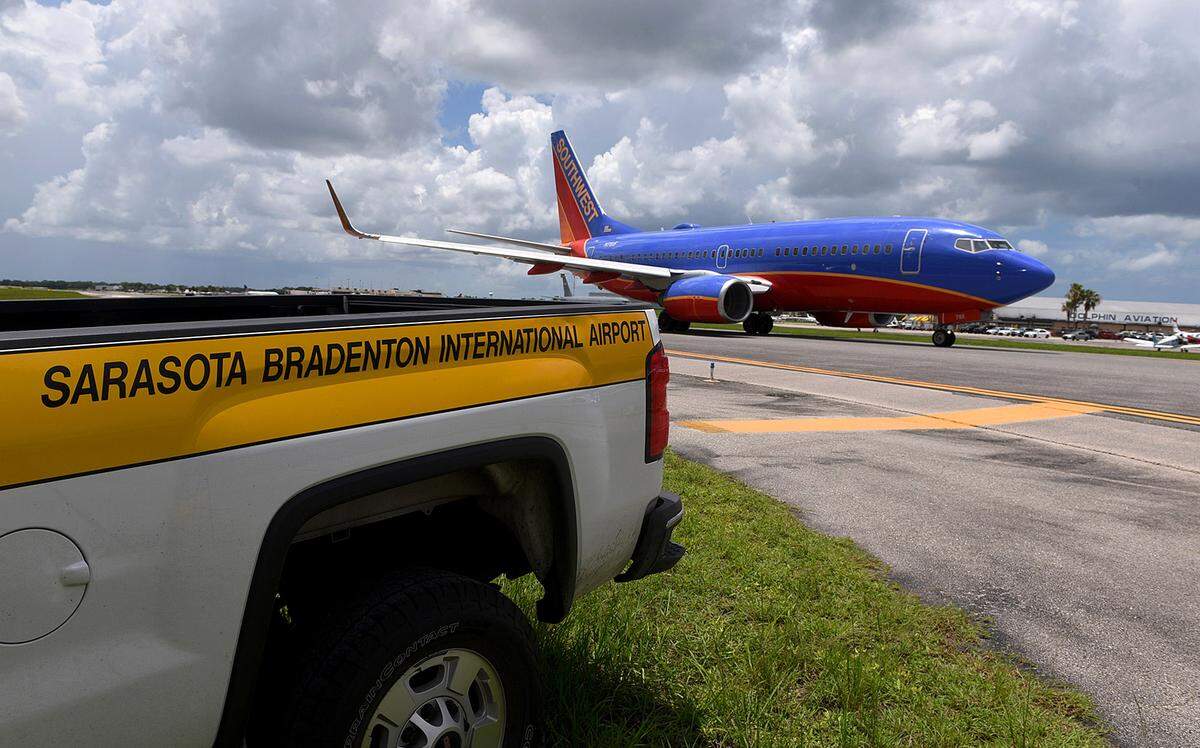
The most recent addition to the SRQ roster, Southwest, arrived in February with flights to Baltimore-Washington, Nashville, Houston Hobby and Chicago Midway. Southwest has been adding more destinations ever since.
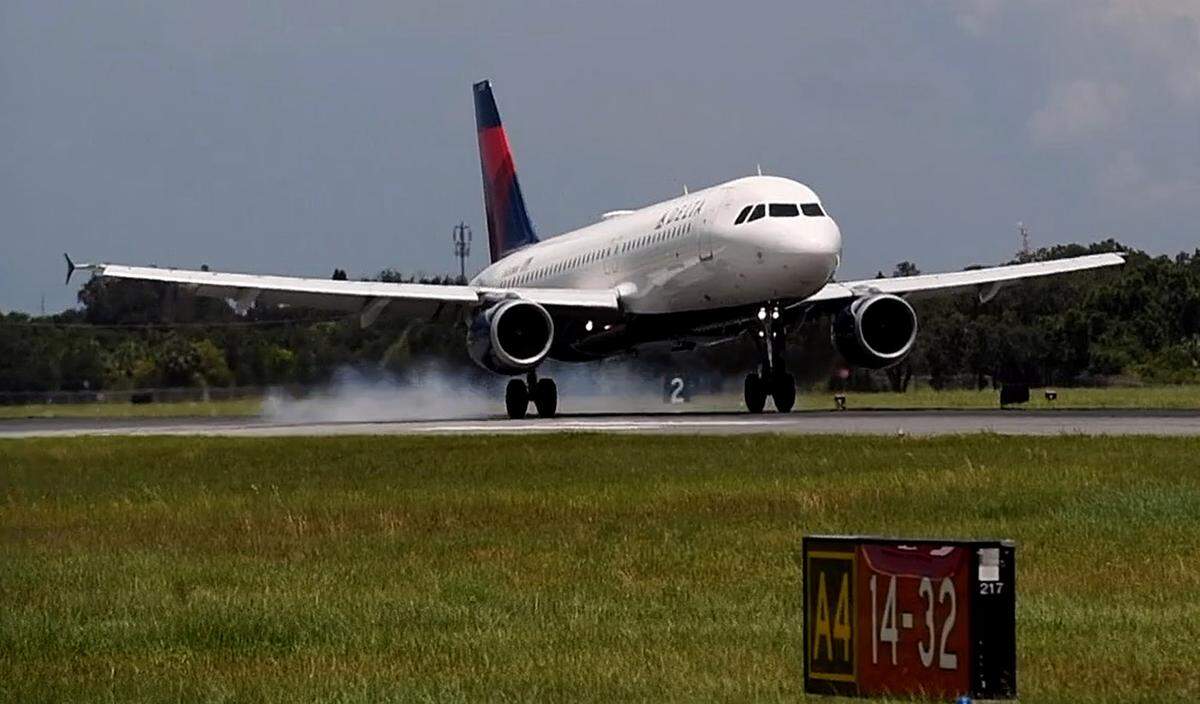
How big a deal is that? In June, Southwest was the leading carrier at SRQ with 87,000 passengers. In recent years, Delta, the leading airliner at SRQ for the past quarter century, or Allegiant had been leading the passenger parade at SRQ.
With all the new airlines and destinations, local residents now can ponder whether they would prefer to drive a few minutes to SRQ or take a chance on traffic conditions between Bradenton and Tampa International.
“There was a perception problem that it was too expensive to fly out of SRQ,” Falcione said.
The new flights, including low-cost carriers Southwest, Allegiant and Frontier, are helping dispel that perception, he said.
“You have unprecedented pent-up demand,” Falcione said of the surge of travel at SRQ and other airports.
About 60 percent of visitors to the Bradenton area, including Anna Maria Island and Longboat Key, arrive by air, while the remaining 40 percent drive, he said. In 2019, about 70 percent of those visitors to the Bradenton area were deplaning in Tampa.
Prior to the pandemic, about 70 percent of travelers at SRQ were leisure fliers and about 30 percent were business class.
Since the pandemic, about 95 percent are leisure fliers and 5 percent are business.
“There is a lot of discussion about how much and when business fliers will return,” Piccolo said of use of Zoom and other remote working techniques adopted during the pandemic.
In the future, Piccolo thinks airlines may add flights to Las Vegas, Providence, R.I., Buffalo, N. Y., and Hartford, Conn. International flights to Europe appear to be much further in the future.
Growth overload at airport?
Gov. Ron DeSantis’ decision to keep the state open for business during the pandemic, compared to many other states, helped spur growth at SRQ. But it was also a two-edged sword.
The growth that came after the arrival of the pandemic was sudden and unrelenting, and has SRQ staff scrambling to keep up.
“We are doing everything to ensure that we don’t outgrow the facility,” Piccolo said of the planned expansion of the terminal, fuel facilities, parking, rental car facility and ground transportation facility, and the possible addition of a parking garage.
Total passenger seats are up 162 percent over pre-pandemic levels, and Piccolo expects that there will be more than 50 nonstop destinations available at SRQ by Christmas.
The total price tag for expansion projects is estimated at more than $100 million, and that doesn’t include the possible eventual addition of another wing to the passenger terminal. For now, Piccolo believes expansion plans will handle growth for the foreseeable future without the addition of a new wing.
History of SRQ airport
In 1939, construction plans were drafted for Sarasota Bradenton Airport, and in 1941, the Sarasota Manatee Airport Authority, the governing board for the airport, was established.
Construction of the airport was a Works Progress Administration project, according to a historic marker near the terminal.
During World War II, the airport became an Army air field, and was home to a bomber group and later used for fighter pilot training.
After the war, the airfield reverted to civilian control.
“In the 1960s, jet flights, an instrument landing system, runway extensions, high-intensity lighting, and additional airlines were added. A new terminal in 1990 supported the change to Sarasota-Bradenton International Airport when Port-of-Entry status was granted in 1992,” according to the historic plaque.
For more information on the genesis of the airport, visit https://www.sarasota-airport.com/History.
This story was originally published July 15, 2021 at 5:00 AM.