
Co-working: Mind-melding places for millennials
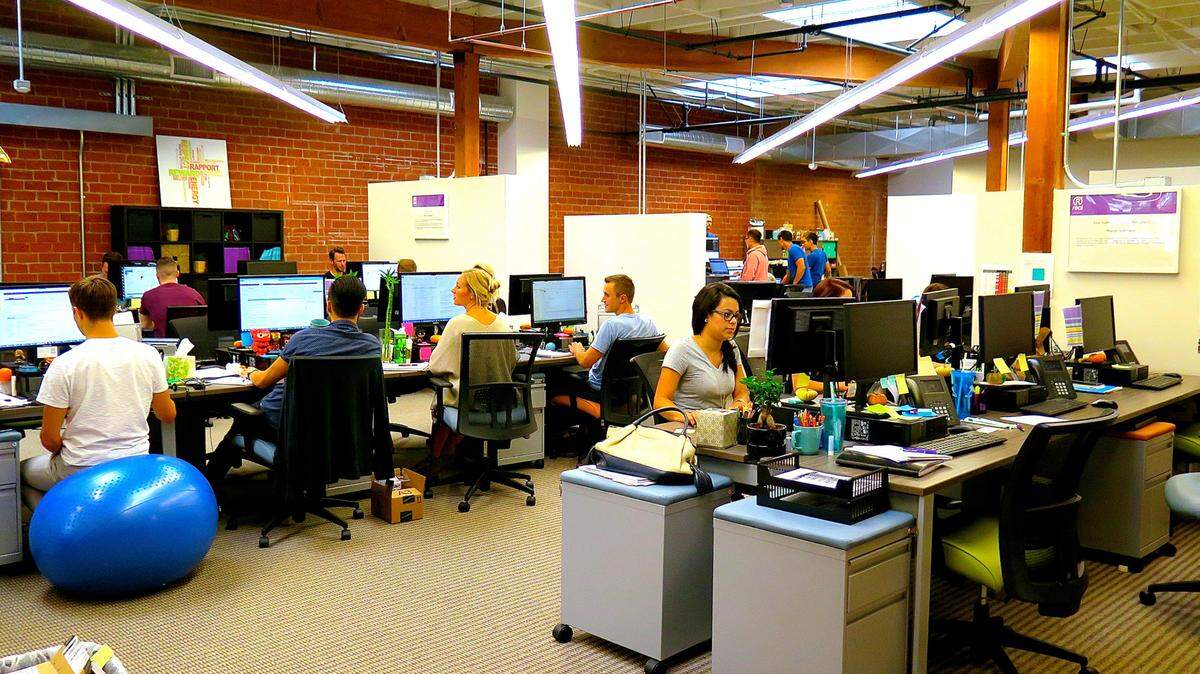
First came home offices where new ideas turned into a small business.
Then Starbucks became the place to work on a laptop and network with neighbors and clients.
Now a new concept -- "co-working" or "shared workplaces" -- is taking hold: Rent a desk for $500 per month in a warehouse or commercial building and work alongside other individual entrepreneurial "soloprenenurs."
The sharing economy has produced this growing type of office around the country to the point where an estimated 40 percent of companies are thinking about adopting it in some form themselves.
"This is perfect -- exactly what we were looking for," said Ryan Johnson, 24.
He's one of five venture-capitalists at Israel-based OurCrowd who work at DeskHub, a 15,000-square-foot co-working space in San Diego.
He previously operated out of his apartment and now is able to invite dozens of angel investors to monthly meetings. Once in a while he picks up tips from other DeskHub companies for possible investment opportunities.
"We love the ability to network with other entrepreneurs and startups," Johnson said. "There are days when the main room at lunch is just crazy -- people having conversations, people touring around. It's a cool environment. You're always talking to somebody new. I hear people making connections and introductions I'm sure they would not have found if they weren't at DeskHub."
Jay Chernikoff, 36, started DeskHub in Scottsdale, Ariz., almost two years ago, when he was shifting from tech to real estate and needed a flexible workspace.
"The idea is as companies grow and become bigger or smaller, they want to retain flexibility," Chernikoff said. "It's the same as the 'rental' economy, Uber, all those things. You have offices shifting in that way, too."
The CBRE brokerage began publishing special reports in January on the shared-workplace movement. It found the commercial real estate world is taking notice, partly in reaction to rising real estate costs in
urban centers, the very places where many millennials, the industry's future tenants and customers, want to live and work.
"The employees these companies want to attract and retain regard blending work and life as integral to their happiness and success," CBRE said.
More efficiency, less space
The brokerage also said office-based companies see co-working as a way to gain more efficiency by using less space per person.
In San Diego, CBRE broker Evan Knudson identified 11 co-work spaces in 18 locations that add up to 109,047 square feet. While a typical office plans for 250 square feet per person, a co-work setup can reduce that figure to as little as 66 square feet.
That's because there are no file cabinets, closed-door executive offices and duplicate bathrooms, break rooms and conference spaces.
"You can be extremely dense and it's crazy to walk through there -- and you don't feel elbow to elbow," Knudson said.
Individual desks typically rent for $400 to $500 per month with discounts for unassigned "floater" desk locations and "social memberships" that allow limited access for working but full access to seminars and special events.
Parking is not necessarily as readily available onsite as in standard office buildings, but proponents of co-working say users find places to park or walk, bike or take public transit instead.
Co-working spaces can attract some interesting and imaginative businesses.
Wag! is a dog-walking service. 6 Degrees is a meeting organizer. GreekRush develops software to help fraternities and sororities on about 25 campuses organize and manage their rush periods, events and routine business.
Cody Cross, 24, got the idea while at Lamda Alpha Chi at the University of San Diego and two other buddies joined him as one of the first DeskHub tenants last year after working out of their apartments.
"I wanted to have an impact and be close to my team and build relationships within the team," he said. "It's hard to do that when you're working remotely."
He said a real office "definitely legitimizes" pitches to investors and the low-overhead costs reduces the "burn" rate of investors' money.
Curtis Clave, 31, started his own co-working space, called Bloc, to make room for his Web developer agency. He is reconfiguring a second location and planning to open a third. He hopes to have seven locations throughout California over the next five years, all close to the beach.
"That's a huge plus for a variety of our members for surfing, walking, being close to restaurants and lots of events," he said.
Place to try out new ideas
Co-working arrangements can help companies experiment with new ideas without requiring a long-term lease commitment.
Patrick Dillon, 36, said he moved his Lightpost Digital spinoff marketing company to DeskHub from the office of his other company, Deal Current, a private-label coupon producer for newspapers and other companies.
"For us it was a perfect opportunity to separate the teams and see if Lightpost could become something big outside Deal Current," Dillon said.
Once the Web design and marketing concept proved successful, he sent the designers back to the quieter Deal Current offices and he and one other salesman stayed to oversee business expansion.
Like weekly Rotary Club lunches, co-working breeds cross-fertilization among disparate businesses.
Dillon said a neighboring business that focuses on Web design and management for nonprofits offered some suggestions on how to set up a sales force.
"The conversation lasted 20 minutes and was worth six months of mistakes," he said.
This story was originally published April 24, 2016 at 8:28 PM with the headline "Co-working: Mind-melding places for millennials ."