
US hiring remains fast-paced, adding 215,000 jobs in March; local market on same pace
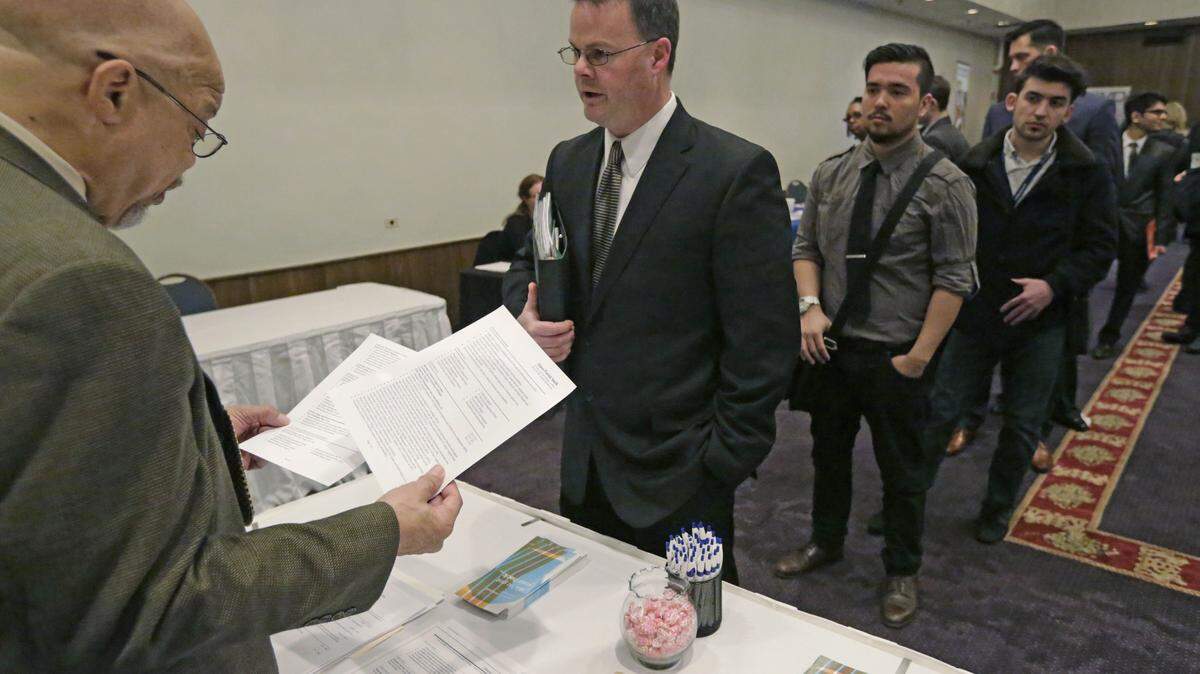
Americans are going back to work.
Powered by a burst of hiring in recent months and an uptick in wages, the huge army of potential workers that had been on the sidelines of the recovery is slowly returning to the job market.
The Labor Department said on Friday the proportion of Americans in the labor force crept up slightly to 63 percent -- the highest level in two years. Although still well below where it had been before the recession began, it extends a trend that began last fall.
Overall, the economy added 215,000 jobs in March, as employers continued to hire at a robust pace, despite volatility on Wall Street and turmoil overseas.
The unemployment rate rose to 5 percent, compared with 4.9 percent in February. But that was a positive indication, analysts said, since it was the increase in participation that mostly accounted for the increase rather than job losses.
"It's clearly a strong report across the board and I was particularly encour
aged by the pickup in labor force participation," said Michelle Meyer, deputy head of U.S. Economics at Bank of America Merrill Lynch.
Job gains on the local level have been rising along with the national numbers. According to Florida Department of Economic Opportunity statistics for February, the most recent period available, the Northport-Bradenton-Sarasota area added just under 3,000 jobs that month, and 8,000 jobs in the same period of 2015. The biggest gain came in the education and health care sector, of 5.8 percent year over year.
Meyer noted that March's jump in participation was the sixth consecutive monthly increase, a sign of a real shift.
At the same time, the labor force grew by more than the number of job seekers, suggesting that many of those re-entrants were going directly to work. "It's really a best-case scenario," Meyer said. "It's not as if folks are coming back into the workforce and going on the unemployment line." In addition to more Americans finding work, the uptick in the participation rate also has the effect of moderating wage pressures by expanding the labor supply. That gives the Federal Reserve and board chair, Janet Yellen, more headroom as they evaluate the risk of inflation and debate when to next raise interest rates and tighten monetary policy.
Although other economic data has been mixed recently, the Labor Department report points to a remarkably solid and steady job market. Since the beginning of 2015, the economy has added well over 200,000 jobs a month on average.
Friday's report suggests an economy gradually returning to a more normal trajectory, while so far avoiding the bubblelike excesses that prevailed just before the Great Recession began in December 2007.
March's gain was in line with that trend. Economists and traders have been equally focused on other factors in the monthly jobs reports recently, like average hourly earnings and the proportion of Americans in the labor force.
One of the biggest anomalies of the recovery has been why wage gains have been modest despite the steady hiring gains. That may be starting to change.
Last month, average hourly earnings rose by 0.3 percentage point, bringing the yearly wage gain to 2.3 percent. Economists expected a 0.1 percent increase; March's change suggests wages are strengthening.
The economic backdrop to the election is also changing.
Democrats note unemployment has fallen sharply since President Barack Obama took office; the jobless rate stood at 7.8 percent in January 2009.
Republicans have been citing stagnant wage growth, as well as the exit of many workers from the labor force. They also contend Obama's stewardship of the economy has hobbled businesses with regulations.
But the steady expansion of the workforce and the signs that a tightening labor market is finally translating into wage gains suggest some of the economic anxiety evident in primary results may be easing
Until recently, the proportion of Americans who are either employed or actively looking for a job had been falling. But it appears to have bottomed out at 62.4 percent in September 2015. The 63 percent participation rate is now back to where it was in February 2014.
"Wages and participation are where the rubber meets the road," said Michael Gapen, chief United States economist at Barclays. "We will take our cue about the overall strength of the economy based on that." Gapen, like many on Wall Street, urged the Federal Reserve to let the good times roll.
-- Herald reporter Matt M. Johnson contributed to this report.
This story was originally published April 1, 2016 at 10:31 PM with the headline "US hiring remains fast-paced, adding 215,000 jobs in March; local market on same pace ."