
US stocks slide following steep market drop in China
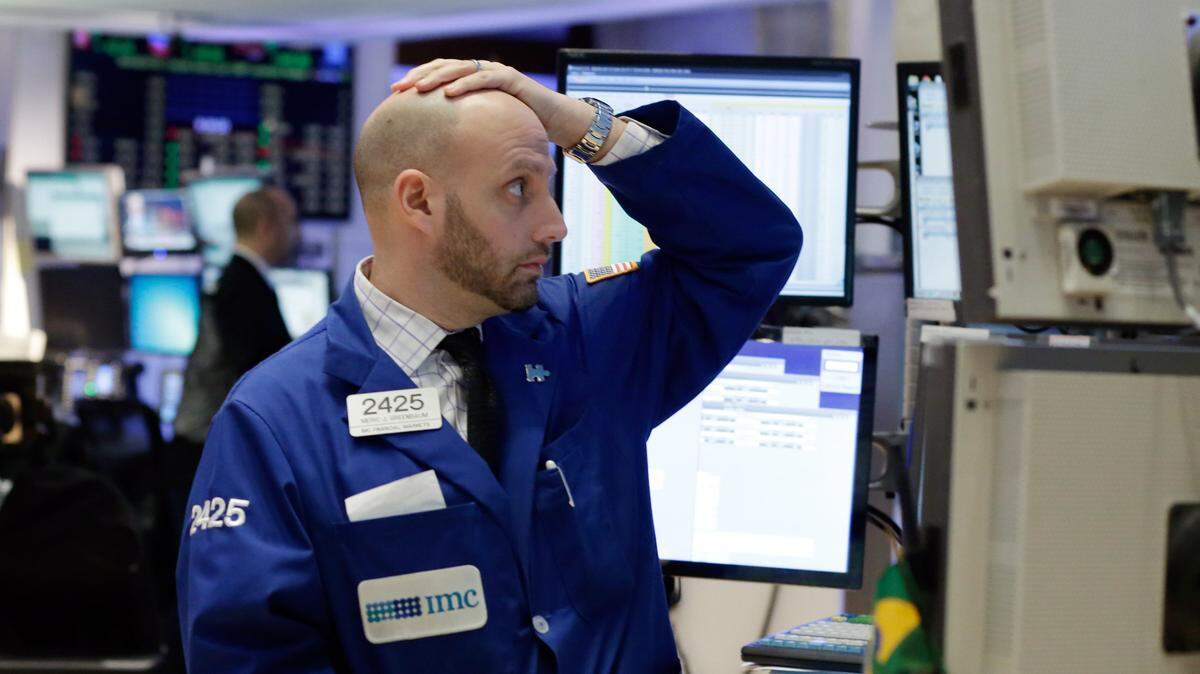
A worldwide stock sell off arrived on Wall Street Monday, serving notice that investors are likely to endure a volatile year as economic growth slows globally and interest rates at home begin to rise.
The Dow Jones industrial average, a closely watched benchmark of 30 blue-chip stocks, tumbled by nearly 400 points Monday, before bouncing back some to close down 1.6 percent. The Standard & Poor's 500, a broader look at the market, and tech-heavy Nasdaq were down 1.5 percent and 2.1 percent respectively.
China helped trigger the morning sell-off after reporting yet another slowdown in its manufacturing sector on Monday, but investors are also growing concerned that rising tension between Saudi Arabia and Iran could lead to higher oil prices and that the U.S. economy may not be strong enough to withstand such global upheaval.
"Fear woke up this morning, and hope is sleeping in," said David Kelly, chief global strategist for J.P. Morgan Funds.
The sell-off quickly spread throughout Asia, Europe and then landed in U.S. markets with a thud.
U.S. investors faced the worst start to a trading year in at least a decade. China's CSI 300 index, a benchmark of the largest 300 stocks listed in Shanghai and Shenzhen, tumbled nearly 7 percent, while Japan's Nikkei and the Euro Stoxx were both down more than 3 percent.
For mom-and-pop investors, the turmoil was an inauspicious start to a year that many market watchers are predicting will be rocky. Investors endured a lackluster 2015 with the major U.S. indexes closing the year either down or flat. And now, analysts said, as China's economy continues to slow, they are likely to see a return of the stomach-churning volatility that sparked deep sell-offs last summer.
"It is a bucket of cold water as we come into the new year," said Jack Ablin, chief investment officer for BMO Private Bank. The fate of the trading year "depends on the global economy, and so starting off on the wrong foot here is obviously disappointing."
This comes just as the Federal Reserve has begun to remove its support of the U.S. economy, allowing interest rates to rise for the first time in years. The Fed's actions were a bet that the U.S. economy was ready to stand on its own, but that could be called into question soon, analysts said. Last week, RBC Capital Markets lowered its expectations for the Standard & Poors index this year. On Monday, new data showed that the manufacturing sector in the U.S. contracted at the fastest pace in six year in December.
"You have to get worried about the adequacy of economic activity going forward," said John Lonski, chief capital markets economist for Moody's Analytics. "Is the economy going to be lively enough?"
A stumble Monday on Wall Street doesn't spell doom for 2016, but if the volatility continues throughout the rest of the month, investors are likely to find themselves disappointed, analysts said.
" 'As January goes, so goes the year' is an old Wall Street saying, which has been correct 72.4 percent of the time," Howard Silverblatt, senior index analyst for S&P Dow Jones Indices, said in a research note this morning.
The global selling frenzy underscores investors' fears about China's slowing economy. The world's second-largest economy has cooled off and this summer policy makers there surprised many by allowing a devaluation of the country's currency. On Monday, China reported that its manufacturing sector contracted again.
The disappointing report cast renewed doubt on the effectiveness of Beijing's policies to boost the country's economy. Exacerbating investors' anxiety in China was the implementation of "circuit breakers" that briefly prevented investors from selling their stock.
Middle East tensions is also rattling some investors. Saudi Arabia, the world's largest oil exporter, cut diplomatic ties with Iran on Sunday. On Monday, Saudi allies, Bahrain and Sudan, also severed ties with Iran in what analysts have described as one of the worst crises in decades between the region's Sunni and Shiite powers.
Oil prices, which have lumbered near record lows for more than a year, rose nearly 3 percent Monday before closing flat on concerns that the conflict could disrupt oil supplies. Some of those concerns may be overblown, said Kelly of J.P. Morgan Funds. Still, the market reaction is a reminder that investors will be watching oil prices closely this year.
"It just reminds us that while economic conditions here at home appear to be stable and improving incrementally, we're still part of a global economic system that is tied very closely together," said Ablin from BMO Private Bank.
This story was originally published January 4, 2016 at 5:05 PM with the headline "US stocks slide following steep market drop in China ."