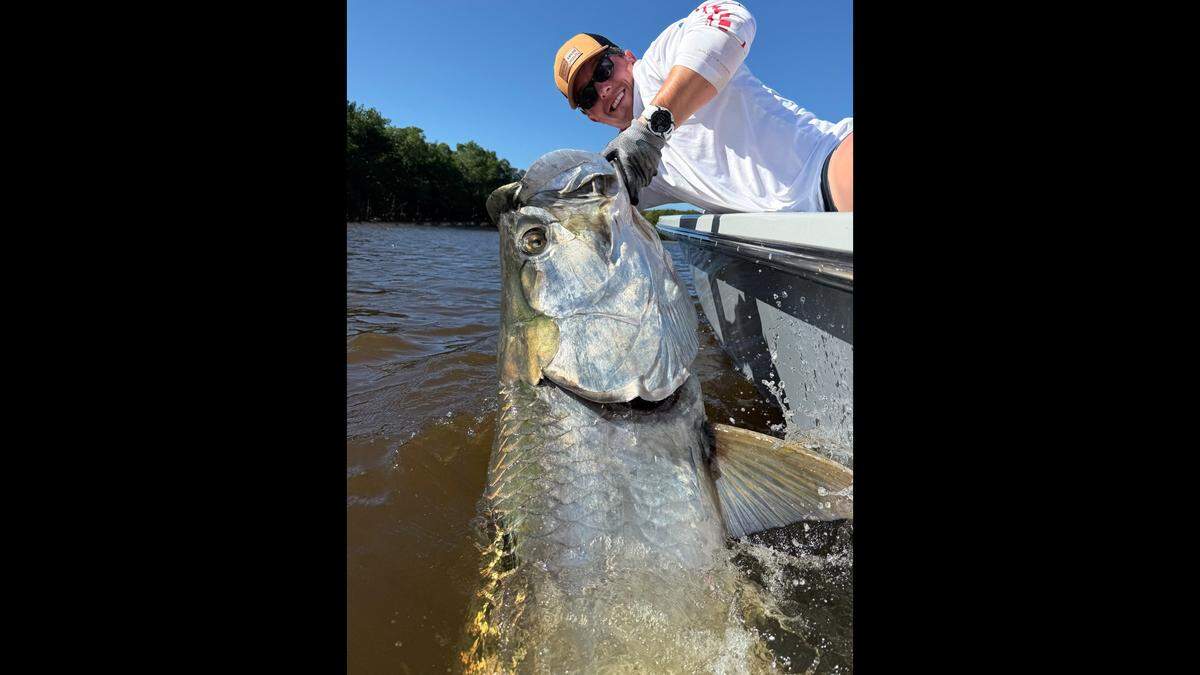
Gulf anglers say tarpon fishing now more difficult. What is eating their catch?
Over the past few years, offshore anglers have had more and more run-ins with sharks.
What used to be a common occurrence when fishing bigger bottom, like springs and wrecks, is now a regular and unfortunate happening across the Gulf no matter where or when you’re fishing. Sharks attacking hooked fish — making it difficult to get them to the boat — is a very real problem.
That problem is growing as sharks are now attacking more fish in shallow and nearshore waters, no matter the month.
“If the water temperature is at least 65 to 68 degrees, we can tarpon fish year-round,” explained captain Logan Waidelich, who specializes in tarpon fishing around the 10,000 Islands area of Florida.
“I’ve gotten good at using modern technology to find tarpon. I prefer to cast artificials like swim jigs, swim baits and crank baits into schools of them. On a nice winter day, where the temperature is 75 degrees, we usually average hooking five to six fish and landing one to three.”
On a January trip before cold weather set in, Waidelich found a school of tarpon. After a battle with two silverkings, his angler hooked their third for the trip.
“It was in a big wide open area with green, chalky saltwater. (Three-quarters) of the way through the fight, the tarpon started getting squirrelly. Normally, they’ll run to the boat, then straight away, but I could tell this one was trying to get away from something,” Waidelich explained.
“I told my angler Brad (Holmvig) to open the bail and let him run and get away from what was chasing it,” he added. “That’s the No. 1 thing you have to do when sharks show up, let them get away. We’re using artificials with heavy 100-pound leader, so I didn’t want to break that fish off and leave everything in it.”
Waidelich started the big motor and they chased down the fish. When all the line was recovered he grabbed the spool to quickly bring the 100-pound-plus tarpon to the boat in a fight that lasted less than 15 minutes. As he secured the catch, and was looking to unhook the fish boat side for the release he got quite the scare.
“I could only see about a foot into the water. All of the sudden, I feel something grab the tarpon and start chomping off his tail while working its way up the fish,” Waidelich said. “It started shaking, and I’m trying to pull the fish away from the shark, but it was climbing up the tail. Once the fish was immobilized it left it, but I knew the fish was doomed at that point.”
The tarpon lost its tail with the bite marks of a large shark outlining the damage.
Handling hundreds of tarpon a year, Waidelich explained sharks used to be afraid of the boat. But now he’s worried they aren’t, and this might become a more common occurrence.
“They started to get closer and closer but weren’t aggressive to boats when we were releasing tarpon. Now it seems like they’re more aggressive and learning boats mean food, while also not being afraid anymore. It’s terrible, like a dinner bell for 400-pound sharks to head in. Once they show up, as soon as one is hooked, they rush up to it. I’ve had to stop fishing more often because I don’t want to feed sharks and result in another loss of tarpon.”
The shark depredation problem seems to be a much bigger and further expanding issue facing Gulf and now bay and inshore anglers. With potential legislation moving forward in the SHARKED Act, anglers anxiously await a resolution. In the meantime, shark encounters continue to be a common, expanding and more frequent problem.
Captain Logan Waidelich can be reached through his social pages at instagram.com/10kcharters.