‘You’re in luck.’ Bradenton-area angler recalls harrowing Gulf rescue
In the more than 30 years I’ve been venturing offshore, the Gulf seems to have gotten smaller.
Most of this is due to technology and reliability improvements. I remember the days of my youth when we’d bring a book of numbers and need to type them into a Loran-C unit to get from one fishing spot to the next.
Being out of sight of land was a stressful trip. You may not see another boat all day if you were 15 or 20 miles offshore and were often up to your own devices with only a radio there to help if needed.
Fast forward to the year 2025 and now 70- to 80-mile single-day trips are done by people in all sorts of boats and boat sizes. Single-engine bay boats running 100 miles to the elbow or Florida middle grounds seem frequent despite something I would never do. 42-foot and bigger center consoles can now cruise at 60 mph, making that distance in no time.
With the Gulf feeling smaller, there’s a comfort that makes day trips almost too routine. On a recent trip, I joined friends aboard a boat I’ve been on a few dozen times without issue. We’ve been 80 miles offshore, caught a ton of fish and always returned home on our own accord.
On this day, the weather was supposed to be slick calm, 5 to 10 mph tops. The ride offshore was nice, but to the west, storms sat upon our desired locations. As a result, we stopped shallower and kept the storms to our west.
After about 30 minutes, the dark clouds had built closer to us. The wind began to pick up to the point where the Rhodan trolling motor would no longer hold us still. We got back on the big engines and jogged away from the storms as electricity showed itself, and that’s not something we mess with.
For about two hours, we kept our distance, and eventually the storms grew overhead and rain fell, forcing us to run a bit shallower. The waves had built to 3 to 4 feet after winds gusted to nearly 30 knots. As the storm moved on, the waves stayed, but the wind died.
We returned to fishing, heading 10 miles further offshore, where red snapper began to bite. For every three we hooked, it seemed two were lost to aggressive sharks. The way to get them into the boat was using heavy tackle and cranking as fast as possible. We hit our limit and wanted to move along for yellowtail snapper.
I pushed the start button on the engines.
But nothing happened.
Made sure it was in neutral and the kill switch was proper.
Still nothing.
Glancing at the volts, we were low, about 11, not nearly the amount needed to start.
No big deal, we thought, the starting batteries might be having an issue, but we can use the house batteries to get us started. After about 30 minutes of swapping to the house batteries, I pushed start again.
A weak half-turnover from the Suzuki 350s, not nearly enough to get started.
At this point, it seemed like things were getting real.
A fellow angler pulled out his Garmin InReach. It allowed satellite-sent text messages. I sent one to my dad.
“It’s Jonny. We’re dead in the water 60 miles out. Batteries dead and engines won’t start,” I said. “Trying to get help, not a joke.”
Off in the distance was another boat, maybe 3 miles away. The Rhodan was still working, but the single 36-volt battery wasn’t an option for starting the engines. I began heading their direction at a slow pace.
During that time, we tried hailing the Coast Guard and texting TowBoat US to make them aware of our predicament. The sweltering sun was directly overhead and the feeling of uneasiness was slowly transitioning to panic. Our last immediate hope was a boat on the horizon.
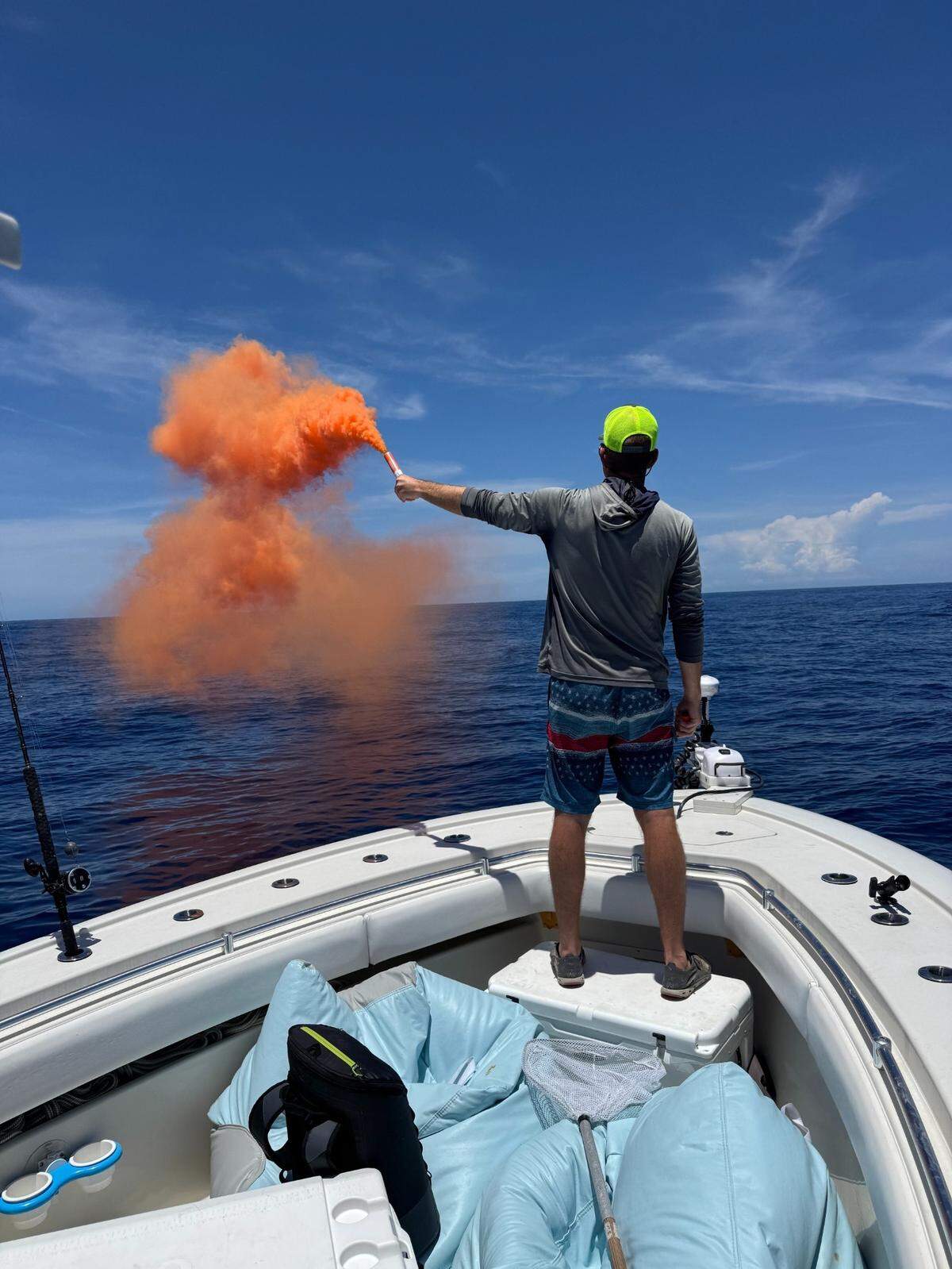
The Rhodan wore out after nearly two hours of slowly working our way to them. The next option was in the safety gear. I pulled out a smoke flare while another pulled out the flare gun. We set off both, hoping the boat that was now probably three-fourths of a mile away would see. After a minute, they started heading in our direction!
They pulled up. We said everyone was OK and explained our situation. The response was one I’ll never forget.
“You’re in luck. You just got saved by five airline mechanics,” said Michael, who hopped on our boat from his twin-engine Boston Whaler and began to remedy our situation.
They didn’t have a battery jumper or jumper cables, but Michael had a quick solution. They unhooked one of their starting batteries and swapped it with us. I saw the voltage meter immediately jump up above 13.
I pushed start once again.
This time they fired right up!
It was an amazing sound, and the feeling of panic that started to set in three hours prior was quickly alleviated.
When you’re 60 miles offshore and suddenly not in control of your own power, the Gulf has the power to make it feel much bigger.
Luckily, one of the good things about a lot of people now fishing is the feeling of support you can now get from seeing others nearby. On this day, we were lucky.