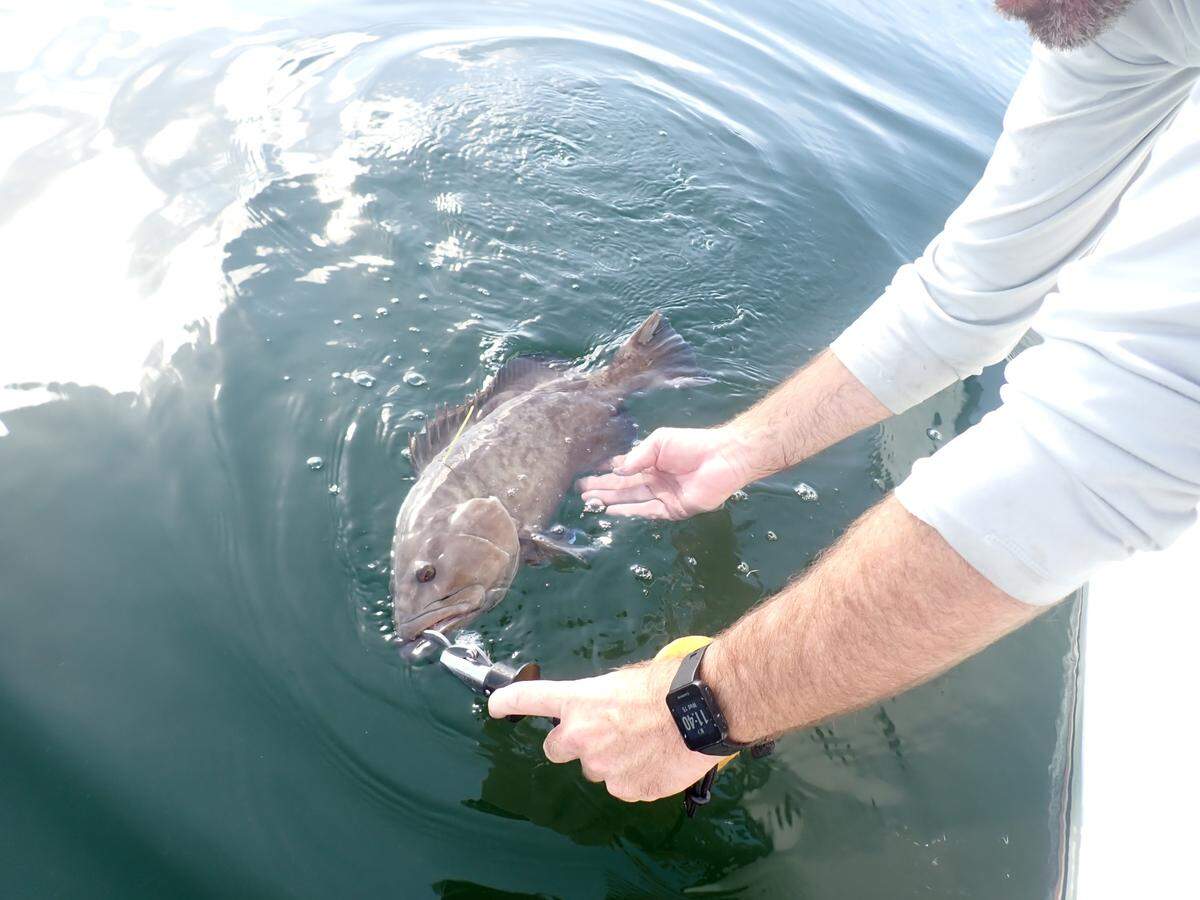
Are gag grouper numbers down in Tampa Bay? How a Bradenton native researcher studies fish
After captain John Gunter caught a tagged gag grouper in Tampa Bay, he called in to report the catch to the Florida Fish and Wildlife Research Institute.
The call was received by a southern-accented biologist who reported the catch of the fish tagged six months earlier while fishing for gag grouper research on Tampa Bay.
“His gag grouper was tagged in March,” said Sarah Burnsed, who took the call and is part of the movement ecology and reproductive resilience (MERR) lab, a collaborative program between UF and FWRI.
“It was implanted with an acoustic tag and released alive at 22.5 inches. It is always good to see they’re active, eating and moving around after having an implant put into their abdomen,” Burnsed said. “It was reported to be 25 inches when he caught it.”
A native of Bradenton who went to St. Stephens before graduating with a Biology degree, Burnsed has been working for the FWRI and with Dr. Sue Lowerre Barbieri, the head of MERR for more than 20 years. In that time, the lab has studied multiple species, including spotted seatrout, red drum, and most recently, nine years of research on gag grouper.
“We’re in the last year of the third study. This one has the tagging component, which is why I was contacted by captain Gunter,” explained Burnsed.
Bradenton native studies local fish population
Much of the reason for such short fishing seasons is lower catch rates in recent years. Management decisions are made based on assessments of the different fish stocks in the Gulf of Mexico.
These assessments use data from a variety of sources, including information from these studies, fishery-dependent data and fishery-independent monitoring. So when there appeared to be a problem with gag grouper, Barbieri’s team began to research the cause.
“A key issue is that fishing pretty quickly decreases the older ages in any species,” explained Barbieri. “If you have a fish like gag that changes sex from female to male, the oldest ages will be male. For gag Gulf-wide, the estimated age when 50% of the fish are male is is 11.6 years and most gag in the population are younger than that.”
All gag are born female and the juveniles use estuaries as nursery grounds. Anglers think of them as deepwater species, but there is much mystery to their life cycle, which these studies looked to uncover.
The first study, concluded in 2018, sampled gag grouper along the west coast of Florida from depths of 16 to 400 feet. More than 1,650 gag grouper were caught in varying depths. The shallowest a male gag grouper was caught was in 161 feet of water. A low percentage of male gags were caught during the survey. Male fish are usually 8 to 23 years old, while sexually mature females are between 4 and 17 years old.
Study two began in December 2018 and ended May 2021, focusing more on deepwater fish and spawning grounds about 100 miles west of Tampa Bay. The discovery of more spawning grounds were found, but it confirmed that spawning grounds and males only occur in deeper water (more than ~150 feet) with most spawning documented in waters deeper than 200 feet.
At the conclusion of the second study, the third began. It has been focused on nearshore gag grouper, what portion of the nearshore females are mature, and if they changed sex to male before heading to deep waters where they spawn.
“All gag grouper in Tampa Bay will be female,” said Barbieri. “Gag grouper do not spawn in shallow water and there are no males in shallow water. Based on the ages we see in Tampa Bay, the probability that a mature fish returned from offshore spawning sites is small.”
Why do fish get tagged?
“Through the use of acoustic tags and recaptures called in by anglers like Gunter’s, the MERR lab is improving our understanding of how long gag stay in nearshore waters and what may signal them to leave,” Barbieri added.
The mystery of just how far gag grouper travel during their life is something still to be discovered. An acoustic tag gives off a signal which is picked up by acoustic receivers (more than 2,000 are deployed in the Gulf of Mexico), allowing researchers to learn more about fish without harming them to get data back, and tracking individuals in their normal behavior.
“The furthest a gag has traveled based on dart tags we have seen is 66 miles. But during an older study, a fish tagged in nearshore waters off Tampa was recaptured off Alabama 325 miles away.”
As anglers, we often feel like fish are there for the taking. But we must remember that as boats become bigger, faster and safer, the Gulf of Mexico essentially becomes smaller. Fish have fewer places to hide.
Now that anglers can target big gag grouper in a single day trip by heading to deeper water, they may take a few big male fish. The biggest of males, known as rusty bellies, have been seen as a prize catch for as long as they’ve been targeted. These are actually more vital to the spawning populations than a large amount of smaller female fish.
I encourage others to read the documentation on gag grouper and be willing to participate in these studies when available. It’s a valuable resource that does require delicate conservation efforts so the more we can be informed, the better the long-term health of the species.