Scenes of destruction — few injuries — on morning after Miami protest of George Floyd death
Broken glass, burned out police cars and a suspended public transit system that left workers stranded.
Those were some of the most visible remains on Sunday from the overnight demonstrations that turned violent after a peaceful start.
Miami, like many of the nation’s largest cities, saw waves of people marching in the streets on Saturday to protest the death of George Floyd, an unarmed and handcuffed black man who died after a Minneapolis policeman drove a knee into his neck for nearly nine minutes on May 25.
On Sunday, the effects of overnight demonstrations were still being assessed even as more protests were planned for the afternoon in downtown Miami and Lauderhill in Broward County.
Miami-Dade Mayor Carlos Gimenez canceled the planned reopening of local beaches on Monday morning — delaying one of the most anticipated milestones in the unwinding of emergency measures imposed in March to fight the spread of coronavirus. Gimenez said the beaches would remain closed until he lifts a countywide curfew.
Outside Miami police headquarters, where a phalanx of police had fired tear gas and rubber bullets at protesters hurling rocks and bottles the night before, about a dozen police officers with shields and helmets stood guard by the entrance Sunday morning about one hour after a mandatory curfew was lifted.
About a block away from them was the burned-out shell of a squad car that had been set on fire. A used can of Spede-Heat CS tear gas stood upright on a Northwest Fourth Street sidewalk under Interstate 95.
Police presence was also high at Bayside Marketplace, which remained closed after some demonstrators smashed windows and burglarized multiple stores that had recently reopened after more than a month-long closure due to the coronavirus pandemic.
And at Miami Dade College’s downtown campus, protesters left behind a scene of broken windows, ransacked vending machines and graffiti on walls. But most of the Wolfson Campus looked untouched.
Saturday night’s unrest overlapped with a fireworks display along downtown Miami’s waterfront intended to honor first responders during the COVID-19 pandemic — adding to the confusion and tension in a community struggling to emerge from a months-long shutdown.
Gimenez, the county mayor, had said that “outside ... professional agitators” had incited Saturday night’s violence. But police reported arresting 57 people overnight, and “a small portion” had out-of-state home addresses, said Juan Diasgranados, public affairs manager for Miami-Dade Corrections.
Most of those arrested face charges of violating Miami-Dade’s 10 p.m. curfew, he said.
No deaths have been reported. Kiara Delva, a spokeswoman for Miami police, said in an email that four police officers were injured as the protest turned from peaceful to hostile. She said police were compelled to use tear gas and rubber bullets against the crowds.
“Subsequently, officers were forced to take the necessary action to disperse the crowd,” she said.
A total of 17 squad cars were damaged in Saturday night’s protests. “Damages ranged from punctured tires to burning of vehicles,” she said.
Miami-Dade’s police department said its officers made 46 arrests Saturday night after responding to reports of looting at Bayside Marketplace and protesters at Miami police headquarters.
Miami Mayor Francis Suarez and Police Chief Jorge Colina are scheduled to hold a press conference in front of police headquarters on Sunday afternoon to provide an assessment of Saturday night’s damage.
Colina, speaking Sunday morning on WPLG-Channel 10’s public affairs program, “This Week in South Florida,” called what happened Saturday night “deflating.”
He said the lethal force that a Minneapolis police officer used on Floyd would violate his department’s policy.
“We don’t allow any sort of neck restraint unless you are prepared to explain why you used lethal force,” said the chief, who added that using a neck restraint is no different than using a weapon.
In Broward, organizers said a protest against police brutality planned in Lauderhill for Sunday afternoon would go forward at a different location because of the city’s attempts to reschedule the demonstration over safety concerns and fears of overcrowding.
“They don’t have the power to cancel something that is our basic human right,” said Tifanny Burks, co-organizer of the event and an activist with Black Lives Matter Alliance of Broward. “They don’t have the authority to do that.”
Organizers instead held the demonstration at Huizenga Park, 32 East Las Olas Boulevard in Fort Lauderdale.
Fort Lauderdale Mayor Dean Tarantalis said the city was allowing the demonstration to go forward Sunday.
“We’re allowing it to take place because under the circumstances we don’t feel we should be trying to thwart people’s right to express themselves,” he said.
The demonstration had originally been planned in coordination with the city to take place at the Lauderhill Performing Arts Center at 3 p.m. But late Saturday the city said in a statement that “in an effort to … produce a safe and secure event, the City of Lauderhill felt it was in the best interest of attendees and the surrounding community to work with the organizers to postpone the event.”
Mayor Ken Thurston said the city had expected 200 people to attend but learned from social media that the crowd might swell to over 1,000. Thurston said he had hoped to reschedule for next weekend when the city could secure more space and backup from the Broward Sheriff’s Office.
“All we want to do is protect the public, protect the protestors,” he said. “We have been cooperative. It is just not possible to proceed today in a safe fashion.”
Organizers called the city’s message misleading and said they never agreed to cancel.
In a Sunday morning tweet, Black Lives Matter Alliance of Broward said: “Just to be clear, our protest is still on and active! We stand together in solidarity not just to make a statement but so we know that we are here for each other. We stand together for the lives lost, our children, ourselves and our right to justice.”
Shevrin Jones, a Democratic state representative from Broward involved in organizing protest, said the city now plans to barricade the area where people had planned to meet, after originally agreeing to set up a stage and portable bathrooms.
“They said they don’t have the resources to take care of it,” Jones said. “I said to the city that it is in the best interest that we find a way to still allow them to express themselves. Shutting it down completely will cause a huge problem.”
The scattered vandalism found throughout downtown Miami on Sunday morning led to inconveniences for some and significant challenges for others.
In Miami-Dade, initial damage assessments appeared to be less than feared after a tense and chaotic Saturday night that saw police in tactical gear firing tear gas at crowds as police cars on fire billowed flames and smoke. Protesters had also marched onto Interstate 95 and blocked traffic, creating hours of gridlock.
Miami’s Time Boutique jewelry store on Northeast First Avenue suffered no damage on Saturday night, but owner Abdo Mazloum spent Sunday getting ready to close his downtown business temporarily.
“We’re boarding up. Just to be safe,” Mazloum said.
He said crowds got close to his store overnight, and that police patrols were too infrequent to make him feel confident about having exposed glass windows on Sunday night.
When will he reopen?
“When there is no curfew,” he said. “And when there’s a police presence.”
At Bayside Marketplace, shards of glass crunched underfoot outside the Lacoste store, one of several vandalized on Saturday.
Miami police officers stood outside the pocket of stores with smashed glass doors and windows, along with emptied display cases inside.
But the destruction wasn’t widespread, with multiple stores appearing unscathed during a brief walk through of one portion of the open-air mall.
Outside, Moses Hernandez, 20, and his friends were hurrying toward the popular shopping destination shortly after 7 a.m., in an extended hunt for a restroom in the city.
“There’s nothing open,” said Hernandez, a retail worker.
He said they arrived overnight for the visit, a day before beaches are set to reopen after weeks of closures from emergency measures to reduce the spread of COVID-19.
“I just want to find a place to sit and relax,” he said.
Blocks away, about a dozen Miami police officers in shields and helmets stood guard outside the city’s downtown police headquarters. The street before them was mostly empty, except for news crews and passing vehicles.
Miami-Dade on Saturday suspended all transit service for the weekend in response to the unrest. Workers stranded trying to get home on Saturday were trying to find ways to get to work on Sunday morning.
“I’ve got to walk six miles. The working people need the bus,” said construction worker Aramis Galsardo, 37, after waiting in vain for his regular bus outside Bayside.
Galsardo eventually asked police if they knew where the bus was, and then learned it wasn’t coming. He crossed Biscayne Boulevard, on his way to an extremely late arrival to a construction site three miles away on the Miami River.
“It’s not my fault,” he said.
Little Havana resident Denis Guerrero said he understood the wave of anger over Floyd’s death. But he was dismayed at one of the pieces of fallout from Saturday: no MetroBus service.
“People take buses to go to work to support your family,” said Guerrero, who was waiting at the corner of Northwest Seventh Street and 22nd Avenue for the No. 7 bus to take him to his job at Dolphin Mall.
On Miami’s Northeast First Avenue, a stretch of storefronts, including two jewelry stores, greeted the day with crumpled glass on front doors that cracked but did not fail.
The Rolex watches remained secure behind huge dents on the glass window at the Mitch the Jeweler store, damage inches away from a flyer telling customers: “You must wear a mask to enter.”
The Metro by T-Mobile store a block away on Flagler Street couldn’t hold off intruders. The display window lay in ribbons on the ground, a neon “Open” sign still hanging by a wire. Display cases inside were cleared of phones.
Even so, the damage was isolated amid a shopping district largely untouched by the unrest.
Clean-up began in the morning, with city crews and private cleaners removing debris and graffiti.
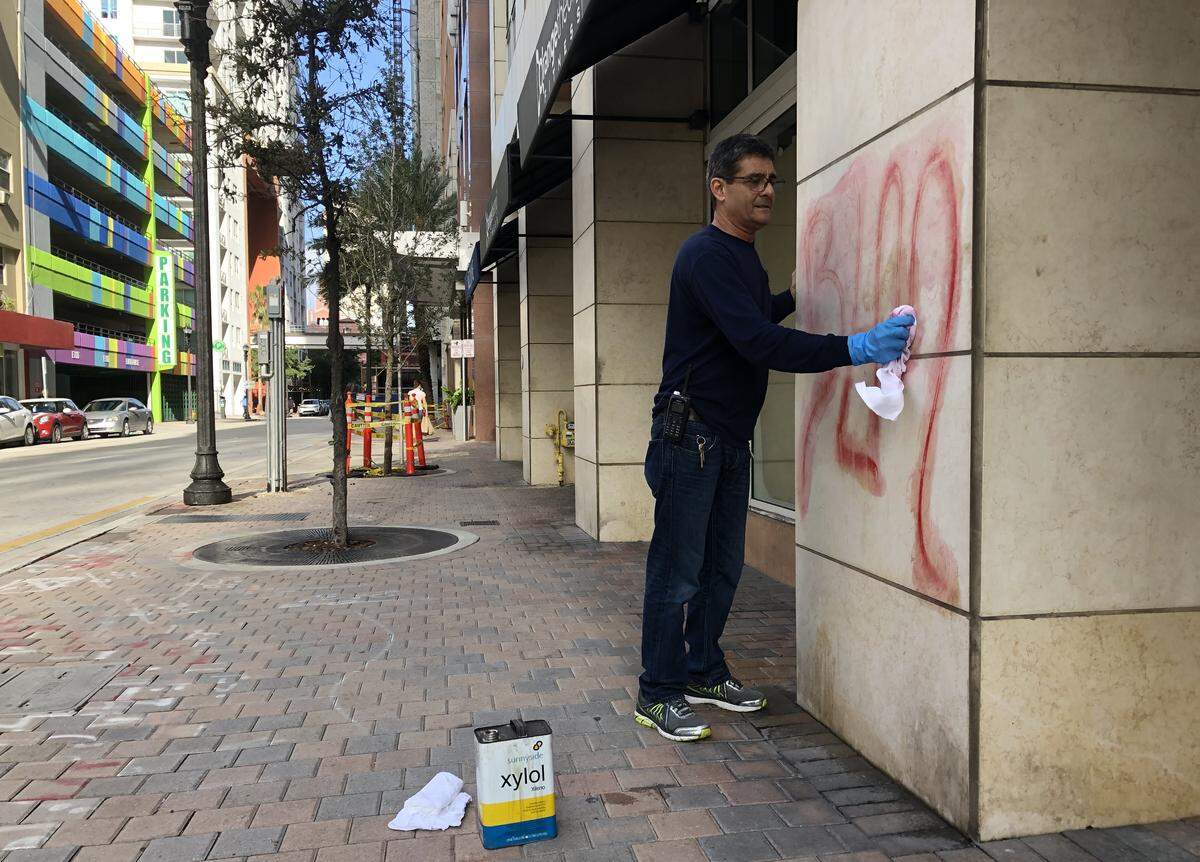
At the Vizcayne apartment building off Northeast Second Street, Angel Pena scrubbed thinner onto the wall tagged with the letters “BLM,” initials of the Black Lives Matter movement.
“It’s difficult,” he said. “This is good paint.”
The curfew will resume from 9 p.m. Sunday to 6 a.m. Monday, though cities can have stricter rules. The ciyt of Miami curfew begins at 8 p.m. Sunday.
After Saturday night’s emergency curfew went into effect at 10 p.m., police fanned out across downtown where protesters remained on the streets and others continued to vandalize and burglarize stores.
Police stood shoulder to shoulder and marched through the streets firing canisters of tear gas that could be felt for blocks. By 11:30 p.m., police had arrested more than a dozen people and mostly cleared the streets in downtown Miami.
The demonstrations in Miami unfolded as similar protests erupted in cities across the country to protest the death of Floyd, a black man who died after a white police officer held his knee on his neck for more than 8 minutes on May 25 in Minneapolis. Video of the encounter — which showed Floyd gasping and saying he could not breathe — went viral and has sparked national outrage about police tactics.
However, Miami’s protests did not appear to cause as much destruction or lead to as many arrests as demonstrations elsewhere, including Los Angeles and Atlanta but most notably in Minneapolis, where rioters looted stores, attacked officers and torched a police station.
Passionate crowds also gathered in other cities across Florida on Saturday.
In Tallahassee, the state’s capital, protesters chanting “no justice, no peace” marched to the city’s police department while a red truck with a Georgia tag plowed through the crowd. In Tampa, protesters berated police officers — and the media — but the gathering was peaceful.
A protest in Coral Gables, one of the county’s more affluent towns, drew a much smaller crowd, about 100 people. The protesters had coordinated with the city’s police department — which drew derision from some social-media activists.
Passing cars honked support. People cried “Hands up! Don’t Shoot!” and “Black Lives Matter” at the corner of Coral Way and LeJeune Road.
This story was originally published May 31, 2020 at 8:14 AM with the headline "Scenes of destruction — few injuries — on morning after Miami protest of George Floyd death."