
Florida Supreme Court approves congressional map drawn by challengers
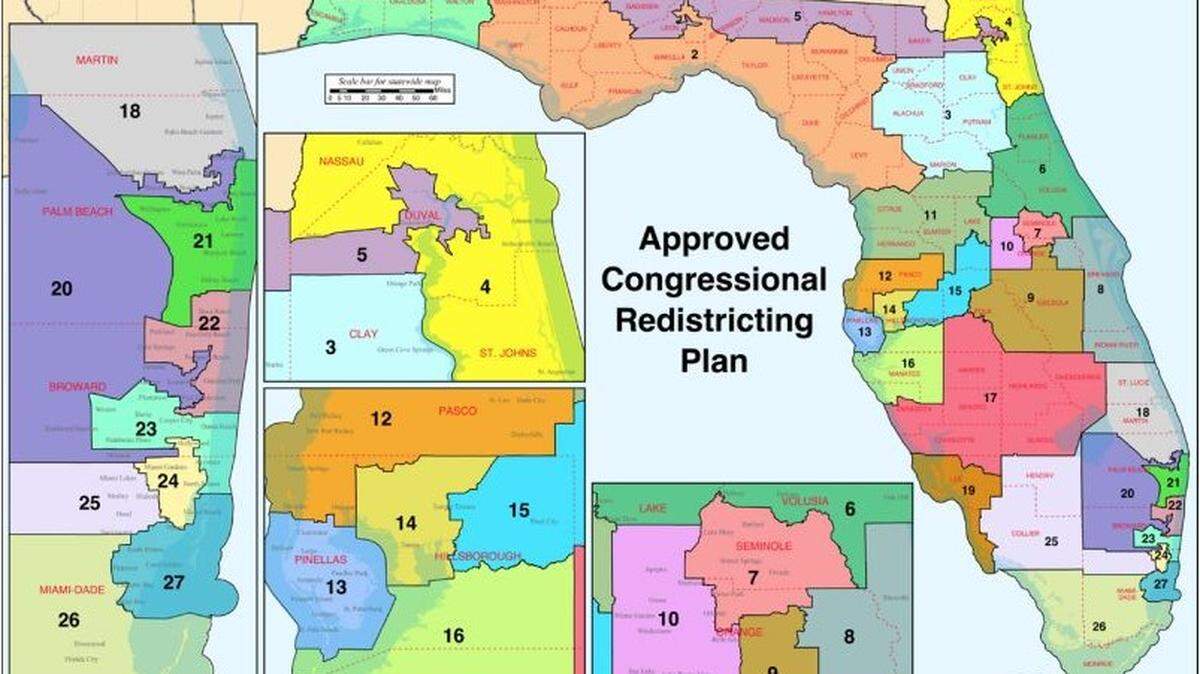
Saying it was putting "much needed finality" to Florida's congressional redistricting process, the Florida Supreme Court on Wednesday approved a congressional redistricting map nearly five years after lawmakers began the process.
The 5-2 decision, validated the map drawn by the challengers and approved by Leon District Court Judge Terry Lewis after the Florida Legislature tried and failed to agree to a map in a special redistricting session.
The map is now expected to be challenged by at least two members of Congress in federal court as U.S. Reps. Frederica Wilson, D-Miami, and Corrine Brown, D-Jacksonville, have already threatened a lawsuit for restricting the ability of their constituents to elect minorities to office. However, the boundaries are now likely to be those set for the 2016 election.
It has changed District 16, which includes Manatee County, to encompass all of Manatee County, the northern part of Sarasota County and the southern part of Hillsborough County. The district is currently made up of all of Sarasota County and most of Manatee.
"It's sad that I will no longer have the honor of representing the southern part of Sarasota County, but I'm looking forward to meeting the people of Hillsborough County," said Rep. Vern Buchanan, who has represented the area in Congress since 2007.
In Miami, the map creates new boundaries for Wilson and Miami Republican U.S. Reps. Carlos Curbelo and Ileana Ros-Lehtinen.
In Tampa Bay, the map merges most of Pinellas County into Congressional District 13, which includes former Gov. Charlie Crist's home. Crist has announced he is running for Congress.
In Central Florida, the changes will move the African-American minority-majority District 5 out of the region and into North Florida, the seat currently held by Brown. The previous configuration had allowed lawmakers to pack Democrats into that district and strengthen neighboring Republican districts.
The ruling also is likely to have a bearing on the pending redistricting challenge over the Senate maps. Leon County Circuit Court Judge George Reynolds has scheduled a five-day trial in Dec. 14-18 in which he will present a recommendation to the court.
Justice Barbara Pariente, who authored the landmark ruling in July that invalidated Florida's 27 congressional districts, also authored this opinion, directing her criticism at Justice Charles Canady and Ricky Polston who dissented with the majority of the opinion.
She rejected Canady's argument that the decision moves the "goalposts" on the Legislature in its redrawing of the districts.
"The goal has not changed and has always been compliance with the Fair Districts Amendment," she wrote. "At this stage, after a finding that the 2012 congressional redistricting plan had been drawn with improper intent, the Legislature bears the burden of justifying its redrawn configurations. The Legislature did not escape this burden when it was unable to agree on a plan to enact and subsequently asked all parties to submit alternative plans to the trial court."
While Canady agreed with part of the decision, Polston disagreed with the entire ruling as adopting a plan drawn by "Democratic operatives"; and chastised the court for violating the separation of power clause of the U.S. Constitution.
That is the same argument lawyers for the Legislature are making in opposing the maps proposed by the challengers in the Senate redistricting fight and the majority opinion specifically countered that claim in the congressional map, noting that there were only eight districts in dispute, all from South Florida, including two redrawn districts in which Democratic incumbents were actually paired against each other in the same district.
"From the outset, we have encouraged the public to submit proposed plans that can be evaluated by the objective criteria of the Fair Districts Amendment," the court ruled.
The ruling also emphasized that "this case does not pit this Court versus the Legislature, but instead implicates this Court's responsibility to vindicate "the essential right of our citizens to have a fair opportunity to select those who will represent them."
The ruling also chastised the Legislature for failing to follow the court's directive to emphasize transparency when it ordered to prepare proposed draft maps, nothing that contrary to the Court's suggested guidelines that "all meetings in which it makes decisions on the new map" should be held in public"; or otherwise recorded for preservation, none of the meetings during which staff developed the Base Plan in collaboration with counsel--as well as outside counsel--were recorded or transcribed."
Lewis rejected the Legislature's third attempt at redrawing Florida congressional districts last month and recommended a map proposed by the challengers.
The map leaves three sitting members of Congress in precarious re-election situations: Gwen Graham, a Democrat from Tallahassee; Dan Webster, a Republican from Winter Garden, and David Jolly, a Republican from Indian Shores. Jolly has already announced he will not seek re-election but is running for the Republican nomination to the U.S. Senate.
The August ruling declared the congressional boundaries used in the 2012 and 2014 elections were invalid because lawmakers had allowed improper interference by political operatives in violation of the Fair Districts amendments to the state constitution.
This story was originally published December 2, 2015 at 2:53 PM with the headline "Florida Supreme Court approves congressional map drawn by challengers ."