
Top Democrat releases first proposed redistricting map for Florida Senate
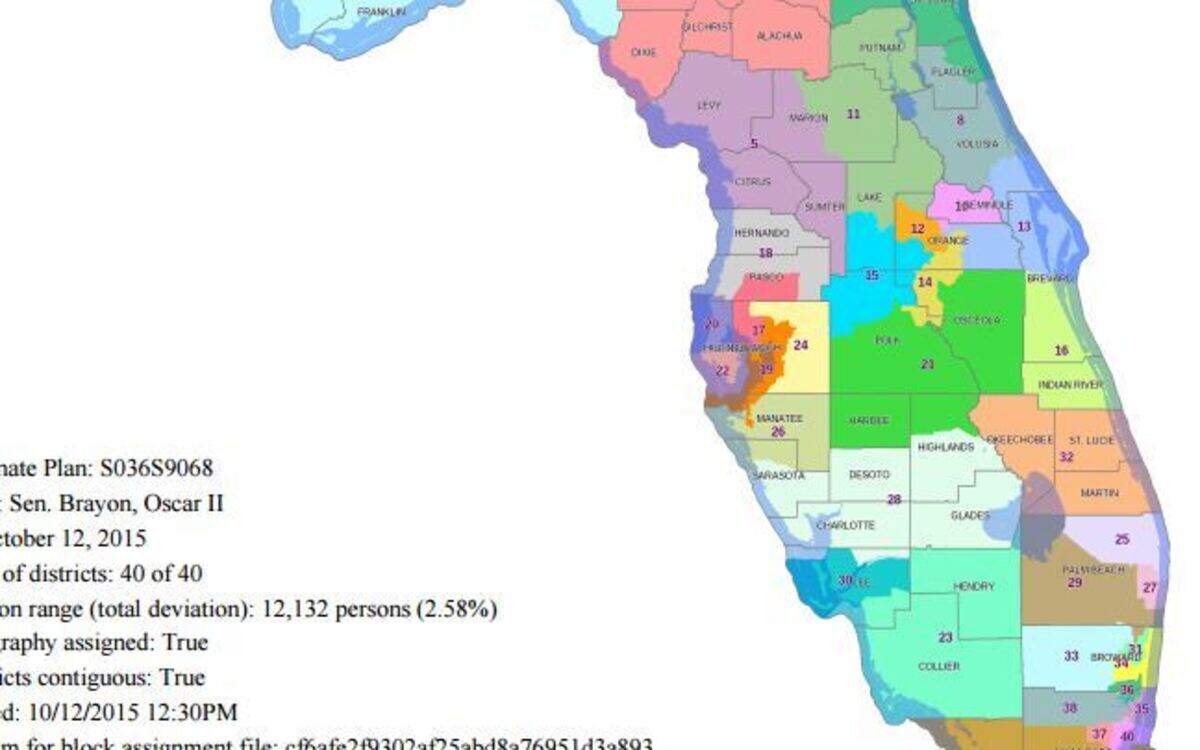
TALLAHASSEE -- Working alone with only a tape recorder and the Senate redistricting staff director, Democratic Sen. Oscar Braynon became the first to file a Senate map for the redistricting special session because, he said, he "wanted to prove that Democrats can draw maps too."
Whether Braynon's map will be accepted by the Republicans in the Senate is an open question but as the Senate's incoming minority leader Braynon said that if they really wanted to show their non-partisan stripes "they should accept my map."
Braynon, D-Miami Lakes, said he does not know how his plan performs for Democrats, because a functional analysis was not done on it. But he is confident it preserves the same number of minority majority and access seats and reduces the number of counties and cities that are split to do it.
"The comment was made it's a nonpartisan staff and we needed another option -- the last one we had was staff drawn with the help of the attorneys and those are the same attorneys that have been defending the other maps,'' Braynon told the Herald/Times. "So I thought maybe myself and a staff person without anybody involved in the lawsuit could come up with another option.''
The map, however, targets major changes to the three areas of the state that will be the pivot points for all debate and discussion in the upcoming special session starting on Monday: Tampa Bay, Central Florida and Miami Dade.
In Tampa Bay, Braynon asked the map drawer Jay Ferrin to start in the south and move north, west of the Everglades but, he directed, Districts 19 and 22 "must not jump the Tampa Bay." He then suggested that from the southern tip of Pinellas, the map must work north "rotating districts 20,17,24,26 clockwise, while respecting existing county boundaries of Pasco and Hillsborough counties."
Braynon said he specifically refrained from drawing coastal districts and instead preferred to follow municipal boundaries while also protecting minority districts, as required by the federal Voting Rights Act and the Fair Districts amendment to the Florida Constitution.
But if Braynon wanted to stay out of the Senate presidency fight between Republican Sens. Jack Latvala of Clearwater and Joe Negron of Stuart, his decision to carve up Sarasota County may have the effect of making it harder for a Latvala candidate, former Sarasota County Commissioner Nora Patterson, to win the district. But in other areas, he helps Latvala.
As for Manatee County, most of the county would be paired with northern Sarasota County in a new District 26. Sen Bill Galvano, R-Bradenton, who now represents a district that extends from Bradenton to include all of Hardee, DeSoto and Glades counties, and parts of Charlotte, Hillsborough and Highlands counties, would live in the new district.
Parts of Bradenton and Palmetto would be part of a new District 19 extending south from Tampa.
By creating a Hillsborough-based black majority seat, the configuration could also force Republican Sen. Jeff Brandes to run against Latvala in Pinellas County.
In central Florida, Braynon preserved the existing minority access seats of Senate Districts 12 and 14 but he dismantled the piece intended to benefit Senate President Andy Gardiner in District 13 by moving that population into neighboring Republican Districts 15 and 26, now held by Sens. Kelli Stargel and Galvano.
In Miami Dade, Braynon instructed staff to start in District 39, now held by Democrat Sen. Dwight Bullard, and "move northward east of the Everglades and stack districts horizontally, stopping at the Brevard County."
His proposal includes all of Collier and Hendry Counties in District 39 and dips into the southern edge of Lee Counties, decreasing the black voting age population of the district while increasing the number of Hispanics. The district now is a coalition district of both Hispanics and blacks that "probably performs for an African American,'' he said.
His plan also preserves the Hispanic-dominated seats of Districts 37, 38 and 40 -- now held by Republican Sens. Anitere Flores, Rene Garcia and Miguel Diaz de la Portilla -- but District 35, now held by Democrat Sen. Gwen Margolis would stretch into Broward County and District 34, now held by Democrat Sen. Maria Sachs would hug the coast of Broward County and then reach inland -- moving her out of her current Palm Beach County base.
Braynon's map leave much of North Florida exactly as it is today but instead of merging Democrat-heavy Alachua County with Republican-rich Clay County -- and pitting two Negron supporters, Sens. Rob Bradley and Travis Hutson, into the same district while merging Alachua with the much smaller rural counties of North Central Florida. In the Daytona Beach District 8, the more compact configuration could also makes it potentially more challenging for for Negron supporter Sen. Dorothy Hukill.
Braynon also divides Flagler to achieve the Republican district in the Northeast and in Orange County, the vortex of the Senate divide, he gives the county a piece of six different districts - including all of a Hispanic-dominated seat and a majority of an African-American, both Democrat heavy.
House and Senate leaders have said they will release five to six "base maps" drawn by staff this week, although they have refused requests by Senate Democratic Leader Arthenia Joyner to release the guidelines used to draw the map and tape recordings collected during the map drawing.
While the Senate has agreed to record all conversations between staff and map-drawers, the House refused to record redistricting conversations during the special session on congressional maps and a spokesman said Monday House members and staff have not changed that policy for the session on the Senate map.
This story was originally published October 13, 2015 at 8:38 AM with the headline "Top Democrat releases first proposed redistricting map for Florida Senate ."