
A key provision of Florida’s proposed property tax break may be unconstitutional
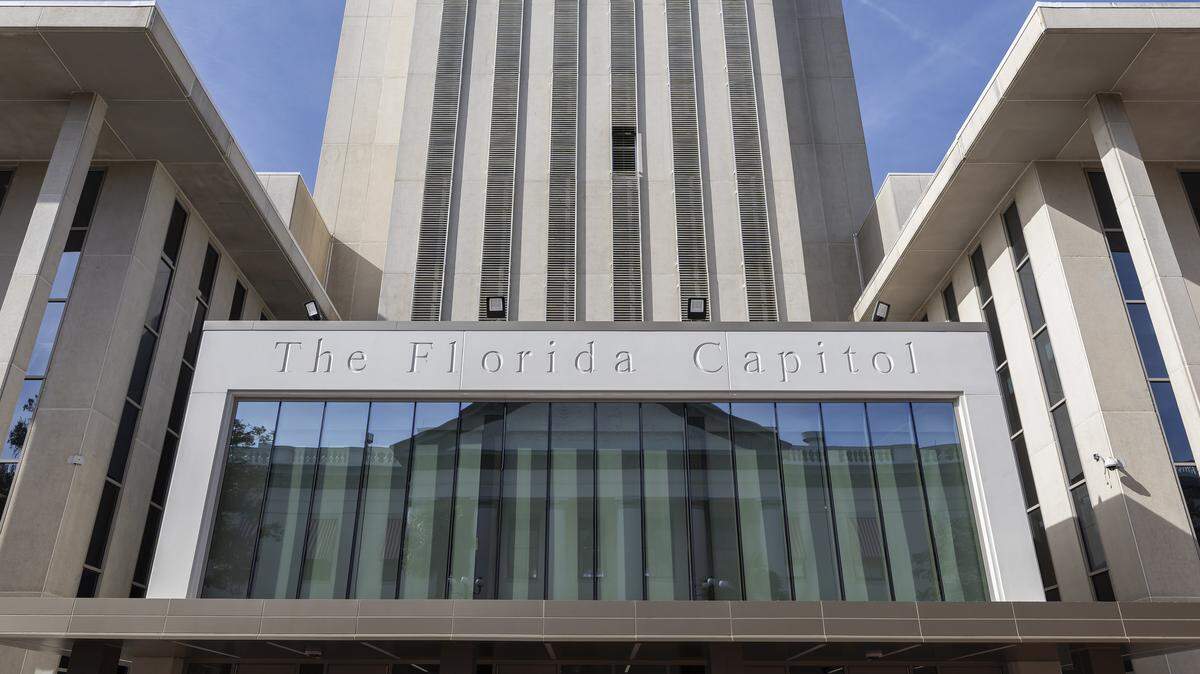
Gov. Ron DeSantis’ property tax proposal has a provision meant to entice Floridians at the ballot box in November: New residents will have to wait five years to benefit from it.
It’s not a new idea. But it could be an unconstitutional one.
More than 40 years ago, the Florida Supreme Court struck down a nearly identical five-year waiting period for new residents to benefit from a property tax break. It cited U.S. Supreme Court decisions that have consistently ruled that states can’t discriminate against their residents by limiting which ones can receive state benefits.
The provision is the latest question about DeSantis’ property tax plan, which would gradually raise the state’s homestead exemption from $50,000 to $250,000 in 2028. The amendment needs 60% of voters to approve it in November.
Two former elected officials sued the state last week, contending the ballot summary was misleading. Even the two GOP lawmakers who sponsored the amendment can’t agree on what it does.
During the less than 24 hours lawmakers spent questioning, debating and passing the proposed amendment earlier this month, little attention was paid to the legal issues surrounding the residency requirement.
According to the language lawmakers approved, only people who currently live in Florida or move here by the end of this year would benefit. Everyone else would have to wait five years. (It allows for local governments to shorten the time frame if it “is warranted for a critical local need.”)
DeSantis said he added that clause to make the amendment more appealing to voters who might be tired of the state’s recent population boom.
“I don’t want Floridians to go and see this on the ballot and say, ‘Oh man, I really would like the property tax relief, but I don’t want the entire state of Illinois to empty out into Florida or wherever because of this,’” DeSantis said last month.
Democratic lawmakers had the same feeling in 1980 when they added to the ballot an amendment that would raise the homestead exemption from $5,000 to $25,000 over three years. It, too, applied only to residents who had lived in the state for five years.
A Nassau County lawyer who was a new resident sued, saying he and other residents were being denied “equal protection” under the U.S. Constitution. The Florida Supreme Court agreed, finding the five-year waiting period unconstitutional because there was no “rational basis” for it to exist.
“It is constitutionally prohibited for this state to impose different taxes on its citizens based solely on their length of permanent residence in the state,” the justices wrote.
The justices also shot down the idea of trying to stop an influx of residents: “The avoidance of possible or excessive immigration of individuals to this state is clearly not constitutionally permissible.”
The court cited two important U.S. Supreme Court decisions. One, from 1969, found it unconstitutional for a state to impose residency requirements for welfare benefits. The other, from 1982, overturned Alaska’s decision to favor long-time residents when it began distributing revenues from its oil reserves.
DeSantis’ office didn’t respond to emails asking why the governor believes the amendment is constitutional.
Legal experts said the question of the constitutionality of residency requirements for taxes has long been settled.
“At first blush, this looks pretty unconstitutional,” said Robert McNamara, deputy litigation director at the libertarian-leaning Institute for Justice, which litigates across the country on economic liberty, free speech and property rights issues.
“Generally speaking, someone who has been a Floridian for five months is just as much a Floridian as someone who’s been there for five years,” he said.
During the special session this month, Democrats asked the Senate bill sponsor, Miami Springs Republican Sen. Bryan Avila, how the residency requirement could be constitutional. Avila pointed to lower-court decisions in Florida, including a 1st District Court of Appeal decision from 2000 in which out-of-state residents challenged Florida’s residency requirement to receive homestead benefits. The court upheld the residency requirement but did not address the issue of different requirements for people who were already residents.
“As a state, we’re given the discretion in order to lay out what tax exemptions to put in place within our tax code,” Avila told senators.
Former GOP Sen. Jeff Brandes, who has been a critic of the amendment, questioned the legality of the residency requirement on X.
“The constitutional right to travel means states don’t get to create first-class and second-class citizens based on when they crossed the state line,” he wrote.
DeSantis spokesperson Alex Lanfranconi responded on X that Brandes must be against the state charging out-of-state tuition for nonresidents.
Florida’s justices shot down that argument more than 40 years ago, noting that the U.S. Supreme Court had already ruled that tuition can’t be based on length of residency.
This story was originally published June 16, 2026 at 5:20 PM with the headline "A key provision of Florida’s proposed property tax break may be unconstitutional."