
A look at Ron DeSantis’ many changing arguments for redistricting in Florida
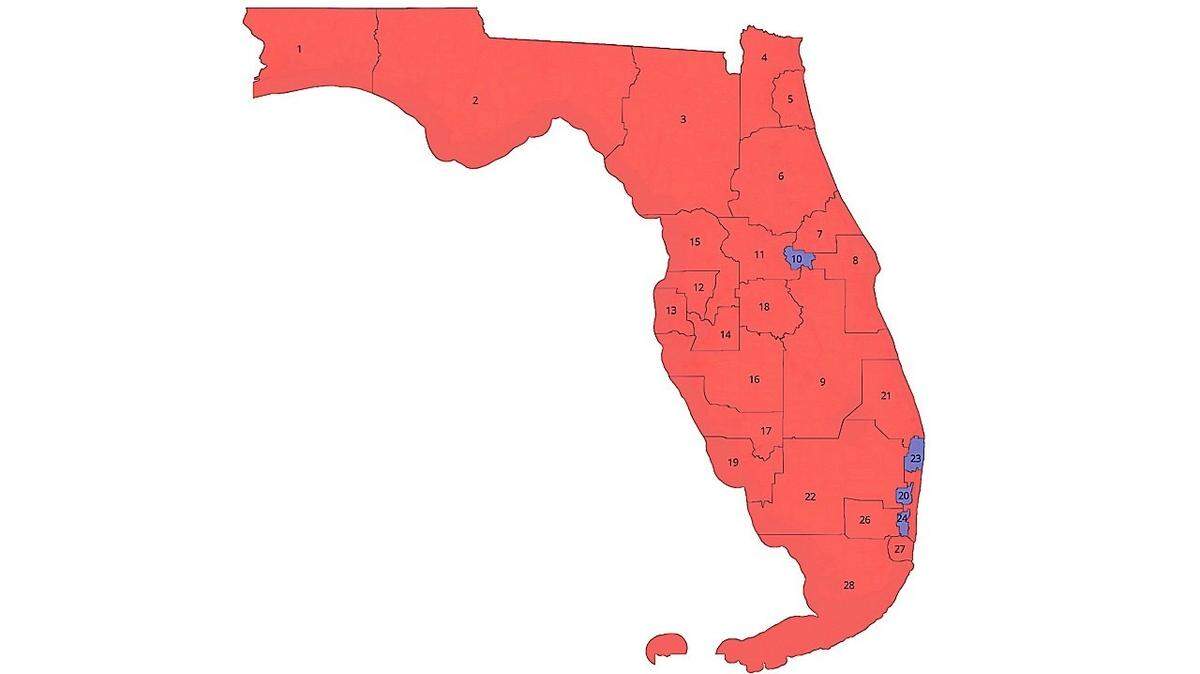
Florida lawmakers on Wednesday approved Gov. Ron DeSantis’ new congressional districts that could give Republicans four more seats in Congress.
But why they needed to do it was a question that was never really answered.
Since last year, DeSantis has given various reasons for not waiting until 2030 to redistrict. None of them, he said, included President Donald Trump’s call to states to redraw their maps to maintain the GOP’s control of Congress.
DeSantis’ latest reasoning emerged Monday — and the outcome could lead to blatant political gerrymandering in Florida and the elimination of the Fair Districts Amendment approved by voters in 2010.
Here’s what the governor has argued:
Reason 1: The current congressional map was bad
DeSantis first raised the idea of redrawing Florida’s congressional map in July last year.
“I do think it would be appropriate to do a redistricting here in the mid-decade,” he said.
The statement came a week after the Florida Supreme Court approved the current map — and a week after Trump called for Texas to redraw theirs to give Republicans five more seats.
Florida’s current map was drafted in 2022 by DeSantis’ office. It was challenged by plaintiffs who argued that it reduced Black voting power by dismantling a North Florida seat held by a Black Democrat. DeSantis argued the district relied too much on race.
The day of the court’s decision, DeSantis said on social media that it was “always the constitutionally correct map.”
But the next week, he said there could be problems with it.
“I think if you look at that Florida Supreme Court analysis, there may be more defects that need to be remedied, apart from what we’ve already done,” DeSantis said at the time.
He and his office then focused on South Florida’s District 20, where about half of the residents are Black. The district’s crab shape into Black communities is “a telltale sign of racial predominance,” his office wrote.
Reason 2: Florida was shortchanged in the census
Every state must redistrict every 10 years, when a new census is taken.
DeSantis said the 2020 census was flawed and undercounted people in the state. Florida should have gained two seats in Congress instead of one, he said in late July last year, Politico reported. (DeSantis resisted for months providing support toward counting Floridians during the 2020 census.)
In January, he announced a special session for redistricting, in part, “to ensure that Florida’s congressional maps accurately reflect the population of our state.”
But the map he introduced Monday does not give Florida another congressional seat — the state doesn’t have the ability to do that.
And the DeSantis staffer who drew the map told lawmakers Tuesday that he used the 2020 census data to do it. He said he was not allowed to use anything else.
Reason 3: The state’s population has shifted
DeSantis has also cited the fact that Florida has grown by about 1.8 million people between 2020 and 2025.
But as Democrats noted, that’s roughly the same pace as every other redistricting cycle. Florida has gained about 3 million people every decade since 1980 without doing mid-decade redistricting.
On Fox News Monday night, DeSantis also mentioned that redistricting was needed to remedy population changes within each district.
“District 14, for example, had about 100,000 votes less than District 12 right next to it because we’ve had growth in certain parts of the state,” DeSantis said.
Jason Poreda, the DeSantis staffer who created the map, told lawmakers that he used state demographic data to adjust districts based on how fast they were growing.
The reason why the the redrawn District 16 stretches nearly 90 miles from the southern part of Pinellas County into rural Central Florida, he said, is because it’s one of the slowest-growing counties in the state. He decided not to combine it with neighboring Hillsborough County because Hillsborough is a “much faster growing county” and should have its own district — the redrawn District 14.
However, he left unchanged the two districts that split northeast Florida’s St. Johns County — the fastest-growing county in the state, a Democrat noted. Poreda, whose map left all the north Florida districts unchanged, said he was “trying to mitigate the changes as much as I can.”
“It just wasn’t necessary,” Poreda said.
Reason 4: A pending Supreme Court decision
DeSantis in January said the special session on redistricting was needed “to comply with an upcoming U.S. Supreme Court ruling.”
That court ruling involves a Louisiana redistricting case that DeSantis believed would strike down part of the Voting Rights Act that allows states to draw districts based on race for the purpose of addressing historic discrimination.
DeSantis general counsel David Axelman wrote to lawmakers on Monday that “the use of race in redistricting” is “something that the U.S. Supreme Court has signaled is unconstitutional.”
Poreda told lawmakers that he used all kinds of data — including political data — to draw the map, but did not use race.
However, DeSantis issued the map on Monday without the U.S. Supreme Court releasing its ruling.
And when the ruling came out on Wednesday, the justices sharply limited the use of race in redistricting but didn’t explicitly ban it outright, as DeSantis was expecting.
Reason 5: The Fair Districts Amendment is illegal
On Monday, Axelman revealed what appears to be DeSantis’ ultimate goal: undoing the Fair Districts Amendment to the state constitution that was approved by 63% of Florida voters in 2010.
The amendment says congressional districts cannot be drawn with the intent to favor a political party or incumbent, or with the intent to deny the rights of racial or language minorities, among other requirements.
The map DeSantis introduced was not drawn to adhere to the amendment’s requirements, his staffers said.
Axelman wrote that the amendment means that race must be considered when drawing up districts, which he contended would be unconstitutional. (The U.S. Supreme Court appears to agree in its recent ruling.)
If one part of the amendment is unconstitutional, then all of it must be tossed out, Axelman wrote — including its prohibition on political gerrymandering.
“Because one part is unconstitutional, there’s little reason to think that voters would have approved the remaining parts by themselves,” Axelman wrote.
However, no lawmakers seemed persuaded by that argument — including the Senate sponsor of the map, Niceville Republican Sen. Don Gaetz.
Gaetz, a former Senate President, said he attended 26 hearings on the amendment at the time and that voters did not view it as one complete package. Voters liked various parts of it.
“I believe that the rest of the Fair Districts Amendment could, and should, and ought to stand,” Gaetz said Wednesday. “I don’t think we should do gerrymandering on the basis of political partisanship.”
This story was originally published May 1, 2026 at 9:00 AM with the headline "A look at Ron DeSantis’ many changing arguments for redistricting in Florida."