
Sen. Marco Rubio hopes Iowa caucuses a tipping point for political momentum
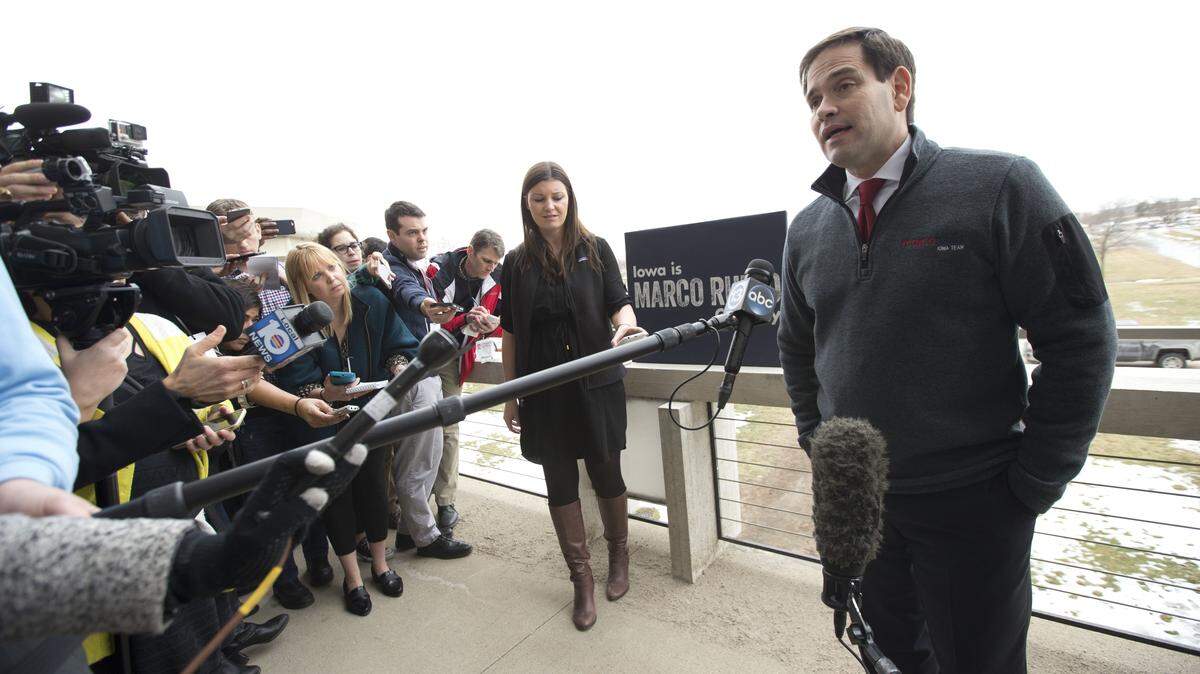
DES MOINES, Iowa -- Marco Rubio isn't expecting to win the Iowa caucuses Monday night -- the first test in the 2016 presidential election -- but the state is crucial to his strategy of building momentum in what he is convinced will be a drawn-out battle for the Republican nomination
A strong showing will propel him into New Hampshire and South Carolina while a weaker one could hobble his chances, underscoring his risky gamble of not focusing on one early nominating state.
No other candidate may have as much riding on Iowa, and Rubio, who has failed to deliver the breakout moment many projected months ago, showed it in recent days. He went on a tear, holding town halls, injecting his stump speech with urgency and highlighting his faith in an appeal to evangelicals.
"I've got more to think about now," said an impressed Jay Jackson, 44, who showed up Tuesday to see Rubio in Marshalltown, one of four town halls the presidential candidate held that day.
Jackson likes Ted Cruz, who is ahead of Rubio in the polls, but said questions about Cruz's temperament left doubt. "Angry is a buzzword," Jackson said. Rubio has sounded angrier, too, but overall presents an optimistic message and vows to unite the GOP, a line that resonated with Jackson.
Rubio needs Jackson -- and hordes of other Cruz supporters -- to caucus for him Monday. If Rubio can come in second to Donald Trump, it would be a major boost heading into next week's primary in New Hampshire, perhaps making it a two-man race for the nomination.
Rubio's campaign, though, is planning on third place and a long slog to the nomination.
"Any time you start a campaign with, what, 17 candidates, no one should expect to have it wrapped up after a state or two votes. We think this is going to go on for several months," Rubio's top strategist, Todd Harris, said in an interview Wednesday after an event in a West Des Moines bar that attracted more than 300 people.
Establishment hope
Rubio remains, for the moment, the establishment's best hope for snatching back control from Trump or Cruz, whom many party leaders fear would squander a chance to win the White House. If he can overtake Cruz, the party will rally behind him. Money will pour in.
Rubio had a strong close in Iowa, picking up the endorsement of the state's largest newspaper, The Des Moines Register, and drawing bigger crowds.
"There's a breeze behind him," said Matt Strawn, former chairman of the Iowa GOP who is unaffiliated with a candidate. "It just feels like Rubio is poised for a stronger finish than not."
For all the campaign talk about "Marcomentum," Rubio has not had the breakout long expected. Content to fly under the radar, and away from Trump's wrath, he remains stuck in third place in national and state polls.
The furious pace he set last week came after steady criticism that he was not showing enough hustle on the ground, not venturing far from Des Moines and relying heavily on TV ads and Fox News appearances as he was overshadowed by Trump and Cruz.
"I don't think anyone winning Iowa makes them unstoppable," Rubio said Friday, trying to manage expectations.
A solid finish in Iowa by Rubio will be compounded by an increasingly competitive second tier in New Hampshire, which holds its primary Feb. 9. Then it's on to South Carolina, a state where Rubio's hawkish foreign policy views would play well but is also favorable to Trump and viewed as prime territory by Florida rival Jeb Bush, who is counting on New Hampshire for momentum.
"The goal is to have more than half the delegates to the convention be pledged to me. That's what I believe we're going to achieve," Rubio told a television station in Cedar Rapids, outlining a strategy that would need strong showings in contests across the South, including Florida, on March 15.
Yet consider the history Rubio, 44, is trying to overcome: No Republican has captured the nomination without winning Iowa, New Hampshire or South Carolina.
'Natural Momentum'
"All of these calculations being made by people saying Rubio can go the distance, are people who have completely ignored voter psychology," prominent conservative commentator Erick Erickson said in an interview before Thursday's Republican presidential debate in Des Moines.
"People are saying the normal rules of politics don't apply anymore. I think they do. Voters want a winner. That's why you are seeing people go to Trump."
Iowa blogger Craig Robinson, who earlier criticized Rubio for not campaigning hard in the state, said: "He's got some natural momentum. But I struggle with his 3-2-1 strategy," a reference to an idea floated by people close to Rubio (and subsequently denied by the candidate) of his finishes in Iowa, New Hampshire and South Carolina.
"What professional sports team goes out there and says 'We want to finish third in the division this year?' " Robinson said. "People who are supporting Jeb Bush and Chris Christie can be convinced, 'Hey, I want my vote to matter.' Viability is a big factor and Rubio's got it. He needs to use it."
Optimistic message
Rubio has been reaching beyond the primary, portraying himself as the inevitable nominee and casting the fight between Trump and Cruz as a "sideshow" that would detract from defeating Hillary Clinton, whom he "can't wait" to challenge.
"I think both parties are messing up America," the first-term U.S. senator said at the bar in West Des Moines. "I think Washington is out of touch."
Rubio launched his campaign in April with an optimistic message anchored by his Cuban immigrant parents' American Dream story. But Rubio has tried to straddle that optimism with the gloomier outlook of his rivals.
In Iowa last week, Rubio told audiences President Barack Obama has tried to "transform" America. He sought to cover up his support for comprehensive immigration reform by playing to fears about terrorists infiltrating the United States. The Roman Catholic began highlighting his faith and bemoaning popular culture values being "shoved down our throats."
Rubio's strongest point remains his personal narrative, the son of working-class parents who can make it in a country that favors the rich (Trump) and politically privileged (Bush).
"We love his message of American exceptionalism," said Rich Gauthier, 44, who attended the event in West Des Moines with his wife, Julie. "There's so much harsh rhetoric. Marco makes the Republican Party bigger."
That's partly Rubio's problem. By trying to appeal to all corners of the GOP -- tea partiers, social conservatives and the establishment -- he has no natural base to spring from.
He's also been hurt by incessant attacks from Trump and Cruz, who launched an ad last week highlighting Rubio's role in writing the Senate's comprehensive immigration bill, and by more than $20 million in TV spending from a super PAC supporting Bush.
"All you hear is Right to Rise, Right to Rise," Julie Gauthier said, referring to the PAC's name. "Bush might as well have lit the money on fire."
Indeed, the former Florida governor has struggled in Iowa, and is near the bottom in polls.
Bush, who had his strongest debate on Thursday, has gained in New Hampshire, complicating Rubio's strategy. Other mainstream Republicans, including John Kasich and Chris Christie, are also showing life in the Granite State.
That puts pressure on Rubio to do well in Iowa.
This story was originally published January 30, 2016 at 12:00 AM with the headline "Sen. Marco Rubio hopes Iowa caucuses a tipping point for political momentum ."