New facility will turn Manatee County’s trash into renewable energy. Here’s how
A new facility at Manatee County’s landfill will transform “waste to worth,” generating enough energy to power thousands of homes and up to $1.7 million per year in revenue, county officials say.
Manatee County Government has reached an agreement with two companies, Nopetro Energy and Johnson Controls, Inc., to use space at the Lena Road Landfill for a $50 million facility that transforms landfill methane gas to renewable natural gas.
Manatee County will not be responsible for any costs for at least 20 years, per the agreement approved by county commissioners on Oct. 7 with a 5-1 vote. Commissioner Jason Bearden voted in opposition, and Commissioner Bob McCann was absent.
The “Renewable Natural Gas (RNG): From Waste to Worth” project gives the county a new revenue source while cutting the landfill’s carbon footprint from the landfill waste that’s burned off. Five full-time jobs are also expected to be created with the new facility.
The county’s annual revenue from the renewable natural gas production is expected to be as high as $1.7 million, according to county officials.
Construction is slated to start in 2026, and the companies plan to have the facility online in late 2027.
Landfill facility to produce energy from trash
At the Lena Road Landfill, the county burns waste through “flaring,” and carbon dioxide is a byproduct. About 75% of that flared methane gas is emitted into the atmosphere as carbon dioxide, while the other 25% is used to power part of the county’s wastewater operations, according to county staff.
According to the Environmental Protection Agency, methane released from solid waste landfills is the third-largest human-generated source of methane emissions in the United States, and is “a potent greenhouse gas that is a key contributor to global climate change.”
To offset that amount of carbon dioxide emission would require 22,000 acres of forest, or the size of Duette Preserve, a presentation from county staff in October stated.
However, with Nopetro’s facility, carbon emissions will be slashed and, instead, repurposed into natural gas and a profit for Manatee County.
“It basically takes landfill gas that’s currently being flared into the atmosphere from the landfill – from everyone’s trash, food waste, et cetera — and turns it into a revenue source for Manatee County,” said Travis Payne, Nopetro’s senior vice president for renewable natural gas development. “They’re currently making nothing from this, and they’re going to end up with a revenue source over the 20-30-year life of the project.”
Payne said this isn’t a new technology, but he’s seen a growth of renewable natural gas facilities across the county.
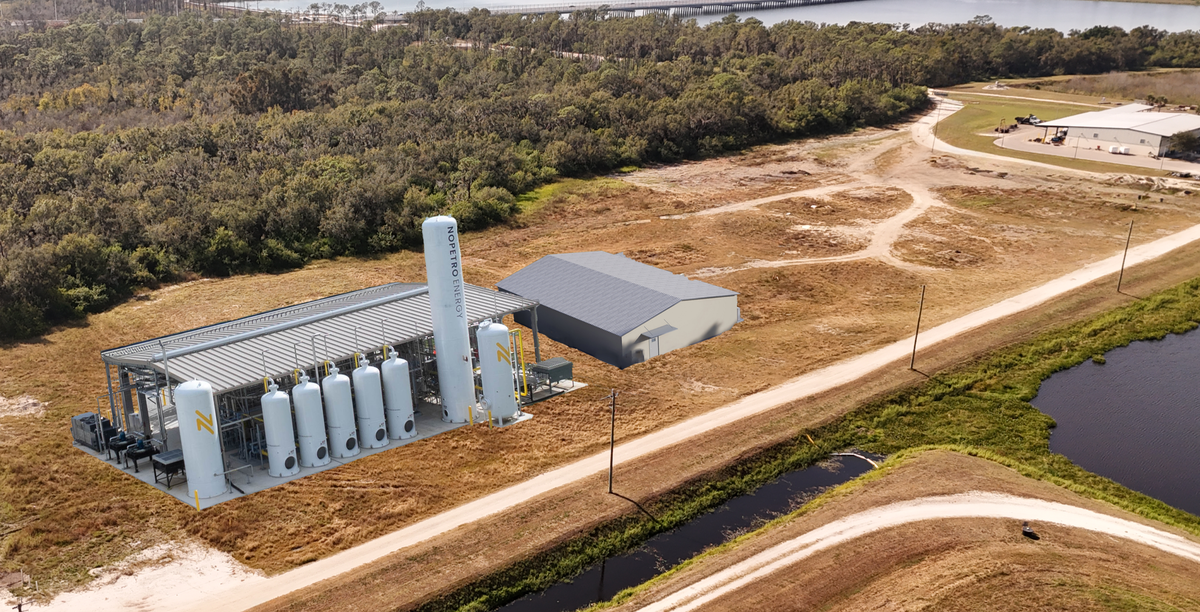
Nopetro operates a similar facility in Indian River County, and the Manatee County plant will be similar in size, Payne said — a less-than-2-acre site.
.jpeg "Sept 1 Pic 2 (1).jpeg")
How does renewable natural gas work?
The facility captures natural gas from the waste that’s flared at the existing landfill before it enters the atmosphere. That gas is “cleaned” through the system and then is injected into the Florida Gas Transmission pipeline.
“We put it into the pipeline, and it’s actually a local source of fuel for the natural gas company, which is TECO Peoples Gas,” Payne said.
The natural gas captured from Manatee County’s facility will be enough to power about 4,500 homes per year, according to the project team.
According to a news release from Manatee County Government, the project will also generate “environmental attributes,” which include renewable energy credits and carbon offsets. The attributes can be sold and “represent measurable reductions in greenhouse gases and reinforce Manatee County’s commitment to sustainability,” county officials said.
Commissioners approve agreement for facility
The idea has been in the works since at least 2023, when the Board of County Commissioners approved the initial idea to turn Lena Road Landfill’s methane gas to renewable natural gas. Bearden voted against the project at the time.
County staff then needed to find a partner to bring the project to fruition. Johnson Controls, Inc. began a performance audit in January 2024 and completed a report in February 2025.
In October, Manatee County commissioners approved a 20-year agreement with Nopetro and Johnson Controls, Inc.
Most board members supported the idea, including Commissioner George Kruse, who described it as a low-risk opportunity with high return.
“We’re talking about trying to lower property taxes, we’re talking about trying to come up with other revenue sources,” Kruse said. “This is a free revenue source on stuff that we’re currently, literally burning off. I never have seen the meaningful downside.”
However, Bearden questioned what would happen with the facility if the investors were to walk away. Since the project is to be built on county-owned land, Bearden also raised concerns about whether a bank could take the land in a hypothetical lien situation.
“I hope that this thing is so successful, I hope you guys prove me wrong. But I’m going to go with my gut on this one,” Bearden said.
Bearden cast the only dissenting vote for the project.
While the natural gas facility will help slash the landfill’s carbon emissions, the landfill is still experiencing capacity issues.
According to the most recent aerial surveys from January, the landfill has a little more than 23 million cubic yards of capacity remaining, which is about 32 years, a spokesperson for the county said. That means the anticipated closure of the landfill is mid-2057.