
In Florida, sea level is rising. Here’s what political hopefuls say they will do about it
The global rate of sea level rise is accelerating, and Floridians are already feeling its effects.
Driven by climate change, sea level rise is expected to become increasingly dramatic in coming years. By 2020, sea level will be 6 to 12 inches higher than in 1992, and by 2060 it could be 34 inches higher, according to Florida Sea Grant.
On Monday night, seven local candidates running for political office in the 2018 elections shared how they plan to address the issue at a Tidal Town Hall in Sarasota.
Co-hosted by non-profit organizations Union of Concerned Scientists, ReThink Energy Florida and First Street Foundation, Tidal Town Halls were created to make up for a lack of discussion surrounding sea level rise during typical televised political debates. The Sarasota event was one of 14 held around Florida.
Invitations to the bipartisan event were extended to all local political candidates. In attendance from Manatee County were Tracy Pratt, Democratic candidate for Florida House District 71; Liv Coleman, Democratic candidate for Florida House District 73; and Candace Luther, non-party affiliated candidate for Manatee County Commission, District 6.
David Shapiro, Democratic candidate for the U.S. House, was also slated to attend but instead went to a nearby vigil for victims of the shooting at a Pittsburgh synagogue on Saturday.
The only Republican candidate to attend was North Port city commission candidate Kevin Rouse.
St. Petersburg-based political strategist Barry Edwards moderated the event, asking candidates several prepared questions before taking questions from the crowd.
The forum addressed a broad spectrum of sea level rise related issues, from promoting responsible development and restoring natural ecosystems to mitigating property tax revenue losses and finding the funding for preventative measures in Sarasota and Manatee counties.
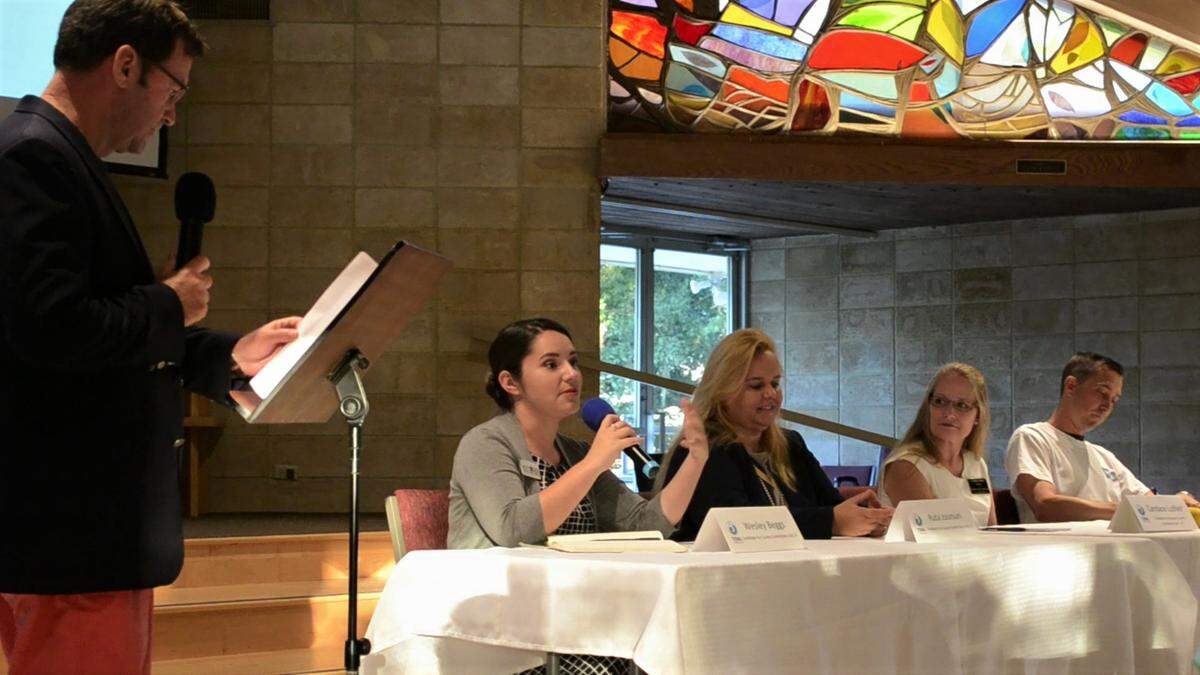
The first panel consisted of county and city level candidates, and the second panel consisted of candidates running for state government.
Here are some of the questions and candidates’ responses:
What can we do now to protect and mitigate against climate change?
“An entire neighborhood had three feet of water in their homes last year that wasn’t even from Irma, it was from the storm that we had before that,” said Manatee County Commission candidate Candace Luther.
“I’ve actually talked to the people that are working on supposedly correcting this problem, and I’m not convinced that there’s going to be a solution from what they’re doing. They’re looking at documents from the ‘70s trying to fix a problem that’s happening now.”
Luther proposed limiting development and bringing on new engineers for Manatee County. Luther also suggested the need for a stronger focus on solar power in Manatee County and throughout Florida.
How are humans affecting sea level rise?
“Overpopulation. Overbuilding,” Luther said.
“Humans are also creating phosphate mining in Manatee County, which is a big problem, because the more water they keep sucking out of the aquifer and dumping out into the Gulf, we’re getting more and more pollution being dumped into the Gulf and more water being dumped into the Gulf. The water that used to be in the aquifer is no longer in the aquifer, it’s now somewhere else. Displacement is not working.”
This summer, algae blooms and red tide once again threatened our tourism industry, the health of us that live near the beaches and the water, and threatened the health of our freshwater lakes, canals and beaches. The Florida Legislature has been trying to deal with this for several years. If you are elected, what would you champion in the legislature?
“I think the answer to this is science. We can’t just hope and pray that this is all going to go away. The reality is we need to be looking to experts,” Pratt said.
“We’ve had extreme deregulation that has just allowed polluters to run rampant, and we’re all paying the price for it. Our waters are our economy, our health, our quality of life, they’re the reason that we like to live here in beautiful Florida.
I would like to see this area become a gem of scientific innovation.”
What should we do today to ensure that a post-disaster rebuild, if and when necessary, will increase resilience?
“We know that because of climate change and its effects we are having more storms and more intense storms because of the warming of the water,” Coleman said.
“So we need to make sure that we’re building more resilient communities, but we also need to make sure we’re ready with the resources to respond, too. Make sure that we have money in the bank, ready to go, so that we can start addressing disasters when they happen. We need to be proactive so that we’ve got smart growth and planning and so that we’re keeping our building codes up to speed and making sure people are safe, because this is increasingly a risk to our health and safety.”
There was no real debate or disagreement between any of the candidates on Monday night. Instead, they built on one another’s statements and took the opportunity to answer questions from voters.
The night ended with some words from ReThink Energy Florida co-founder Brian Lee.
“Those of you who watch candidate debates,” said Lee, “I’m sure you might remember the exact number of questions that were asked about sea level rise, because it’s a real easy number to remember. Zero. That is why we are holding events like this.”
Full video streams of Tidal Town Halls can be found at facebook.com/ReThinkEnergyFL.
This story was originally published October 30, 2018 at 7:39 AM.