
Navy’s P-8A Poseidon builds a high profile in Pacific with secret flights
Navy’s P-8A Poseidon builds a high profile in Pacific with secret flights
KADENA AIR BASE, JAPAN -- Professional silence is part of the job description for sailors when they fly the Navy’s newest surveillance jet over disputed territory in the western Pacific. That’s what the Pentagon demands when it asks crews to search for submarines in a testy corner of the world.
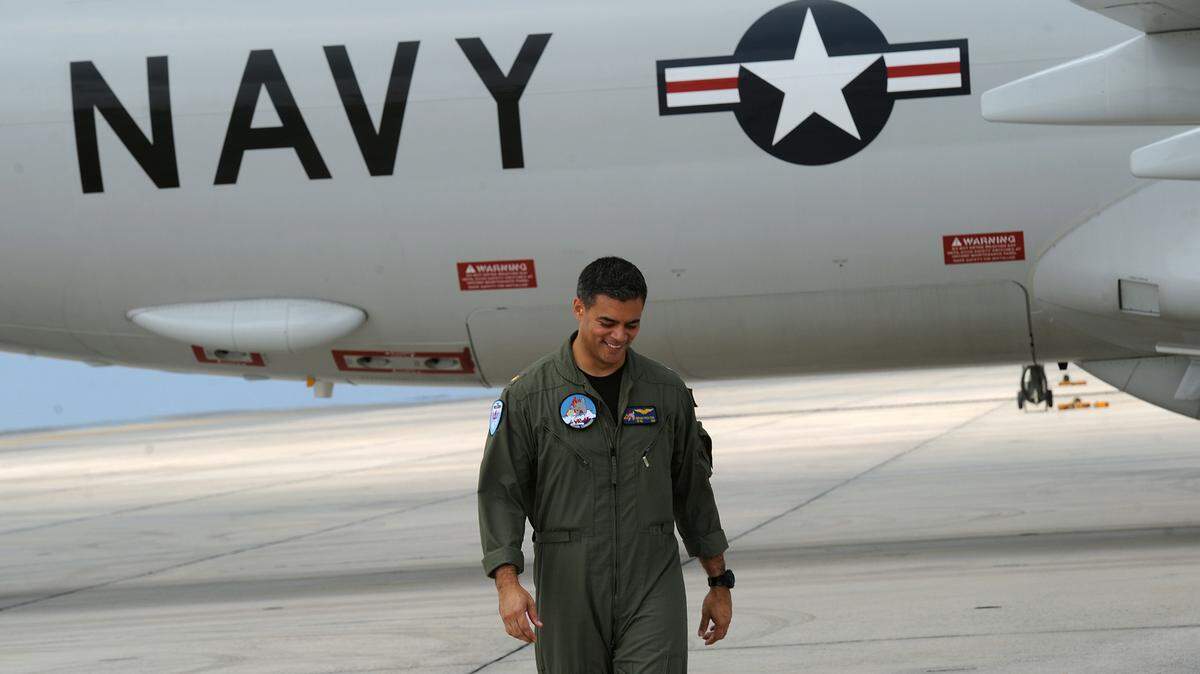
“Every mission we fly out of here is classified,” Cmdr. John Weidner said as he invited a team of reporters on one of his P-8A Poseidon jets during his deployment to Japan last August.
The flights may be secret, but his jets are receiving a lot of attention these days.
They’ve been some of the Pentagon’s eyes and ears gathering evidence of China’s military expansion in the contested waters of the South China Sea, where China has swelled the scale of small atolls in territory recently claimed by neighboring nations.
Flights from Weidner’s squadron over those islands have been among the most visible assignments handed to the P-8A Poseidon since it started coming off Boeing’s production line in Renton, Wash., and joined the Navy’s fleet three years ago.
The commander of the Navy’s Pacific Fleet joined him on one. The Defense Department later trumpeted Adm. Scott Swift’s observations from the mission.
“There are forces of instability at play in the region, and that’s generating uncertainty,” Swift told reporters in July, using language meant to suggest that China’s expansion had worried American allies in the region.
Dozens more Poseidons are in line to be built on Boeing’s $33.5 billion contract. About 40 of them eventually will be flying out of Naval Air Station Whidbey Island, Wash., where the Navy has spent about $120 million preparing for them since 2013. The first ones are expected to arrive there next fall.
The jet is a militarized version of Boeing’s 737 equipped with advanced radars and intelligence gathering devices. Today, all of the Navy’s active Poseidons are based at Naval Air Station Jacksonville in Florida.
The jets are packed with 129 sonobuoys - floating sonar devices - that sailors can drop in the ocean from a chute in the rear of the plane to find submarines hiding out deep underwater. They also can drop depth charges, torpedoes and anti-ship harpoon missiles.
The Poseidon is a replacement to the P-3 Orion, a maritime patrol plane that’s been in the Navy’s fleet since the 1960s. The Orion is well-loved by many sailors in Navy air, but its escalating maintenance costs compelled the Pentagon to start looking for an alternative a decade ago.
Now, the Defense Department is spending about $2 billion a year in the Puget Sound region to continue building Poseidons.
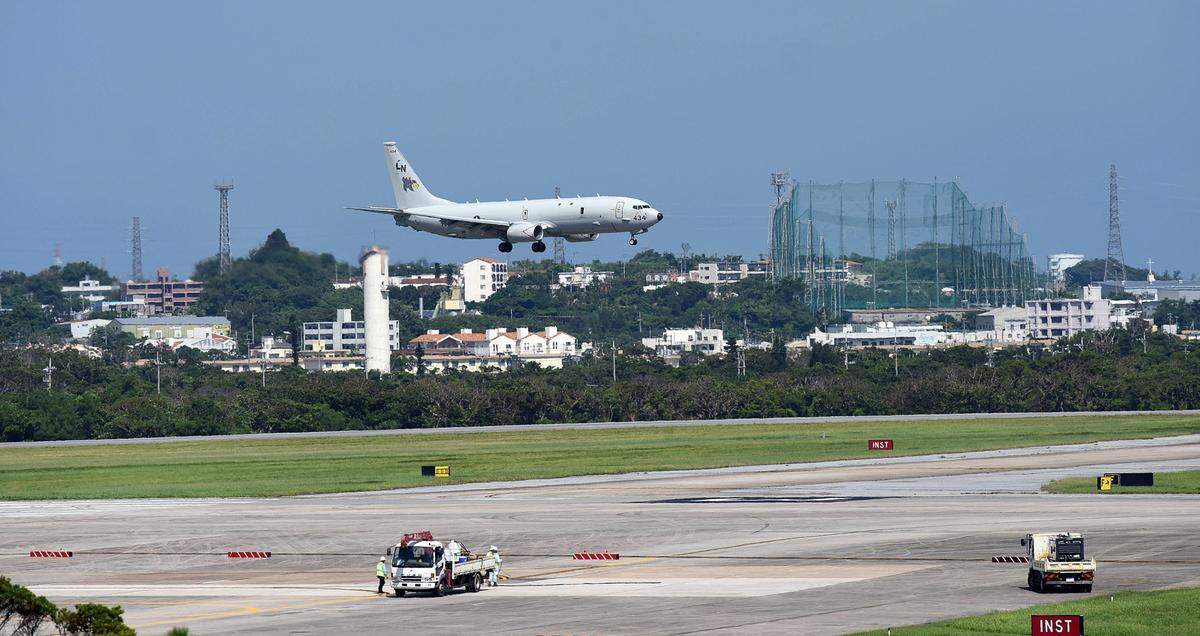
Weidner’s crews from Patrol Squadron 45 spent much of the past year at Kadena Air Base on the Japanese island of Okinawa. It’s home to the Air Force’s largest combat wing and it’s one of the main seats of American military power in the Pacific. The Navy has kept a rotation of about six Poseidons there for the past two years to boost its intelligence-gathering arsenal in a region that’s seeing a broad international military buildup.
On Okinawa, military contractors who work on the jet can be identified with patches that show an angry-looking Greek god of the sea underscored with the phrase “Made in Seattle.” It’s similar to the patch worn on the uniforms of Poseidon crews.
Several members of Weidner’s squadron had experience with the Orion. They said the main advantage of the new jet is its ability to fly farther on their patrols, as well as updated technology it contains that Weidner likened to owning the latest, easiest-to-use smart phone.
“We can go a lot farther, a lot faster,” said Lt. Andrew Lee, a P-8A pilot who has flown its predecessor.
Plus, “it flies a lot more comfortably than the P3s,” said Petty Officer 1st Class Dany Scully, who has served in the Navy 19 years with much of that time on the Orion.
The Navy in May released a video a P-8A crew recorded flying over suspected Chinese military bases in the South China Sea. It also invited a CNN crew on one of those flights last spring. That mission spurred warnings from the Chinese military that it could provoke an armed response.
After those flights, the military rejected requests from reporters to accompany P-8A crews on similar assignments. Weidner and one of his crews opened up one of the jets for a tour on the ground.
The sailors couldn’t say much about the specifics of their flights, but their faces seemed to light up when they described their core task of finding submarines. That’s a growing challenge in the western Pacific, where China and other nations have ambitious plans to grow their navies.
“My job is to track the submarines. If we have to hunt for the submarine, we find it. Usually it works out pretty well,” said Petty Officer 2nd Class Austin Lien, 27.
“We are the most advanced, most capable aircraft to do it,” added Lt. Cmdr. Brian Fichter, a flight officer.
A Poseidon crew typically has nine sailors with three pilots, two flight officers and four technicians who track radars, acoustic devices, cameras and electronic communications signals.
“This is where we earn our paychecks,” Fichter said as he gestured to the panels where the technicians work.
Aside from the flights over contested territory, the Navy also has promoted several humanitarian missions that the Poseidon has been assigned. It helped search for the remains of Malaysia Airlines Flight 370, which disappeared in March 2014.
It also has collaborated with American allies on the Pacific at military exercises to work through how they might share information in battle or in a natural disaster.
Like the Orion before it, the Poseidon won’t operate only at sea. It has instruments to collect electronic communication signals, which the military uses in conflict areas such as Afghanistan and Iraq. The squadron at Kadena last summer anticipates an assignment in the Middle East before it’ll return to the Pacific.
This story was originally published November 25, 2015 at 12:55 PM.