
High court seems ready to scrap mandatory public union fees
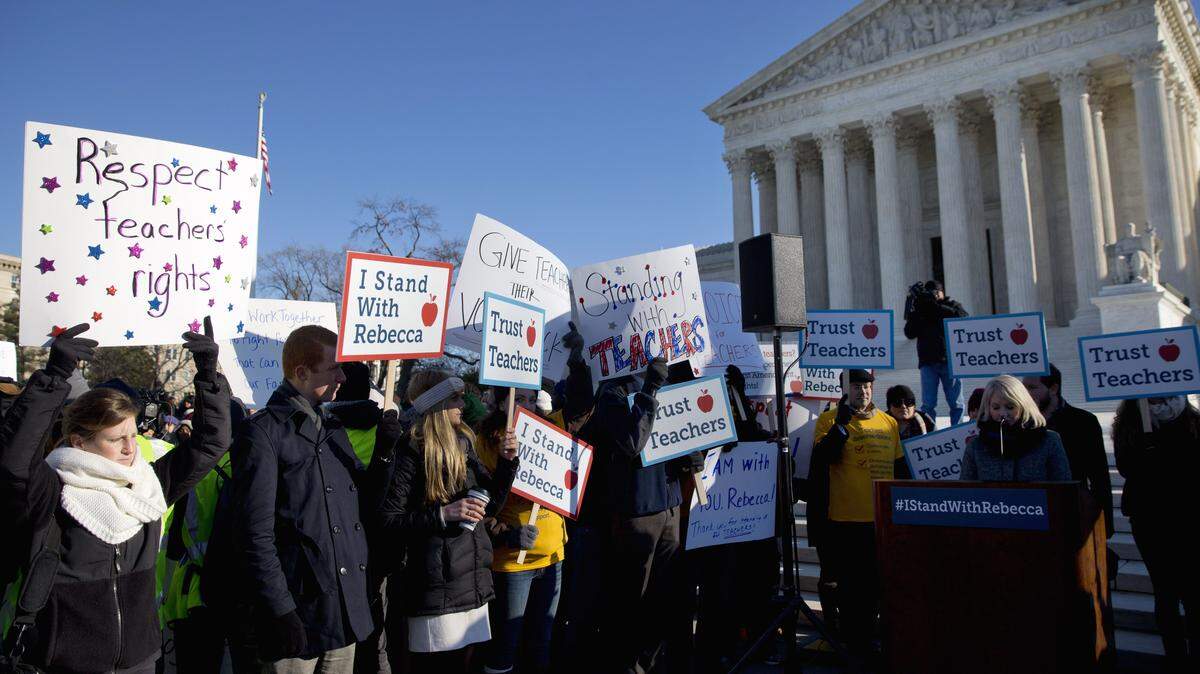
WASHINGTON -- The Supreme Court appears ready to deliver a major setback to American unions as it considers scrapping a four-decade precedent that lets public-sector labor organizations collect fees from workers who decline to join.
During more than an hour of oral arguments Monday, the high court's conservative justices seemed likely to side with a group of California teachers who say those mandatory fees violate the free-speech rights of workers who disagree with a union's positions.
Labor officials fear unions' very existence could be threatened if workers are allowed to get all the benefits of representation without at least paying fees to cover the costs of collective bargaining. The case affects more than 5 million workers in 23 states and Washington, D.C.
But Justice Anthony Kennedy rejected arguments by lawyers for the state of California and the California Teachers Association that the current fee system is needed to prevent non-members from becoming "free riders" -- workers who reap the rewards of union bargaining and grievance procedures without paying for it.
"The union basically is making these teachers compelled riders for issues on which they strongly disagree," Kennedy said, noting the political nature of bargaining issues like teacher salaries, merit promotions and class size.
Even Justice Antonin Scalia, who in the past has expressed some sympathy for the free-rider argument, said all the items negotiated in a collective bargaining agreement "are necessarily political questions."
Arguing in support of the union, California Solicitor General Edward DuMont said the state needs a reliable bargaining partner that is funded by all the workers it represents. He said the fees for collective bargaining typically apply to non-political issues such as mileage reimbursement, working hours and other mundane matters.
Chief Justice John Roberts dismissed that reasoning, saying even routine matters can become politically charged if they involve how the state spends money. "That's always a public policy issue," Roberts said.
The group of 10 teachers that filed the challenge wants the high court to overturn a 1977 case that allows public unions to collect money from members and non-members alike, as long as the funds aren't spent for political action. The court in that case, Abood v. Detroit Board of Education, said the arrangement was justified to prevent non-members from becoming free riders.
The challengers argue that public-sector unions have become more political over time. They say even a push for higher salaries and pension benefits raises political questions about the best use of tax dollars for cash-strapped localities.
A federal district court ruled against the teachers, saying the outcome was clear under Abood. The 9th U.S. Circuit Court of Appeals affirmed.
Half the states already have right-to-work laws banning mandatory fees, but about 80 percent of workers represented by public-employee unions are in states that don't, including California, New York and Illinois.
Union advocates say the lawsuit is part of a conservative agenda to weaken unions, which are known for reliably supporting Democratic candidates and policies. The challengers are backed by the conservative Center for Individual Rights.
Arguing for the California Teachers Association, lawyer David Frederick said the First Amendment applies differently to public employees. He said the state has a strong interest in promoting efficiency and avoiding costly workplace disruptions by designating the union as workers' exclusive bargaining representative.
Even if the court doesn't overturn settled precedent, it could still give the challengers a partial victory. The justices are also considering whether public employees should be required to "opt in" to paying the political portion of union dues. Currently, workers must "opt out" of the political fees by checking a box on a form.
The "opt in" requirement could lead to more workers declining to pay the political portion of union dues, though it typically is a much smaller part of the overall payment.
A decision in the case, Friedrichs v. California Teachers Association, 14-915, is expected by late June.
This story was originally published January 11, 2016 at 5:57 PM with the headline "High court seems ready to scrap mandatory public union fees ."