
President Barack Obama announces new efforts to combat heroin epidemic
President Barack Obama announced new efforts Wednesday to combat the opioid and heroin overdose epidemic plaguing Manatee County and the rest of the country, including a memorandum to federal agencies to improve training for opioid prescribing and to improve access to addiction treatment.
"This crisis is taking lives; it's destroying families and shattering communities all across the country," Obama said at a panel discussion on opioid drug abuse in Charleston, W.Va. "That's the thing about substance abuse; it doesn't discriminate. It touches everybody."
Local addiction health experts said the policy changes proposed by the president are great steps to help fight the heroin and opioid epidemic. But Mary Ruiz, CEO of mental health and addiction treatment facility Centerstone Florida, said policy steps need money to be truly effective.
"We need money for local treatment centers," Ruiz said. "These are laudable efforts, but we need resources."
Florida ranks No. 29 in the U.S. in injury-related deaths, which includes overdoses, according to a report released in June 2015 by Trust for America's Health. It is one of 36 states where drug overdoses have become the main cause of injury-related deaths, surpassing motor vehicle accidents.
Nationally, drug overdose deaths have more than doubled in the past 14 years, resulting in 44,000 deaths per year. Florida ranked 23rd highest for drug overdose deaths, at a rate of 13.7 per 100,000 people.
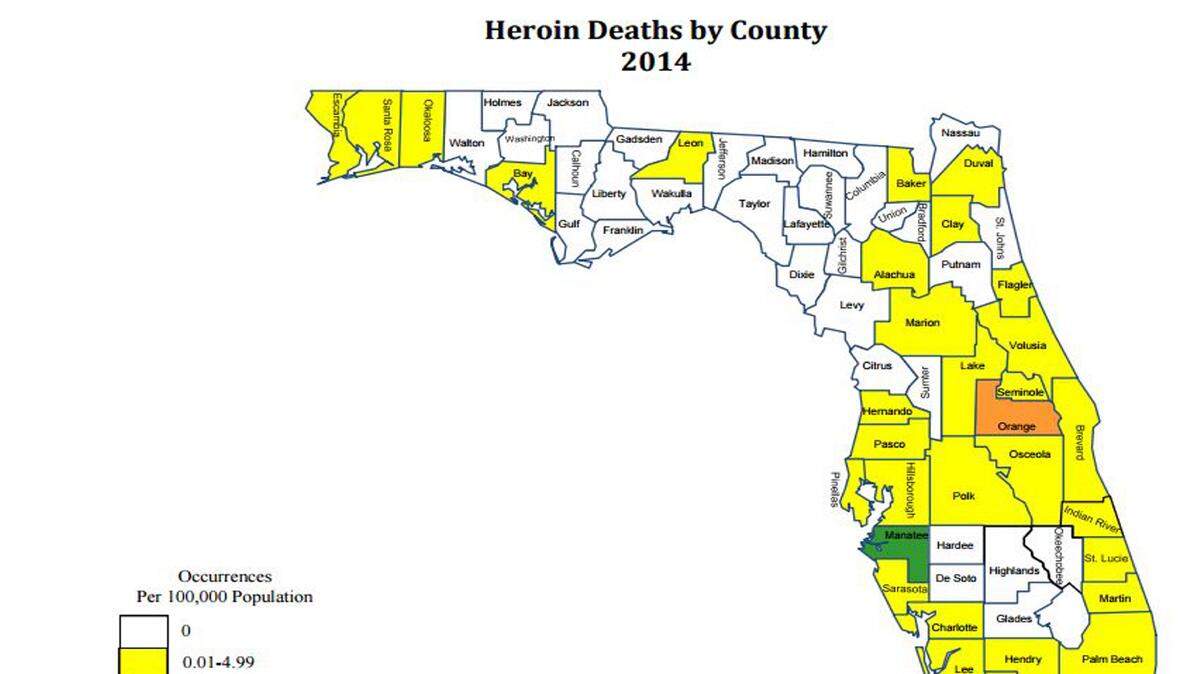
And the state medical examiners commission recently reported Manatee County in 2014 had the highest per-capita overdose deaths in Florida due to the opioids heroin and fentanyl.
Obama proposed improving prescriber training by ensuring there is proper training for all doctors who prescribe opioids. Currently, addiction specialist Dr. Mark Sylvester said, most medical schools don't even offer addiction rotations, though all doctors can prescribe opioids.
"Not every doctor has to spend even one day in addiction training," said Sylvester, who is based in Lakewood Ranch. "They'll spend six weeks in radiology, which most doctors don't even use, but not a day in addiction. ... The system needs to be rebalanced."
Ruiz agreed, saying even dentists prescribe opioids to their patients. And while their intentions are not to trigger addiction, but to alleviate pain, many don't even screen for addiction history. Additional training in medical school, or in annual Continuing Medical Education courses, is necessary to cut down on opioid addiction, and therefore overdoses due to heroin and other opioids.
Additionally, Obama said his administration would analyze barriers to access to addiction treatment and take steps to eliminate those barriers, particularly to medication-assisted treatment with drugs like suboxone. Those drugs cut down on cravings for opioids, block other drugs' effects and help with withdrawal symptoms.
One barrier, Sylvester and Ruiz agreed, is a federal limit on doctors who prescribe medication for addiction treatment. Any physician can take an eight-hour online course to become certified in addiction treatment, and then has a cap of 30 patients for the first year. In following years, they have a cap of 100 patients.
"A doctor typically treats between 400 and 1,500 patients at a time. I'd say I have about 1,000 patients, and 90 percent of those are for addiction," Sylvester said. "That means I can only treat one out of nine people who walk through my door."
Sylvester advocated lifting all caps on board-certified addiction specialists like himself, but keeping limits on those doctors who only went through the eight-hour training.
Ruiz disagreed, saying the desperate time in the country called for as much access to treatment as possible, especially since medication-assisted treatment has been dubbed the "gold standard" of addiction treatment.
"Right now, if everyone suffering addiction in the country went for help, we would only have enough treatment available for 18 percent of them," Ruiz said. "We can't take medications away from the paramedics on the battlefield."
Another barrier is the lack of money for medications and addiction centers. While Centerstone typically has to limit the number of patients they have in medication-assisted treatment due to the 100-patient cap per doctor, a larger barrier is the fact most of their patients don't have insurance and can't afford it.
"About 20 percent of the Florida population doesn't have insurance," Ruiz said. "And a disproportionate percentage of that group are probably addicts."
Even those who do have insurance run into issues when insurance refuses to cover the treatment, Sylvester said.
"If a guy is driving drunk and gets seriously injured, most insurance will happily write a check for that," Sylvester said. "But most commercial and federal insurance either doesn't provide any, or provides limited substance abuse treatment coverage."
Other goals announced by the Obama administration Wednesday include:
n Have more than 540,000 health care providers complete opioid prescriber training in the next two years.
n Double the number of physicians certified to prescribe buprenorphine for opioid use disorder treatment, from 30,000 to 60,000 over the next three years.
n Double the number of providers that prescribe naloxone, a drug that can reverse an opioid overdose.
n Reach more than 4 million health care providers with awareness messaging on opioid abuse, appropriate prescribing practices, and actions providers can take to be a part of the solution in the next two years.
Kate Irby, Herald online/political reporter, can be reached at 941-745-7055. You can follow her on Twitter@KateIrby
This story was originally published October 21, 2015 at 5:26 PM with the headline "President Barack Obama announces new efforts to combat heroin epidemic ."