
Florida lawmakers discuss legislative solutions to Manatee County heroin epidemic
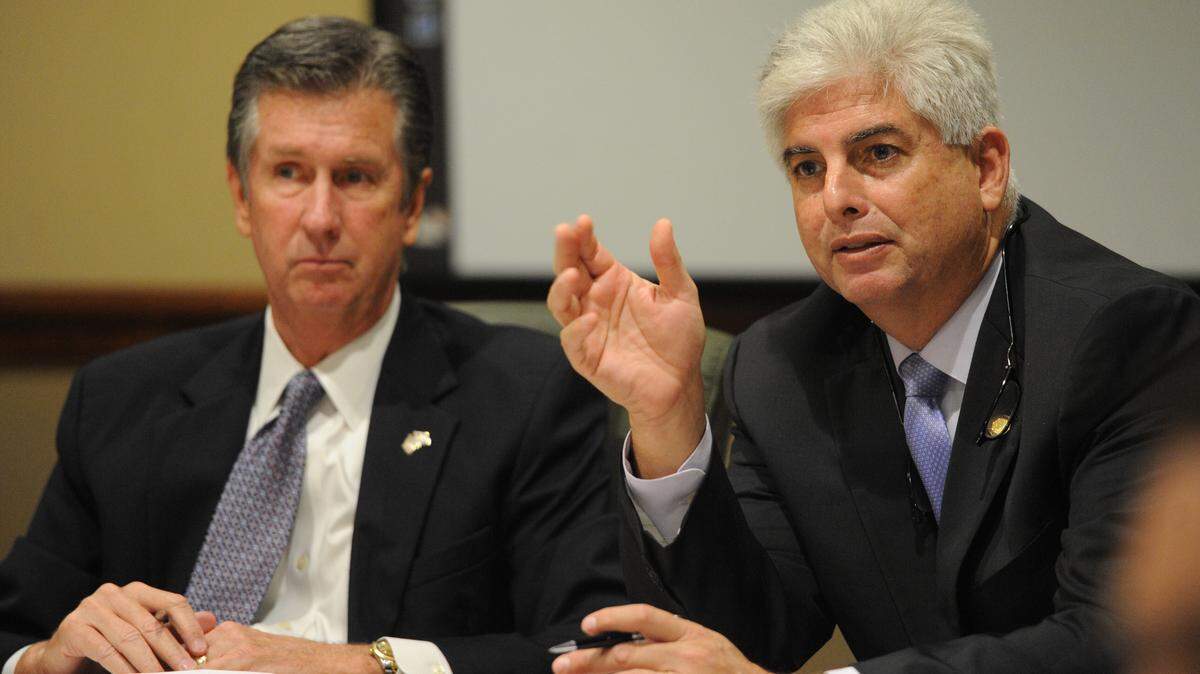
BRADENTON -- State Rep. Jim Boyd, R-Bradenton, met Wednesday with community leaders to discuss legislative solutions to the heroin epidemic.
The roundtable focused more on different organizations' problems dealing with the epidemic than on solutions, namely inadequate funding. Discussions about issues and roadblocks, however, did raise possible legislative steps.
"Funding is an issue that as a state we've got to figure out how to tackle," Boyd told the group of officials from local governments, law enforcement and medical services. "I believe that this is such a problem throughout the state that this is going to get some traction in the budget this year."
Policy-wise, exact solutions were hard to grasp. State Rep. Julio Gonzalez, R-Venice, said he wants a bill that would put together a consistent, statewide addiction treatment system.
"How can we put all these systems together into a network so we can follow two or three entry points for patients, get them into the system and try to get them into a sustained treatment approach?" Gonzalez said. "Give them a fighting chance so that they can continue with their lives."
Boyd and Gonzalez said there is widespread support in the House and Senate for action on the heroin epidemic. Though Manatee County might be the epicenter, Boyd said, it's an issue statewide.
Other bills could include one to increase addiction training for Florida doctors, with an emphasis on prevention and alternative pain treatment to decrease initial prescription of opiates, which can sometimes lead to opioid and eventual heroin addiction.
Dr. Mary Ruiz, CEO at the addiction and mental health treatment facility Centerstone Florida, noted that strong opiates can be pre
scribed by dentists and to those as young as 11.
Another bill could look at involuntary detainment of drug addicts for a few days to make sure they are evaluated by a medical professional after an overdose, similar to Marchman or Baker acts. Hospital and treatment officials cautioned against doing this without additional space or resources.
"Honestly, during season, I don't know where we would keep them for a day or two, or if we could even afford it," said Nicole Dollison, chief operating officer at Manatee Memorial Hospital, which already had problems treating the indigent population before the heroin epidemic hit.
Ruiz said they're already past capacity at Centerstone, with 177 heroin detoxification stays in August alone. And a few days wouldn't be long enough to treat someone, she said.
"That 72 hours gets them out of the medical danger zone, but it isn't enough to get them out of the treatment danger zone," Ruiz said.
No specific policies were discussed regarding prevention, but both county and school officials say there must be more emphasis on drug education in schools.
The DARE program had funding cut starting in 2008 until it was completely eliminated in 2011, leaving Manatee County schools without any concentrated drug education course.
"For every $1 you spend in prevention, you save $10 in social costs," said Jessica Spencer with the Manatee County Substance Abuse Prevention Coalition. "For prevention in schools, every $1 saves $18 in social costs."
And while treatment is important to help those suffering from addiction, Spencer cautioned they need to focus on the best way to spend resources long term.
"We can bandage this all day long, but we need to fix the artery that has exploded," she said.
Wylene Herring-Cayasso, director of student services and alternative programs in the Manatee County School District, said she only has one employee in the district who deals with drug issues and intervention. She said the district needs a focused drug education course, particularly in elementary schools.
"The latest we've seen is high school students are sharing drugs from their parents' medicine cabinets, and they have no idea what it is," she said. "We get students who arrive intoxicated to school. ... and some of them have driven to school under the influence. We're getting a lot of drug issues in school, and it's increasing for us."
Boyd seemed supportive of more education, but emphasized it isn't just schools. Families, he said, need to help ensure their children are aware of the effects of drugs.
"Families are going to fix the problem, not the government, not law enforcement," Boyd said. "We have to raise our kids and talk to our kids. It's sad, but we've got to treat the disease and not the symptoms."
Kate Irby, Herald online/political reporter, can be reached at 941-745-7055. You can follow her on Twitter @KateIrby
This story was originally published September 30, 2015 at 11:58 PM with the headline "Florida lawmakers discuss legislative solutions to Manatee County heroin epidemic ."