
2016 Sarasota Film Festival | Festival introduces world to 'Regina' and personality disorder
MANATEE -- Rebbie Ratner is a passionate young filmmaker from New York City who wanted her first project to do nothing less than change the world.
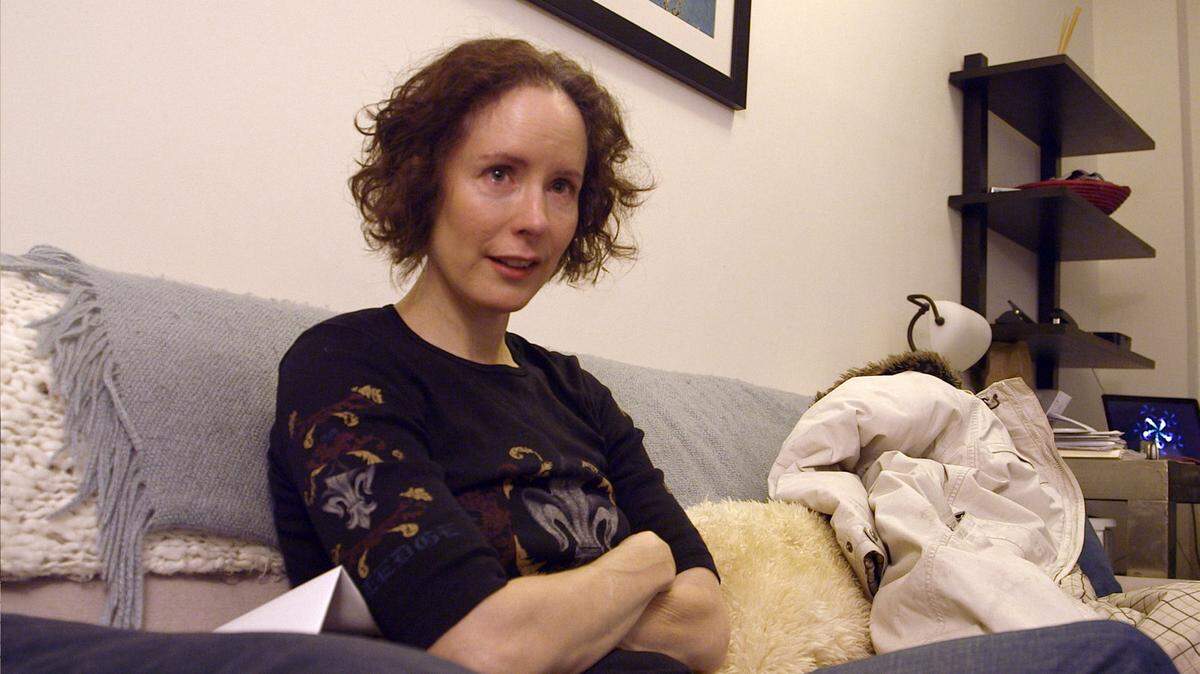
It remains to be seen if her raw and often shocking documentary, "Borderline," part of this year's Sarasota Film Festival, will be transformative by introducing "Regina," a real 45-year-old woman who lives with borderline personality disorder and, courageously, wants the world to know how it often strangles her life and relationships.
"Borderline," said to be the first documentary to capture the live experience of BPD, is among 10 films in this year's slate of Sarasota Film Festival offerings that touch on mental health.
This is the second year that the festival has chosen a social issue to highlight throughout its program. The social issue for 2015 was homelessness, The film festival runs April 1 through April 10
Films in this year's program that will touch on mental health include "Touched With Fire," "Borderline," "Disorder," "Mad," "Off The Rails," "In Pursuit of Silence," "The Brainwashing of My Dad," "SPLit," "Tony Robbins: I Am Not Your Guru" and "Crossing Bhutan."
Ratner might be the absolute best person to direct the first documentary about BPD and bring to light how long it takes people to get a diagnosis and how patients are often misdiagnosed by treaters. She is living with the condition, having finally been diagnosed after years of confusion and uncertainty about why she often behaved as she did.
"I wanted to make my first documentary about something I really cared deeply about and I realized my documentary was right in front of me," Ratner said by phone last week.
Her film, for which she will be available for discussion afterward, will be shown at 1 p.m. April 9 and 1:15 p.m. April 10 at the Regal Hollywood 20 Cinemas, 1993 Main St., Sarasota.
Ratner, who is director and also co-producer with Suzanne Mitchell, has painstakingly researched the body of published work about BPD to inform herself and her film. She said a piece written by Drs. Frank Yeomans and Barry Stern for the Personality Disorders Institute of the Weill Medical College of Cornell University is spot on when it comes to BPD.
"While the world is enriched by the variety of personality styles that exist, when a person personifies and lives out a particular personality
style in an extreme and inflexible way that causes a certain level of distress in one's emotional and interpersonal life, they meet criteria for a personality disorder," the doctors write.
"We find it helpful to give an overview of BPD as a disorder comprising difficulties in four areas," the doctors continue. "Emotions tend to be intense and rapidly shifting, relationships tend to be conflicted and stormy, there may be impulsive, self-destructive or self-defeating behaviors and there is a lack of a clear and coherent sense of identity. This last problem may underlie all the preceding ones."
When Ratner was about 12-years-old she realized, with a deep sadness, that she was beginning to burn bridges with all of her friends, not something mentally healthy for a soon-to-be teen.
She was reacting inappropriately to things she now, after years of therapy for BPD, regards as normal everyday interactions.
"If someone wouldn't call me back I would say to myself, 'They don't like me, they don't want to hang out with me and I never want to see them again,' " Ratner said.
This impulsive behavior severed relationships, she said.
"By the time I was 30 or 35 I was unable to do certain fundamental things you do to have relationships," Ratner said. "Some of those things involve being able to step into another person's shoes and understand the position they are coming from instead of feeling defensive."
Through therapy, Ratner, who doesn't necessarily hold that BPD is a mental illness as much as a faulty mental outlook, learned to be curious rather than critical.
"Rather than make an assumption, I have learned to make an investigation," Ratner said. "In my old 'Borderline' world I would receive a neutral signal and take it as rejection. Now I dig deeper."
The BPD diagnosis affects an estimated 1.9 to six percent of the U.S. population and has tremendous impact on family and loved ones, Mitchell, the co-producer, said.
Eighty percent of those with BPD attempt suicide, and 10 percent succeed, Mitchell added.
"Approximately 14 percent of the outpatient substance addicted and eating disorder populations meet diagnostic criteria for BPD and this statistic balloons to 25 percent in these inpatient populations, yet few are actually given a diagnosis," Mitchell said. "Because of the stigma and lack of professional training, people with the BPD diagnosis are considered 'difficult people and impossible to treat.' People who know they have the diagnosis keep silent because of this prejudice and the potential backlash if they do speak out. Making public the diagnosis allows others a chance to gain information and help."
Ratner views herself as a "classic" Borderline case, which means she says she went a long time without a correct diagnosis. She was once diagnosed as bipolar she said.
"By the time someone enters treatment, it takes on average five years to get a proper diagnosis," Ratner said. "You have to go to a lot of treaters. There is a tremendous amount of malpractice. Many providers don't have the skill to treat it. The irony is, once you become familiar with the symptoms, it's not that difficult a diagnosis to make."
Regina, also reached by phone last week for this article, said her experiences eerily mirror Ratner's.
"I remember as a teen failing an exam," said Regina, who prefers not to give her last name. "Some kids may have had the reaction, 'I've got to study harder next time.' But my reaction was, 'I will fail high school. I will be homeless. I might as well die now. How can I commit suicide. I am not cut out for life.' "
Like Ratner, Regina has been in therapy and is doing much better as an adult.
While it is a little uncomfortable suddenly being the face of BPD, Regina said she will deal with it if the film helps people.
"Making the film was empowering because I was admitting to the world that I have this," Regina said. "It was fun. I just hope the film can do a lot of good."
Tickets are available at sarasotafilmfestival.com or by calling 941-366-6200.
Richard Dymond, Herald reporter, can be reached at 941-745-7072 or contact him via Twitter@RichardDymond.
This story was originally published March 28, 2016 at 5:39 PM with the headline "2016 Sarasota Film Festival | Festival introduces world to 'Regina' and personality disorder."