
One of the Holocaust’s ‘hidden children’ shared her incredible story at a Bradenton school
Not long ago, hatred spread through Europe and forced millions of people to either hide or die.
Nazis and their supporters killed 6 million Jews, including 1.5 million children, along with countless other victims who were murdered for their race, sexuality, disability or political leaning. Fueled by the German phrase Lebensunwertes Leben, meaning “life unworthy of life,” they tore apart families from 1933 to 1945.
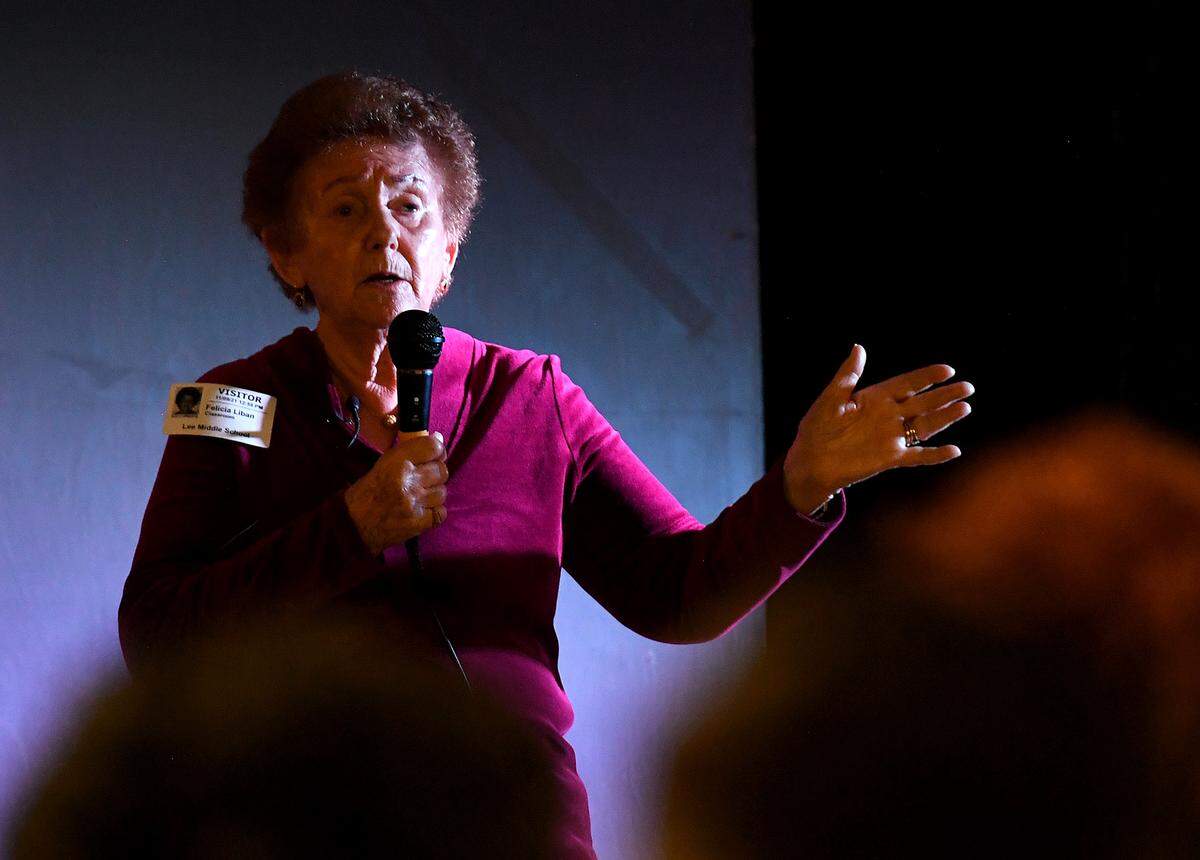
One of those families included Felicia Liban, a Holocaust survivor who spoke to dozens of students at Electa Arcotte Lee Magnet Middle School on Tuesday afternoon.
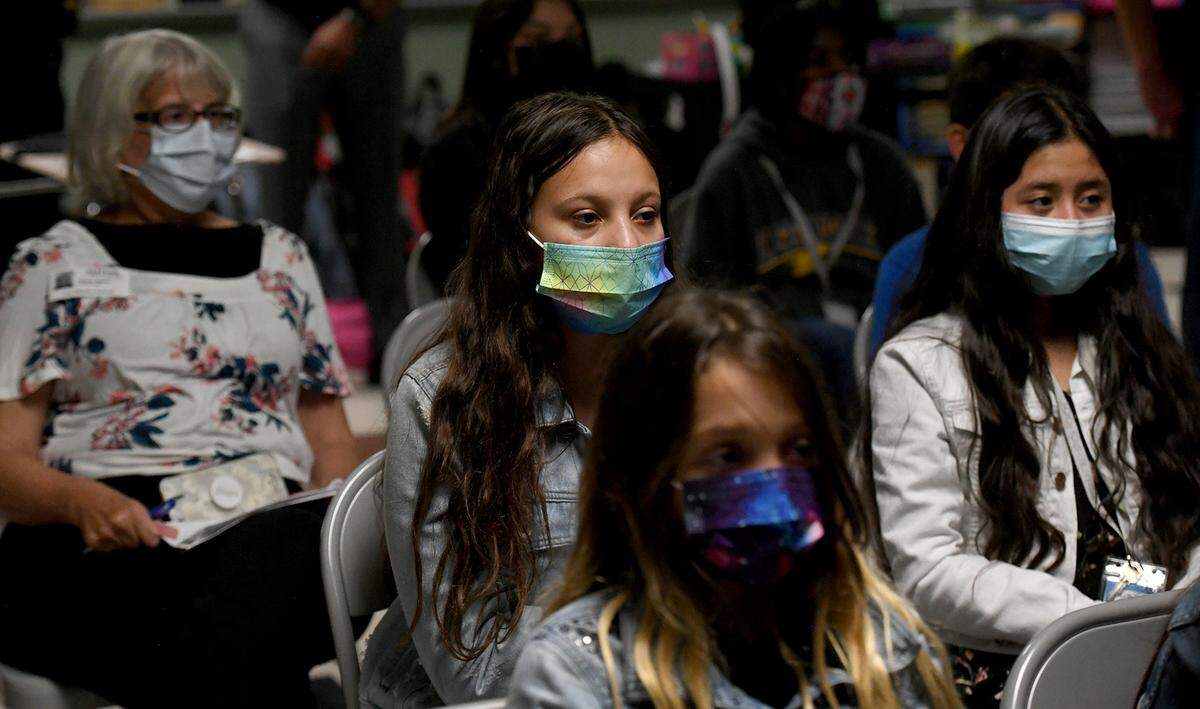
The 30-plus students fixed their eyes on Liban and sat silently — apart from the occasional gasp — as she brought the classroom on a journey through her family’s struggle.
“You could hear the rumbling of the tanks,” Liban said, recounting her time as a 5-year-old Jewish girl in southern Poland.
Liban, one of the “hidden children” who escaped, shared her story as part of Florida’s Holocaust Education Week, which runs from Monday to Friday.
The yearly reflection takes place in Florida and aligns with the anniversary of Kristallnacht, or the Night of Broken Glass, when Nazis destroyed Jewish homes, schools and businesses.
It was important to remember the atrocities that happened less than 90 years ago, she said, because people continue to forget history and its many lessons. Some people diminish the seriousness of what happened, while others deny the Holocaust ever occurred, she said after the event.
A school district administrator in Texas found herself in hot water last month, when she directed teachers to share “opposing” viewpoints about the Holocaust. And a principal in Palm Beach County lost his job when he refused to acknowledge that it was a “factual, historical event” last year.
That’s why the Jewish Federation of Sarasota-Manatee brought Liban to the Bradenton middle school on Tuesday afternoon, and why Liban was so eager to share her story.
A life in hiding from the Nazis
Her father planned to escape the country and then arrange for his family to make the same trip.
Liban remembers seeing her father walk down the stairs and leave their family home — their final moments together, as she would come to learn.
Germans later raided their home, confiscated all their belongings and forced them to move into a ghetto surrounded by towering walls. Her mother was allowed to leave only for work, when she made undergarments for the Christian people who lived outside the wall.
Liban said she lived in a room with several family members, not including her grandfather, who died just before their move to the ghetto.
“He was buried in a Jewish cemetery,” she said. “In a way, it was better for him because they probably would have killed him. He was a lovely, sweet man.”
About one year later, Liban said, the Germans forced everyone to gather in a large, enclosed plaza, where the guards began to separate people by their age and ability to work.
Her mother, a resourceful woman, knew that staying was not an option.
“She grabbed my hand tightly and she said, ‘We are walking out of here. Don’t look left or right. Do not talk to anybody. Just follow me,’” Liban said, recounting the moment she and her mother escaped the plaza.
Her mother bribed someone with jewelry so they could enter a building and climb out the other side. They walked into the basement, traveled through a coal chute and found themselves outside of the ghetto.
From there, she said, they walked a long path to the home where her mother’s acquaintances lived. They promised to watch after Liban while her mother left to acquire fake paperwork and new identities — vital tools for surviving the Holocaust.
But after several days, her mother was nowhere to be found, and Liban’s new family taught her a different way of life.
“If any stranger came into the apartment, I am to go into the closet and hide in there and be quiet until I’m called to come out,” she said. “This way nobody would know I was there. After all, I was a Jewish child.”
A span of two to three months passed, much of it spent inside that closet, Liban said. Then one day the doorbell rang.
But it was no stranger, she continued. It was her mother, who survived a run-in with hostile Germans before they carted her off to a concentration camp.
“They beat her something terrible,” Liban said. “They hit her and they kicked her. She was in very, very bad shape.”
Nazis forced people to wear garments that identified them as Jews. In her mother’s case, it was an armband that she stuck in her pocketbook, and when the Germans found the armband in her bag, they beat her and sent her to the camp.
Proving her resilience once again, her mother struck a deal with the truck driver who was leaving the concentration camp and heading into town for supplies. The mother wanted to see her child, and the driver agreed to take her, but only if she returned immediately after.
Liban quoted the truck driver in her story on Tuesday afternoon: “’If you don’t return, I will get killed, your mother will get killed, your brothers will get killed, my family will be killed.’”
Knowing that to be true, the mother surprised her daughter and vowed to return after the war, but until that time, Liban’s mother had to go back and endure the concentration camp.
“I didn’t see her for three years, and I always thought about her, but there was nothing I could do,” Liban said.
Hiding her Jewish identity
Liban said she felt loved at the apartment, but hiding in a closet and scrounging for food was no life for a young girl.
So the family moved her to a home near the Ukrainian border, where she lived in a small house with a thatch roof and an outdoor bathroom. She had all the milk, eggs and sunshine she could need, but no place was truly safe during the Holocaust.
Liban adopted a new name, attended a Catholic church and learned how to pray. The new identity saved her life when Germans held her at gunpoint and forced her to recite scripture.
“If you look afraid, that’s a bad thing to show, so I did everything I was told,” she said.
People in the community were starting to suspect that she was Jewish, but with help from her new family, including the man she called uncle, Liban obtained paperwork that confirmed her new identity.
The paperwork meant no more hiding in closets or reciting prayers at gunpoint, Liban said. She learned how to read and write, she went on shopping trips, and she enjoyed walks in the park.
That lasted until 1945, when the war ended and her mother returned from the concentration camp.
“It was such a wonderful reunion,” Liban said. “We were so happy to be together. At the same time, I loved my aunt and uncle. It was hard to leave them, but eventually I did go with my mom.”
World War II was over but antisemitism was still alive in Poland, so she and her mother traveled to Germany, where she had surviving family members. They rode atop a train, on a pile of coal, and Liban developed typhoid after drinking from water pumps along the way.
She later learned that her father died from the same disease after Russians captured him and sent him to a concentration camp in freezing Siberia.
Despite her serious illness, Liban made it to Germany, where bombs had completely razed the buildings, so she recovered in the basement of a hospital.
She and her mother then traveled for two weeks across rough waters in the Atlantic Ocean. The Statue of Liberty came into view as they approached New York, their new home for a period of time, before they eventually moved to Michigan.
“Life was OK, living in Detroit,” she said. “Some time later I met my husband, I got married, I lived in New York 50 years. I had three children, five grandchildren and life is good.”
‘My blood boils’
The Holocaust is one of the most infamous examples of how quickly hate can spread.
It also offers a glimpse at how good people — much like the ones who kept Liban and her mother safe — have the power to combat great wrongs.
In a proclamation issued on Tuesday morning, the Manatee County School Board said it was important to remember the Holocaust, and to resist hatred or tyranny.
“The history of the Holocaust offers an opportunity to reflect on the moral responsibilities of individuals, societies and governments,” the proclamation reads.
Education is important, and there was still much work to be done, Liban said on Tuesday, referring to those who still deny the Holocaust occurred.
“My blood boils,” she said.
This story was originally published November 10, 2021 at 6:23 PM.