
‘Always smiling.’ Bradenton 7-year-old faces extremely rare cancer with help from class
Aubrey Romero’s entire life changed in 21 days.
Romero, a 7-year-old girl in Manatee County, had swelling on the left side of her face, where a new tooth was emerging. So her mother, Renee Kellar, scheduled a visit to the dentist’s office on Aug. 9, expecting a routine visit.
“I thought, ‘OK, it’s a little swollen,’ but there was no problem,” the mother said. “No pain, no nothing.”
But soon after the office took an X-Ray of Aubrey’s face, it became clear that a large mass was to blame for the swelling. That’s when the whirlwind began.
Family and friends came to learn that Aubrey has an extremely rare form of cancer that affects few people — none of them young girls.
And though her diagnosis marked the start of a long journey, she’s gotten overwhelming support from her teacher and classmates in Bradenton, and from doctors across Florida.
The journey started in early August, right after their trip to the dentist’s office, when Kellar drove her daughter two hours to see a specialist in Cape Coral. From there, the family got referred to yet another doctor.
Days later, on Aug. 13, Aubrey and her mother traveled to Tampa for a visit with Dr. Pat Ricalde, a craniofacial surgeon who immediately recognized the urgency of Aubrey’s swelling.
Dr. Ricalde brought the family to St. Joseph’s Hospital, less than a mile down the road, where she performed a biopsy the same day — the first of many medical procedures to come.
According to the people who worked on Aubrey’s case, Dr. Ricalde’s initial sample confirmed their fears: Aubrey’s tumor was cancerous. The exact type of cancer, however, remained a mystery.
That changed when a group of doctors at the University of Florida reviewed the sample and made an unusual discovery.
They diagnosed Aubrey with ghost cell odontogenic carcinoma, an extremely rare form of cancer that usually affects men, and that disproportionately affects people of Asian descent.
About 50 other cases have been documented in English medical literature over the last several decades.
“None of them we could find were in kids,” said Matthew Mifsud, one of the lead doctors in Aubrey’s case. “They’re all in adults. It’s a particularly unusual situation.”
Dr. Ricalde, who took the original biopsy, coordinated with Dr. Mifsud and a team of other specialists to tackle the cancerous tumor.
Their efforts led up to a major surgery at Tampa General Hospital, where 10 people worked for 12 hours to remove the tumor and reconstruct Aubrey’s face, her mother said.
“They couldn’t even tell me how many stitches because it was just thousands,” Kellar said. “But she looks amazing and beautiful. She’s so resilient.”
From the initial dentist appointment on Aug. 9 to the surgery on Aug. 30, cancer turned Aubrey’s life upside down in just three weeks, and she still has a long road ahead.
But with the help of modern technology, medical experts and Aubrey’s unbreakable spirit, the future is looking hopeful.
“God put every single person in place to make this go as perfectly as it did,” her mother said. “I could not have asked for a better team.”
‘She has done incredibly well’
Dozens of people — surgeons, dietitians, speech therapists, nurses, radiation experts, social workers and many others — will take part in Aubrey’s recovery process.
Dr. Mifsud and Dr. Mark Tabor are among those people. Tabor, an associate professor of otolaryngology at USF Health, said more than half a dozen people discussed Aubrey’s cancer before the surgery.
“There’s not a lot of data about it,” said Tabor, who also works in USF Health’s Morsani College of Medicine as the director of sinus and endoscopic skull base surgery.
“It’s so rare,” he continued. “There’s nowhere that says, ‘malignant ghost cell tumor is best treated with X, Y and Z.’ You need thousands of patients to give you that data.”
The group, he said, is a special tumor board that includes people with different specialties. Virtual meetings, which became standard during the COVID-19 pandemic, empowered them to gather quickly and discuss Aubrey’s treatment.
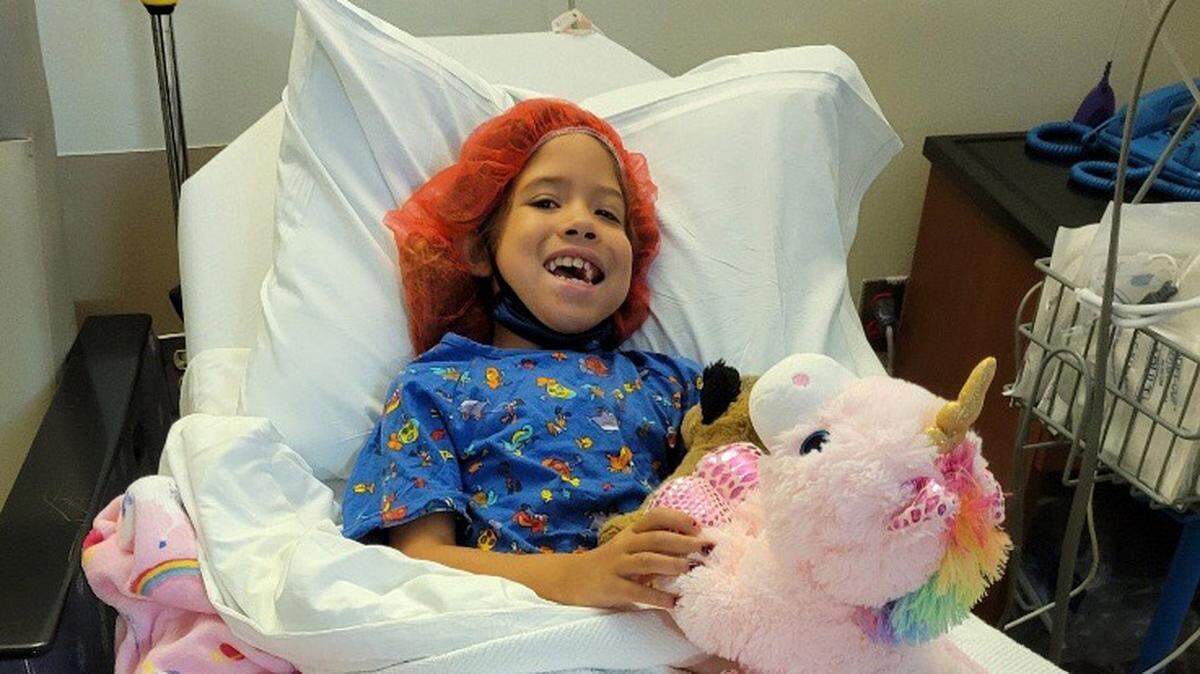
They decided her recovery should start with surgery, not chemo or radiation, so Dr. Tabor oversaw the removal of Aubrey’s tumor, while Dr. Mifsud handled the facial reconstruction.
“Her whole upper jaw on the left side was completely replaced by the cancer,” Mifsud said. “The area where her cheek would sit, the bones there, the bone that supports the bottom of the eye socket — all of that was involved with the cancer.”
Mifsud, an assistant professor of otolaryngology at USF Health’s Morsani College of Medicine, said engineers used a 3D printer to create a model of Aubrey’s cancer, along with a separate model of what her face should resemble after surgery.
The models helped to guide Mifsud during surgery, when he used bone and muscle from Aubrey’s left shoulder blade to reconstruct her face.
The surgery was major, especially for a 7 year old, but Aubrey was back to dancing and performing cartwheels less than one month later.
“It shows you that, with the right attitude, you can make these steps if you have the right team,” Mifsud said.
Purple for Aubrey Day
Aubrey’s team goes far beyond the hospital.
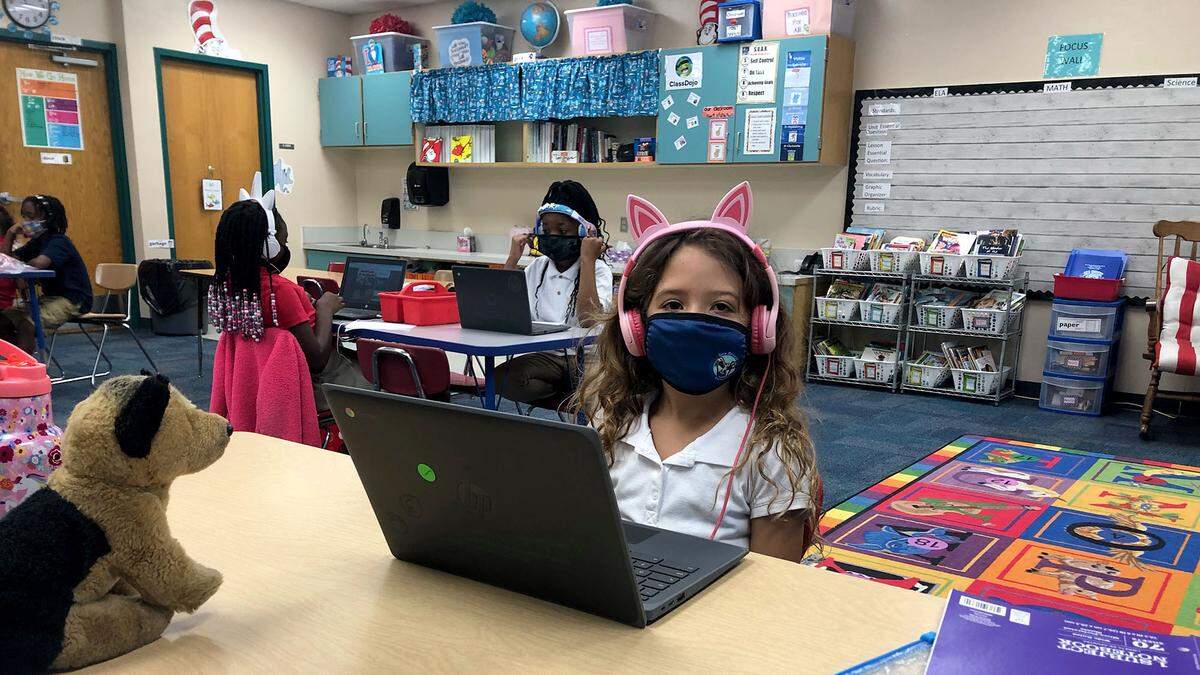
In a second-grade classroom at Sea Breeze Elementary School, classmates write letters to Aubrey in their free time, and they ask about Aubrey’s recovery on a daily basis, teacher Lori Schumaker said.
“Those kids absolutely love that child, and it’s because she loves everyone,” Schumaker said. “She does not see anything negative in anybody. It’s been very hard on my class. The kids miss her terribly.”
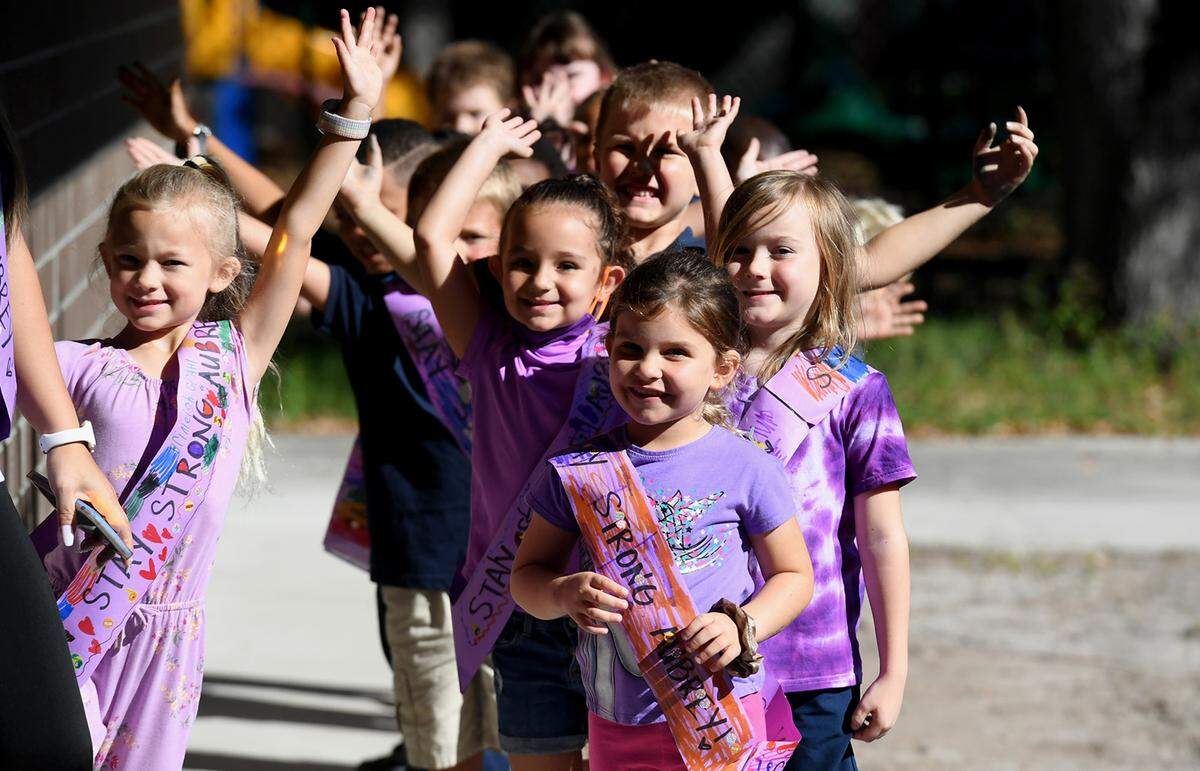
It was hard not to fall in love with Aubrey, the teacher said, describing a girl who never stopped smiling, dancing and brightening up the room.
After learning that Aubrey was sick, Schumaker and her students wasted no time. They hung encouraging signs throughout the campus in Bradenton, and one week later, on “Aubrey Day,” staff and students throughout the school wore purple — Aubrey’s favorite color.
During the event, when Aubrey was recovering at home, her classmates offered support and well-wishes in a recorded video.
“We love you,” a second-grade student said, addressing Aubrey through the camera lens.
“We really, really miss you,” another followed.
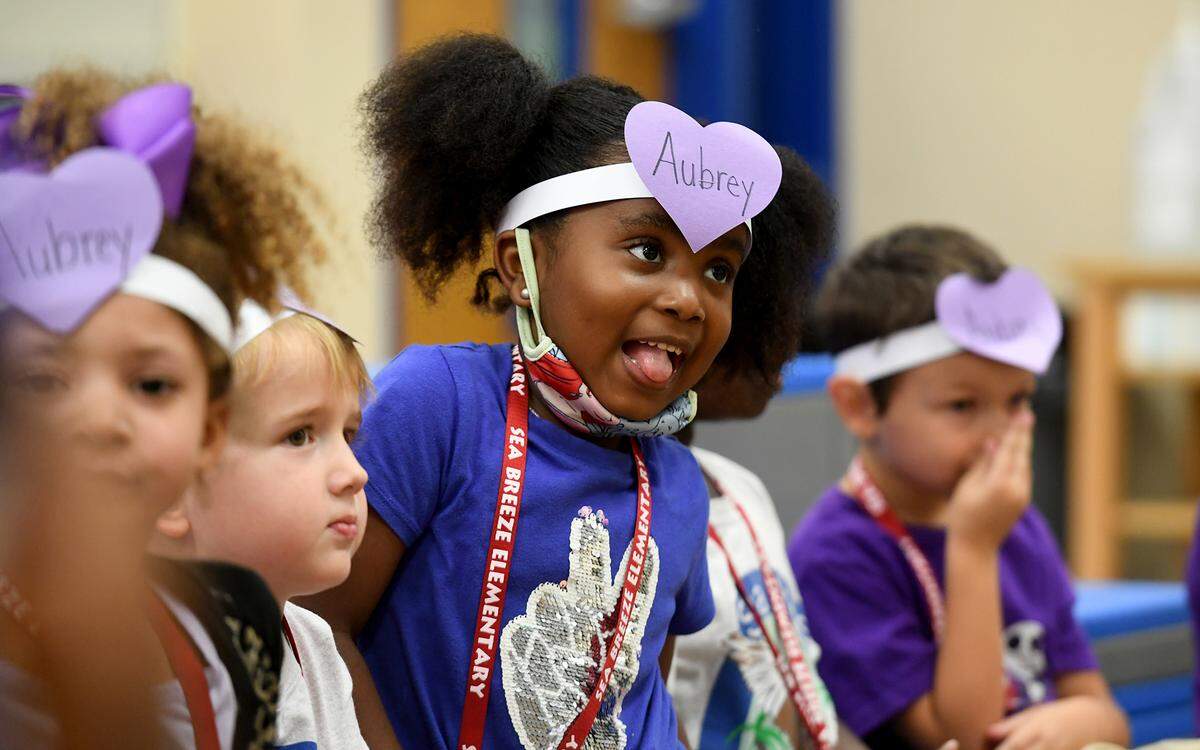
The event raised thousands of dollars after families and school employees donated to help with the tremendous costs of Aubrey’s recovery.
And her teacher continues to fundraise in other ways, including a GoFundMe that raised more than $12,500 as of Friday afternoon.
Schumaker also looks forward to homeschooling Aubrey each week. Despite everything she’s been through, she keeps up with school work and throws in a few cartwheels and splits during their study sessions, the teacher said.
“Aubrey takes everything in stride and is always smiling no matter what,” Schumaker said.
Aubrey’s lifelong battle
While her future was hopeful, the rare cancer has changed Aubrey’s life forever.
After going under anesthesia for surgeries and treatments, she now fears the idea of falling asleep alone, so she sleeps alongside her mother, Kellar.
“You’re a little 7 year old, you’re in the hospital and all these doctors and nurses keep coming at you,” Kellar said. “Everyone’s wanting to look at her and poke at her.”
“Then she goes into the operating room,” the mother continued. “There’s all these strangers and lights and machines and equipment and sounds. Mommy’s not there. Her protector’s not there.”
The removal of her tumor was a big step forward, but cancer still exists near her brain and optic nerve, meaning another surgery might cause Aubrey to lose her vision, Kellar said.
So they took the fight to Miami, where Aubrey is now braving chemotherapy and proton radiation. Most days last six hours or more, her mother said, describing all the work that goes into completing a treatment.
And though it was hard to envision the months and years ahead, Aubrey’s mother knew that recovery would be a lifelong process.
Doctors will need to monitor Aubrey to make sure her cancer doesn’t resurface. She may need to take certain medications for life, and her dentures will have to be remade as she grows into her teen and adult years.
But if anyone could beat the cancer — and do it with a smile — it was Aubrey, her friends and family said.
She finds comfort in her pets: a 3-pound dog named Melody and a 40-pound dog named Bella, along with her two cats, Elsa and Moana — both named after beloved Disney characters.
And she finds joy in making other people happy. Even after weekly chemotherapy and radiation, Aubrey manages to put a smile on other people’s faces.
It was a trying experience, Kellar said. But her daughter, and all the educators, doctors and loved ones who support her, have proved to be heroes in the face of a rare and inexplicable cancer.
“They need the key to the city,” the mother said.