Could new Sugg Middle School be net-zero energy? It’s on the right track, expert says
An effort to turn the reconstruction of W.D. Sugg Middle School into a net-zero energy school is “on the right track,” according to a pioneer in the field.
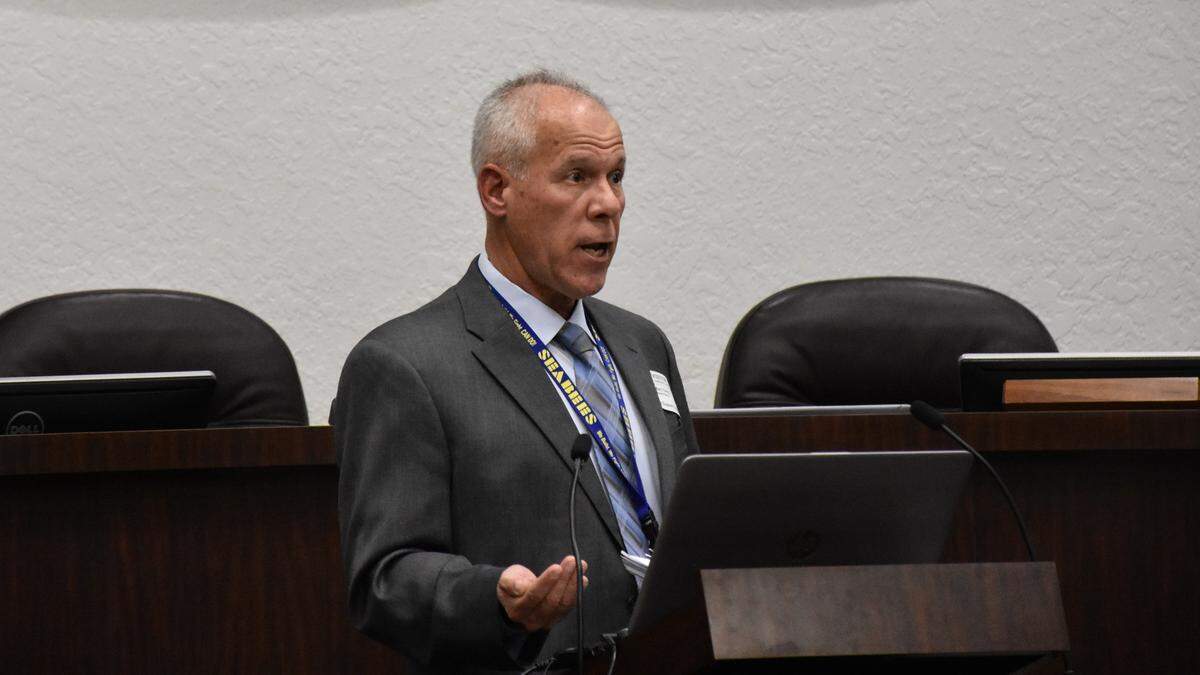
The Manatee Clean Energy Alliance hosted a forum Monday morning at the School District of Manatee County Administration Building to hear from Marc Clinch, the chief facilities officer with the School District of Osceola. Clinch oversaw the construction of NeoCity Academy High School, Florida’s first high-performance, zero energy school.
NeoCity is decked out with 650 solar panels, which generate all the power the school needs. That technology is expected to save Osceola $3.2 million over the next 20 years. With a set of provisions that the Manatee School Board will consider on Tuesday evening, Sugg Middle could save even more than that.
“This supplement (to the contract) is very much on track. This is definitely on the right track. This is very achievable,” Clinch said.
The board is in negotiations to rebuild Sugg, where construction is set to begin in June, according to school district documents. The existing structure at 38th Avenue West and 59th Street West will be torn down and rebuilt, but the board hasn’t yet decided on a renewable energy commitment.
That vision has been championed by local climate change activists who are fighting to achieve 100 percent renewable energy throughout Manatee County by 2045.
“Any time a new school is considered for construction, or an older one is evaluated for renovation, the school board should be taking into account new approach to energy, conservation, use and creation,” Manatee Clean Energy Alliance founder Jim Willard said in a prepared statement. “The cost of solar panels has decreased dramatically, so we can take advantage of Florida’s abundant sunshine and reduce our school district’s energy costs.”
School Board members will vote to decide whether the Sugg construction contract will include an automated system to monitor indoor air quality and energy usage, a target goal for the building’s energy intensity and to allow the final contract to be reviewed by an independent auditor for compliance with those goals.
The district is budgeting $57.1 million for the Sugg project, but adding the clean energy aspect would increase the cost. Clinch didn’t shy away from the fact that building a net-zero facility costs more than a traditional one, but the return on investment happens faster than one might expect, he explained.
“The costs are not prohibitive. Yes, there are costs premiums for high-performance or zero energy,” said Clinch. “For our project, the return on investment was less than five years for high-performance and another three years for full zero-energy, and that was to add the solar panels.”
“This is phenomenal for a school facility that will be there for 40 or 50 years, or more. The thought process needs to center around life cycle and not first cost,” he added.
Another speaker at the forum, Tim Rummage, a professor of environmental studies at Ringling College, agreed that it’s time for Manatee schools to adopt clean energy in the face of a climate change.
“These students are facing a much different world that the one I grew up in. What our students today are facing is that the environment they’re growing up in right now will bare no resemblance to the environment they’re living in even 10 or 15 years from now. It’ll be significantly warmer. It’ll be significantly more humid,” Rummage predicted.
A green vision for Sugg is better for the environment and better for Manatee’s bottom line, Clinch pointed out. By generating solar energy, the school could significantly cut down on its utility bills, which are one of a school district’s biggest expenses.
In February, Osceola’s power bill for the 50,000-square-foot NeoCity Academy was just $800 thanks to $1,200 in credits earned for the school’s contributions to the local power grid. Sugg would be at least twice as large as the Osceola school, which should generate even greater savings.
“Fossil fuels are a technology that we’ve grown past, and it’s time to acknowledge that,” said Rummage. “Schools aren’t supposed to be part of the problem; they’re supposed to be part of the solution.”
School Board members will discuss clean energy at a 3 p.m. workshop meeting Tuesday afternoon. A vote on the proposed contract additions is expected at the 5:45 p.m. meeting.