
More than 60 new HIV cases in Manatee in 2015
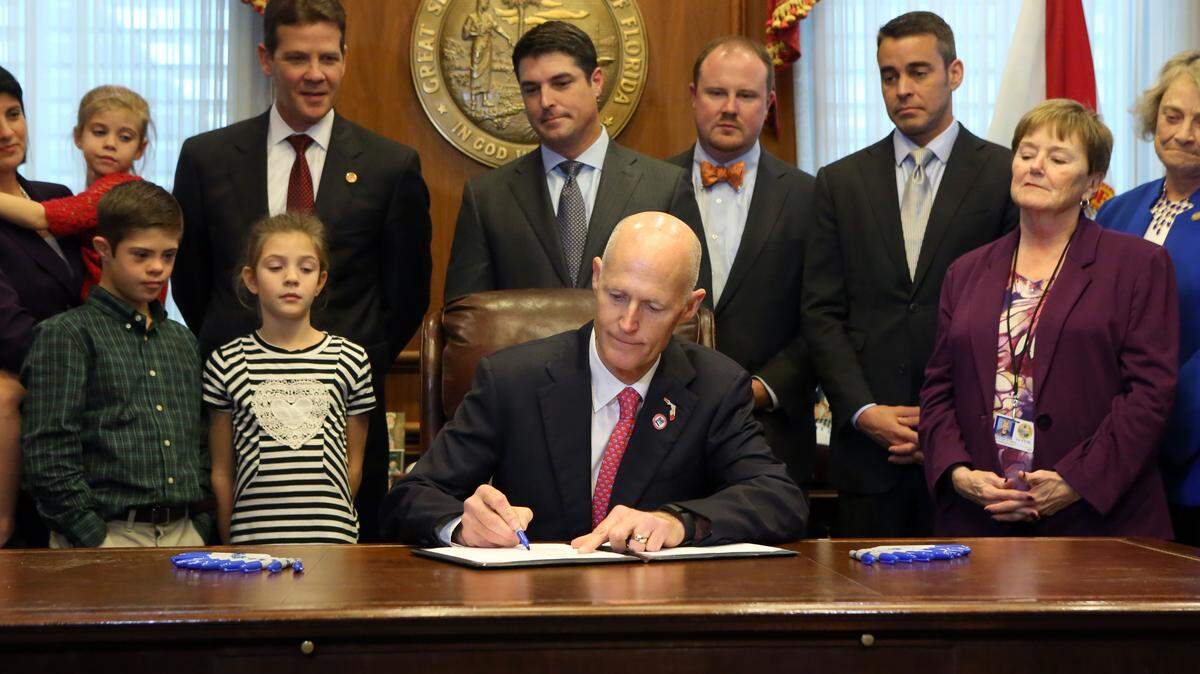
TALLAHASSEE -- Florida leads the nation in new HIV infections, but it's not being treated as a crisis by Gov. Rick Scott or the state's top health officer, Dr. John Armstrong.
As the disease has spread, Scott and Armstrong have imposed four years of personnel cuts in the Department of Health that have shrunk the size of county health departments.
State lawmakers are now asking whether the spending decisions have produced a sicker population in a state where HIV infections have risen each year since 2012 as they've declined across the country.
Miami-Dade and Broward were Nos. 1 and 2 in the U.S. in new HIV infections in 2014 per 100,000 residents, according to state and federal data.
As of November 2015, Manatee County had 62 new HIV cases, about the same as in 2014, according to the Manatee County Health Department. Those numbers are provisional and more complete data will be available this summer.
Armstrong said Florida is spending a record $34 million on HIV and AIDS prevention this year, thanks to a federal grant. He did not dispute the rise in infections.
"Earlier this year, the Florida Department of Health in Manatee County increased staffing levels within our Division of Disease Control to address the increase in cases of sexually transmitted infections in our county. This program is responsible for the location, notification, and referral of clients (and partners) who are diagnosed with a reportable sexually transmitted infection," said Adam DuBois, public health preparedness manager, in an email Tuesday.
"DOH-Manatee also supports a mobile unit which offers testing and counseling services to our residents and visitors daily, including weekend events and community health fairs," DuBois said.
Statewide, staff reductions did not impact the surveillance, education, prevention, counseling, testing, care and treatment of HIV/AIDS patients, Armstrong said in a statement.
Some advocates say Armstrong is part of the problem because he rarely talks about HIV or AIDS and instead places greater emphasis on fighting childhood obesity.
"Without leadership at the head of the agency speaking about this, it creates a hurdle," said David Poole, director of legislative affairs for the AIDS Health Care Foundation, which offers treatment and prevention throughout Florida.
Poole worked in the Department of Health's HIV program for 12 years. He said staff reductions have hampered prevention, and that has led to a rise in cases.
"Silence equals death," said Ron Ford, 53, of Clearwater, a former HIV caseworker who has the virus. "This does not have to happen. But people have to start talking about it for it not to happen."
Armstrong is under new scrutiny about rising HIV rates and budget cuts as he faces a Senate confirmation hearing Tuesday in an effort to keep his job.
A former U.S. Army trauma surgeon, he was a top medical officer at the USF Health Center, earning $405,000 a year, when Scott appointed him surgeon general and health secretary 2012.
In his first year, the state saw 4,512 new cases of HIV infections. The number has increased every year since then.
New cases last year totaled 6,240, the highest since 2002.
Although Florida is among the nation's fastest-growing states, Scott has pushed every year to trim the state work force, and nearly one quarter of those reductions have been in the Department of Health.
The 67 county health departments, largely funded by the state health agency, have declined to 10,519 positions compared with 12,759 in the year Scott took office.
"It's indicative of the neglect of this administration across the board in social services," said state Sen. Oscar Braynon, D-Miami Gardens. "We have a rise in AIDS and we have a reduction in public health spending. We're now cutting just to be cutting."
Braynon is a member of the Senate Health Policy Committee that will scrutinize Armstrong's record starting Tuesday.
The panel has six Republicans and three Democrats. All three Democrats have been critical of Armstrong and one Republican is voicing doubts.
State Sen. Don Gaetz, R-Niceville, is troubled that under Armstrong, the agency's mission has shifted away from direct patient care to messaging about health.
"We've seen a reduction in services provided by county health departments," Gaetz said. "Health conditions exacerbate and folks wind up in emergency rooms. That's a cycle that doesn't end well for patients or taxpayers."
Gaetz said he respects Armstrong's work as a doctor and veteran, but wants the agency's mission to return to treating more people at county clinics. He said he was undecided on whether to confirm Armstrong.
If Armstrong loses Gaetz's vote and can't win support from all five other Republicans on the panel, he'll be in jeopardy of losing his $141,000-a-year job.
Armstrong has clashed with senators twice in the past year. He dodged questions about whether the Senate's failed effort to expand Medicaid would have led to better health outcomes. His agency's changes to the Children's Medical Services program last year ended coverage for about 9,000 children.
State Sen. Denise Grimsley, R-Sebring, supports Armstrong, but said past budget cuts may have cut too deeply.
"I'm not sure that we haven't over-reduced," she said. "It's time for us to go back and look at the funding we give to them, especially in rural counties."
Others say money is not the problem.
"We have found that Tallahassee is supportive and is doing whatever they can, within their ability, to address the uptick in HIV," said Priya Rajkumar, vice president of Metro Wellness and Community Centers in Tampa Bay.
Rajkumar said the state has launched programs to address HIV and AIDS in minority communities, including efforts to reach two separate high-risk groups: black women, and men who have sex with men.
Scott wants the Legislature to make more Health Department cuts next year. In his budget recommendations, Scott called for eliminating 718 more Department of Health jobs, of which 507 are in county health departments. Those cuts would save $13 million.
"Nearly two-thirds of the proposed staff reductions are vacant and therefore will not impact daily DOH operations of result in any interruption in services," Scott's office said.
Armstrong's own data shows that since fiscal 2010, the year before Scott took office, the amount of state money spent on county health departments has fallen 26 percent, from $173 million that year to $128 million in the budget year that ended last June.
During the same period, Scott also has vetoed millions of dollars for local health care programs.
For information on HIV testing and counseling in Manatee County, visit manatee.floridahealth.gov/programs-and-services/infectious-disease-services/aids/outreach-and-testing/_documents/hiv-van-schedule.pdf
This story was originally published January 26, 2016 at 1:23 PM with the headline "More than 60 new HIV cases in Manatee in 2015 ."