
Florida doctor helped create ice to treat malaria in 1800s
In 1833, John Gorrie moved to Apalachicola in the Panhandle of Florida. He was a doctor focused on the treatment and study of tropical disease.
Before we had air conditioning and window screens to keep insects out of the home, the low-lying coastal areas of Florida were a good place to study those illnesses. At that time, doctors thought tropical diseases were generally caused by bad air and swamp gases. The common name for malaria, for example, is derived from the Italian phrase for bad air.
Because of this, Dr. Gorrie thought a dose of cooled air might be the best medicine for his patients. Unfortunately, in the 1830s there weren't any rail lines running to Florida from the icehouses of the North. By 1844, ice was only available in Apalachicola by sailing vessel, brought in from New York at great cost.
Dr. Gorrie struck upon a new solution. By compressing air, cooling it and then allowing it to return to its normal pressure, he could chill the air even in the summer heat of Florida. With a little more refinement he was even able to produce ice. Since then we have discovered that most tropical diseases are spread by mosquitoes, not bad air, although
keeping patients cool improves their comfort and discourages some of the insects that spread disease.
How does this connect to Manatee's local history? Up until the early 1900s, every bit of ice used to pack fish had to be shipped in. This was a time-consuming and difficult process, starting at the freshwater lakes of the Northeast in the dead of winter. Using large saws made for the purpose, work crews would cut large blocks of ice.
The larger the block of ice the slower it would melt, but if it were too large it would prove difficult to move. To keep them from melting, these blocks were insulated with sawdust and straw, and kept in an ice house. Icehouses were low, well-insulated buildings often built partially (if not entirely) underground. During the course of the year, blocks were brought out, packed into ships or railroad cars, insulated with sawdust, and transported around the country as needed.
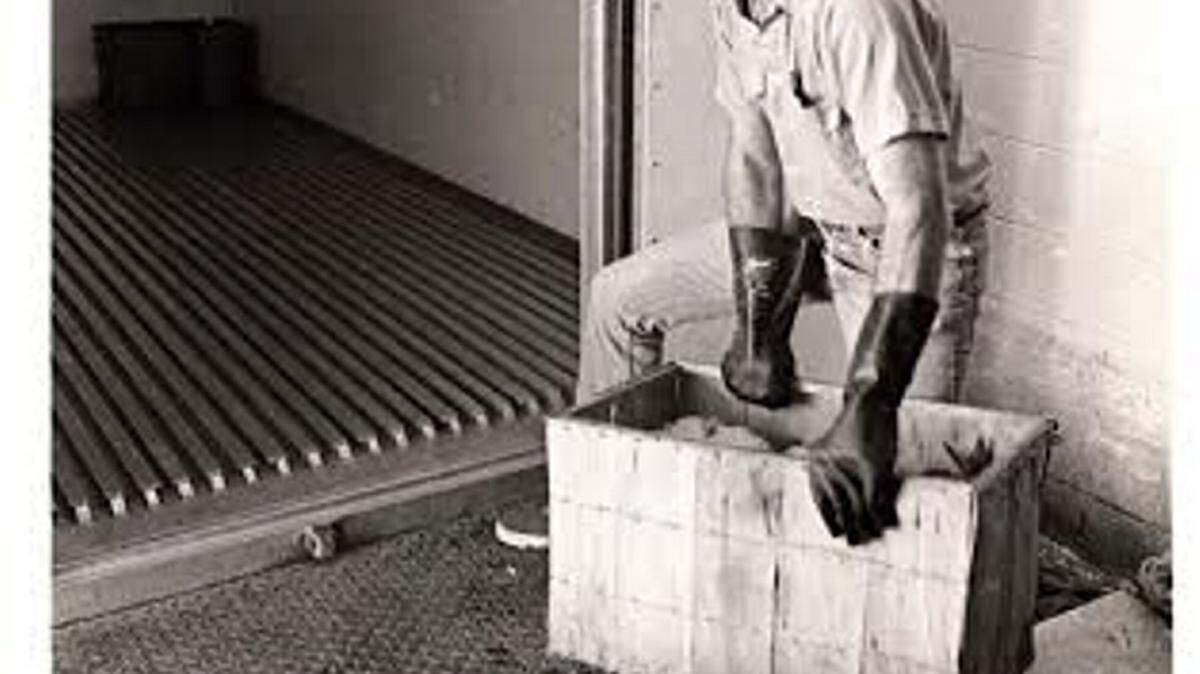
By the first half of the 1900s, ice machine technology had made its way to Cortez. The early ice machines made huge blocks of ice, so someone, usually local youth, would be paid to chip the ice into smaller pieces. These smaller pieces were used to preserve the catch brought in by the fishermen. The ice is able to keep the fish fresh at the market.
Later, ice machines could be set to create smaller blocks and cubes. This cooling technology allows fish caught well out into the Gulf of Mexico to be kept cold and fresh on the trip back to port. Today, fresh fish on ice is a standard in any fish market. Just as standard is the ice in your sweet tea and the air conditioning in our homes, businesses and cars. We owe these comforts, in some part, to a doctor in Florida almost 200 years ago trying to treat malaria and yellow fever.
To find out more about commercial fishing in Florida, visit the Florida Maritime Museum and be sure to catch the upcoming lecture on the history of Florida's fishing industry at 3 p.m. Nov. 18. You can also visit the Florida Maritime Museum free of charge, 9 a.m.-4 p.m. Tuesday through Saturday. For more information, contact us at 941-708-6120 or visit Floridamaritimemuseum.org.
John Beale, education and volunteer coordinator for the Florida Maritime Museum, teaches about Florida's fascinating history and how it connects to the water and the world around us. Contact him at john.beale@manateeclerk.com or 941-708-6120.
This story was originally published November 10, 2015 at 11:32 PM with the headline "Florida doctor helped create ice to treat malaria in 1800s ."