As LGBTQ+ Floridians face new threats, locals point to education. ‘Language is so important’
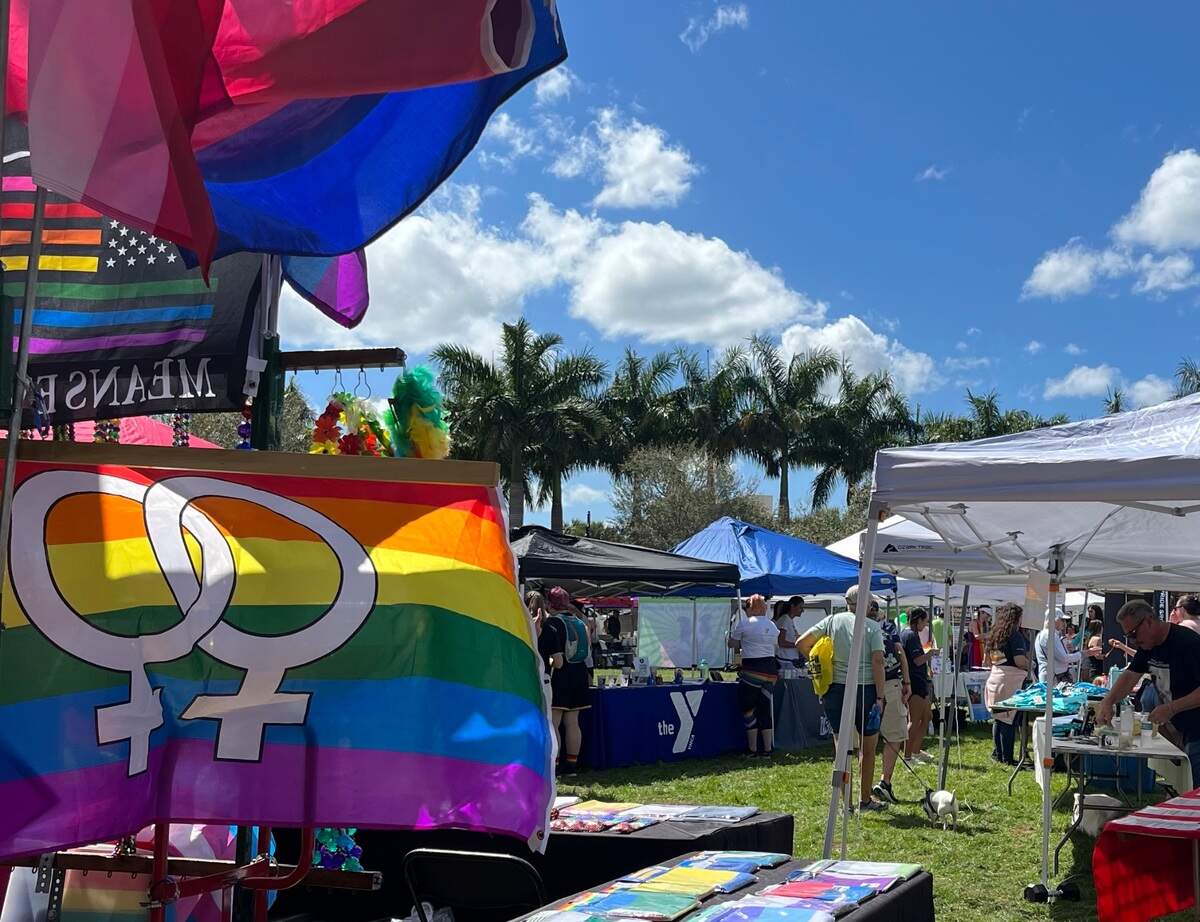
Last weekend, St. Petersburg held its annual pride festival, one of the largest in the country.
But with ongoing talks of Florida’s “Don’t Say Gay” bill and the possibility of gay marriage being overturned, locals say the celebration of Pride is beginning to feel more like a fight.
While some people’s reaction might be to leave the state, 42-year-old St. Petersburg resident Rachel Covello said the community needs to come together and stand their ground.
“We need people here waving rainbow flags more than ever,” she said. “When people are saying everyone in Florida is awful or homophobic, it’s become even more important for us to go out and highlight the places that are out there, highlight the businesses that are inclusive and welcoming.”
For LGBTQ+ organizers and advocates like Covello, educating others and normalizing their place within the community is opening the door for further inclusion.
Christine Grossman, an outreach coordinator for ALSO Youth in Bradenton and Sarasota, agrees. She works with youth who are exploring their sexuality and those who are interested in educating themselves about the community.
She believes that LGBTQ+ education is the best way to prevent the spread of false information.
“There are a lot of folks that are uneducated and don’t have access to individuals who are a part of the LGBTQ+ community who can answer their questions,” she said. “I make sure that I’m creating a safe space so we can make sure our communities are as inclusive as possible.“
Growing up in New York, Grossman had easy access to LGBTQ+ resources. It was shocking to her when she moved to Florida and there were virtually none within an hour drive.
“It made me realize how fortunate I was to have the resources I had and how important it was for folks in the community to step up to make sure that there are more resources for folks in less populated areas,” she said.
Importance of terminology
One of the most important parts of education is using correct terminology, especially as acceptance of gender and sexual orientation are shifting.
New research out this month shows that about 300,000 teens identify as transgender in the U.S., about twice as much as previous estimates. The study was part of the Williams Institute, a research center in the UCLA School of Law that specializes in LGBQT issues.
“Language is so important, especially when speaking to groups of people,” Grossman said. “Gender neutral language is the safest, but also very difficult to shift as gendered language is ingrained in us from a very young age.”
The way the LGBTQ (lesbian, gay, bisexual, transgender, queer) community describes itself has also shifted. LGBTQIA, which adds intersex and asexual orientations, and LGBTQ+, which includes all other sexual identities, are now commonly used.
“Language can be confusing and it can be intimidating,” said It Gets Better Project spokesperson Ross von Metzke. “But if there is the desire to use inclusive and respectful language, that’s the most important thing. The rest really just comes down to learning and practicing and wanting to improve.”
It Gets Better Project, a global LGBTQ resource nonprofit organization, has its own glossary page of definitions and resources for terms and labels commonly used by the community.
Although the glossary was created for LGBTQ youth, it benefits anyone who is interested in learning more about using inclusive and accurate language.
“At the end of the day, language helps us better understand our world and each other,” von Metzke said. “When people feel respected and acknowledged, they feel seen and supported.”
Past terminology was harmful
In decades past, offensive terminology used to describe gay people was harmful. Media, and this newspaper, also used and published harmful language.
In 1950, the Bradenton Herald republished an article originally written by the Associated Press titled, “5,000 Perverts In Washington, Many On Payroll.” The article uses the words “perverts” and “homosexuals” interchangeably.
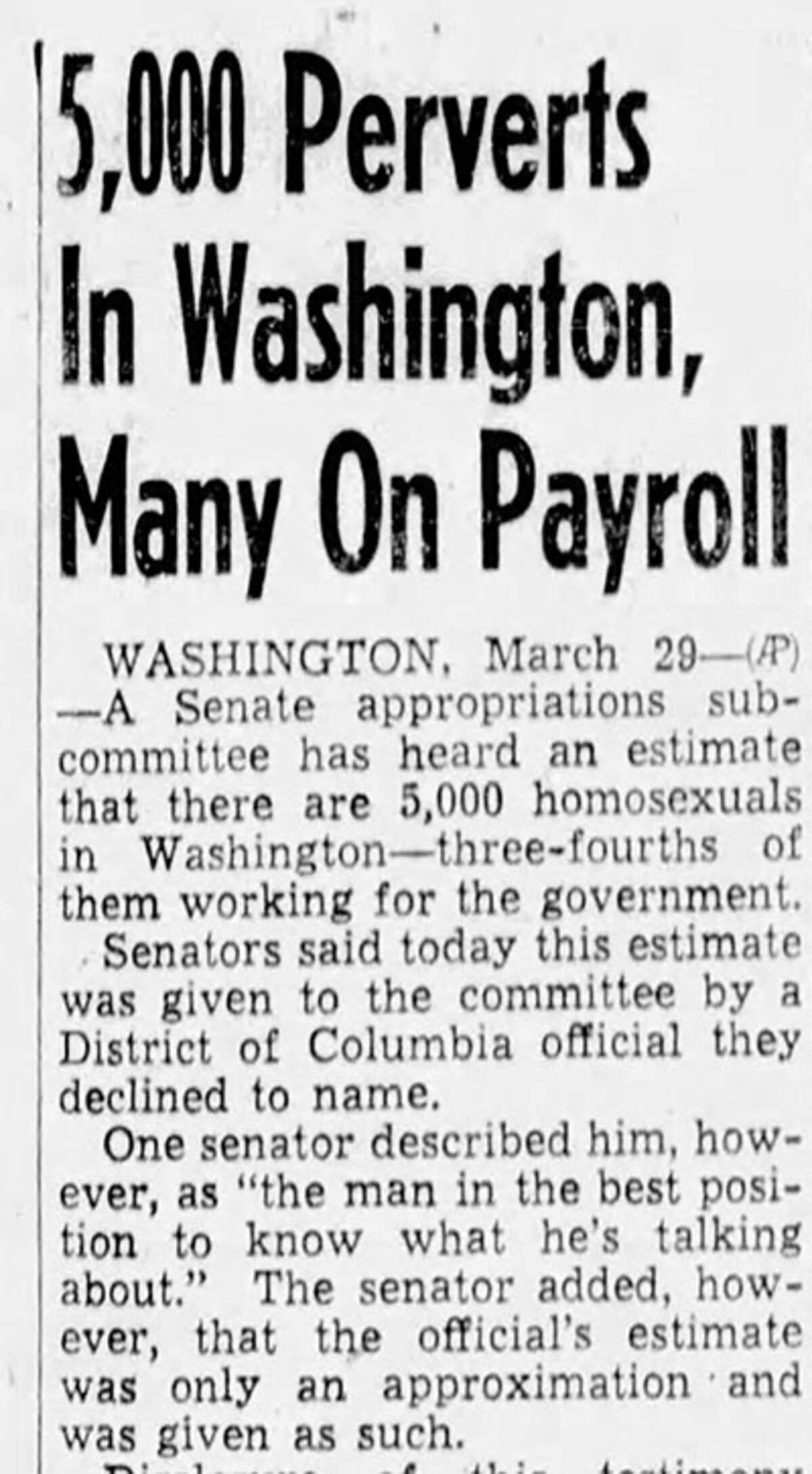
The article came from an internal investigation report submitted to the U.S. committee of expenditures. The report, was considered factual at the time, suggested men and women who were attracted to the same sex needed to be cured of those desires.
The report’s conclusion suggested the government remove all suspected LGBTQ individuals from employment.
Grossman said that this type of language was very dangerous.
“Relating the queer community to pedophiles, predators, groomers or recruiters are all very, very dangerous narratives,” Grossman said. “It’s just associating people with a negative association that has nothing to do with the community and there’s no fact or basis to them.”
In 1985, an opinion piece from the newspaper’s editorial staff discussed whether or not teachers should be able to share their sexuality in the classroom.
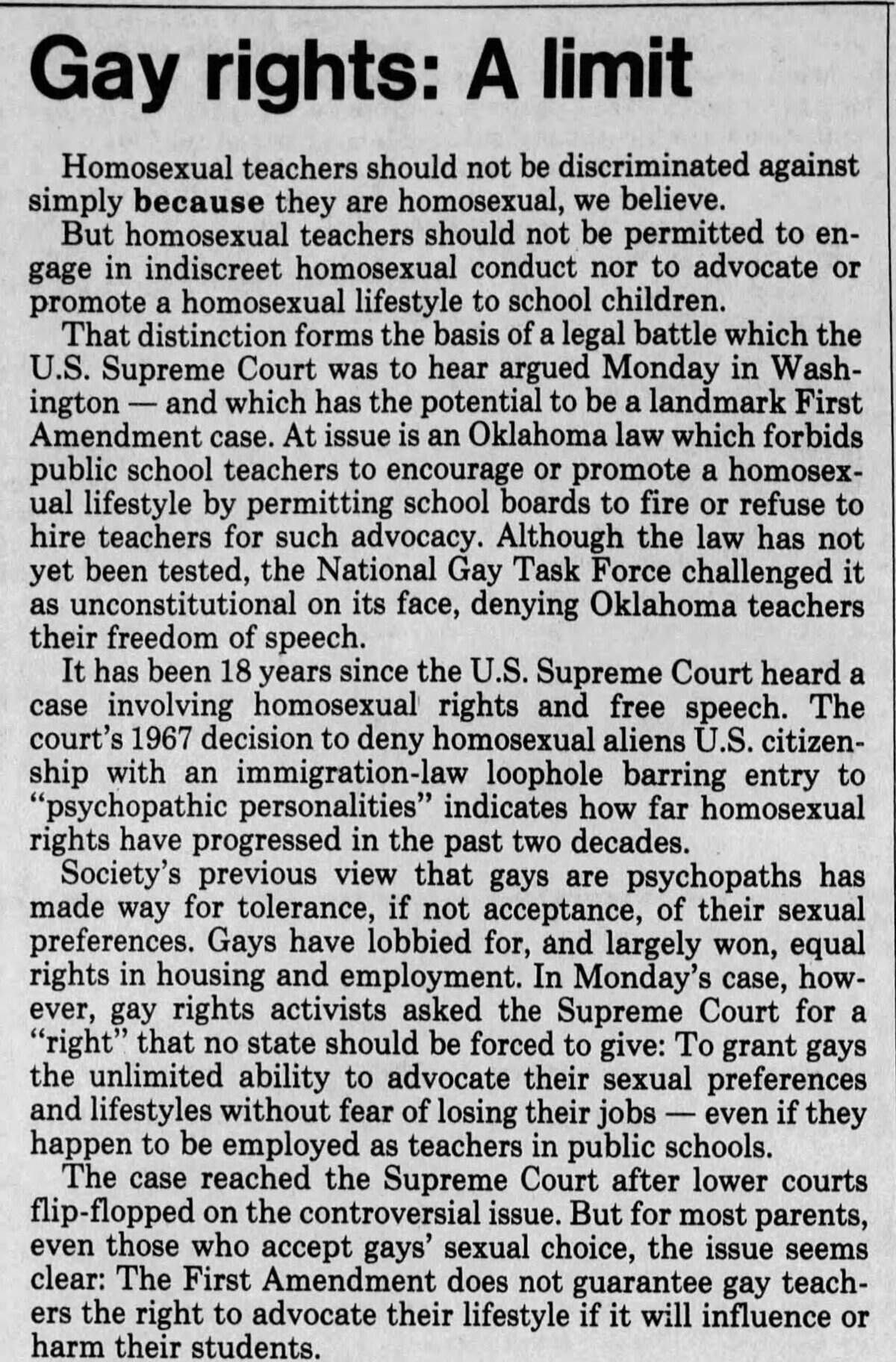
In “Gay rights: a limit,” the newspaper’s editors reflected on a Supreme Court legal discussion and shared they did not think gay teachers should be able to talk about their personal lives.
“If a male teacher could talk about their wife and what they did for their vacation, why couldn’t a male teacher who’s married to a man talk about their vacation?” Grossman said. “It would be okay for some people to talk about their experiences but not others.”
Changing perceptions of travel
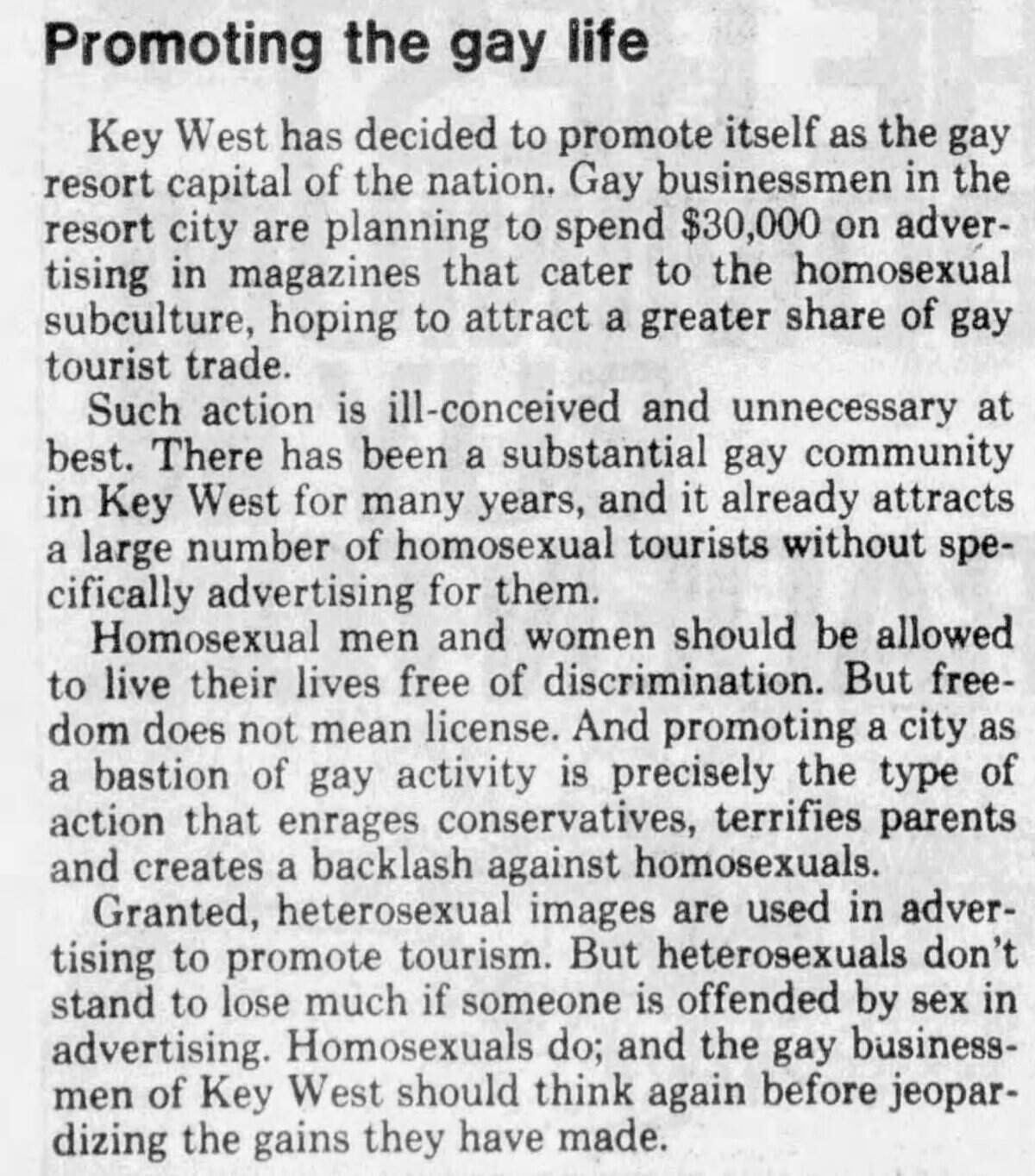
In 1982, the Herald published an opinion piece from the newspaper’s editorial staff. Titled “Promoting the gay life,” the statement shared that the editors disapproved of the Key West businessmen who wanted to advertise LGBTQ+ travel to the area.
The editors warned that advertising LGBTQ+ relationships could be found offensive. They suggested that offending others would be “jeopardizing the gains they have made.”
Since then, LGBTQ+ travel has grown to many other parts of Florida.
Covello is the founder and CEO of Outcoast.com, an LGBTQ+ Florida travel blog. She began the website five years ago because travelers were not aware of the LGBTQ+ communities in Florida.
Covello reaches out to hotels, restaurants and tour groups to collaborate on advertising travel to the LGBTQ+ community.
“I think some of the destinations try marketing LGBTQ+ travel without getting an LGBTQ+ voice involved,” she said. “And that’s where they don’t succeed because they’re doing things for their own perspective and not really hearing and listening to the community members it’s targeted toward.”
Covello is used to educating others wherever she travels.
“I’m always open to a conversation with anyone,” she said. “We have our own unconscious bias towards people that we don’t think agree with us.
“Instead of preaching gay stuff or talking about LGBT stuff, I try to just open people a little bit more closer to inclusion.”
.jpg "Manateepride1 (1).jpg")
This story was originally published June 30, 2022 at 5:50 AM.