
Red tide organism detected in low levels in Manatee, Sarasota waters
The organism that causes red tide was detected at trace levels in one water sample off of Manatee County over the past week.
In Sarasota waters, one “very low” concentration was detected as well as several samples that indicated background levels of the Karenia brevis organism.
While K. brevis is sometimes undetectable in samples taken by researchers, it is almost always present in Gulf Coast waters.
“Red tide blooms are exclusively initiated in the Gulf of Mexico, where K. brevis is almost always present at low and harmless concentrations,” UF/IFAS Extension and Florida Sea Grant faculty wrote during the 2017-2019 red tide bloom, one of the longest on record.
While detectable levels of K. Brevis may seem like a cause for alarm, small amounts are not unusual and do not indicate the same harmful side effects as a bloom concentration of the algae.
At background levels, no unpleasant side effects from K. brevis are anticipated for wildlife or humans.
At very low levels (more than 1,000 to 10,000 cells of K. brevis per liter), respiratory irritation is a possible side effect of the organism’s presence, according to FWC. Shellfish harvesting may also need to be closed if concentrations reach 5,000 cells per liter or more.
More serious effects of K. brevis, like fish kills, are typically felt only when the algae reaches bloom concentrations at more than 100,000 cells per liter.
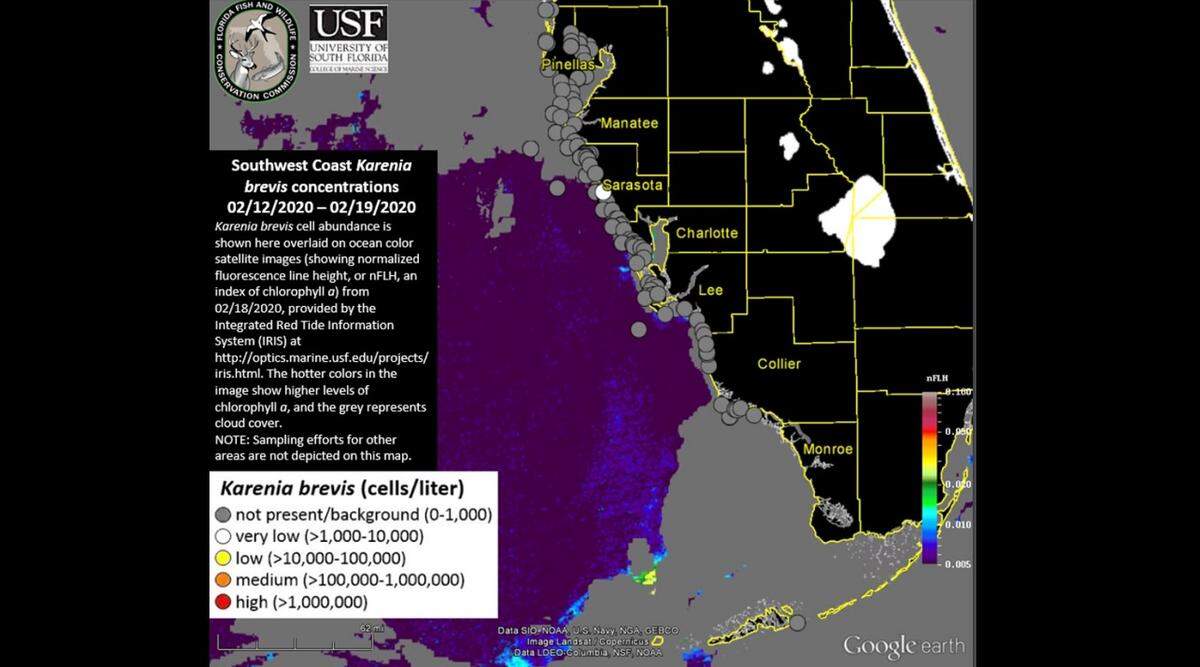
The background concentration detected in Manatee County was in a water sample taken on Feb. 17 in the vicinity of the boat ramp near Longboat Pass on Sarasota Bay.
In Sarasota County, a sample taken alongshore of North Jetty Park on Feb. 17 revealed a very low concentration of K. brevis. Background concentrations were observed at six locations in Sarasota County over the past week, including one 19 miles west of Longboat Key.
No fish kills or respiratory irritation associated with red tide were reported over the last week, FWC says.
The agency will issue its next complete red tide status report on Feb. 28.