
‘It’s wonderful.’ Widow of man who jumped from Sunshine Skyway praises plans for barrier
Ten years ago this March, Todd Korell got up from his bed in the middle of the night, neatly put away the television remote controls, got into his car, drove to the top of the Sunshine Skyway Bridge and jumped to his death.
He had parked directly in front of one of the crisis telephones installed in hopes that if someone was thinking about ending their life, they would pick it up. They would get help. Todd did not.
He and his wife Debbie, along with other family members had gone out that Friday night. They had a great time. Nothing seemed out of the ordinary. Until Debbie woke up that night to find her husband gone.
“I woke up and was like what’s going on here? Is there something wrong? He got up in the middle of the night and was gone. That was it,” Korell said. “They talk about people having psychic bonds with other people. Well, I could feel mine being ripped apart. It was painful.”
Korell knew something wasn’t right. She called the police. She called the hospitals. She called her husband’s cellphone company, who was able to locate his last position but refused to tell her, saying they could only tell the police.
The next day, a homicide detective showed up at her door. He sat Korell down at the dining room table, and pulled out her husband’s wedding ring and watch and laid it on the table. That’s the day a 10-year journey of pain and trying to understand what happened began.
It’s a journey she admits is far from over.
“I don’t know how in the process of healing, you eliminate those feelings,” Korell said. “You just get used to living with them. It’s very much like peeling layers of an onion. Last year would have been our 20th wedding anniversary and it took me totally by surprise. It was a piece of grief I had to process that wasn’t able to be processed until that event occurred. That’s what it’s like for suicide and also like sudden deaths, especially the younger they are.”
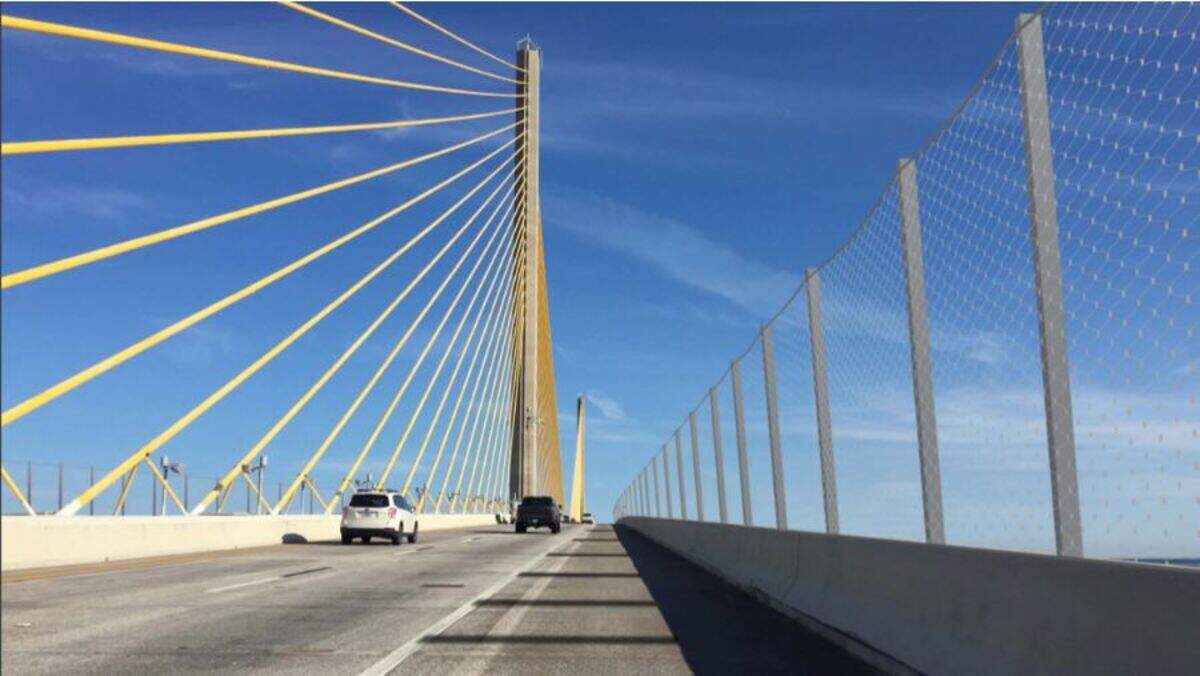
Will a suicide deterrent on the Skyway work?
The Florida Department of Transportation announced on Jan. 9 plans to move forward with a suicide deterrent barrier that is expected to start being installed by this summer.
According to the Centre for Suicide Prevention, the Skyway has garnered an unfortunate label: “Suicide hotspot.”
Some mental health experts theorize that choosing to jump from a famous bridge points to a sense of the isolation they are feeling at the time, but the Centre says the decision is a, “powerful one. It resonates profoundly in the public consciousnesses.”
Even though committing suicide by jumping off a famous bridge or other public space is rare — about 5 percent of overall suicides — the National Institute for Mental Health describes sites such as the Skyway a “suicide magnet,” when such a place provides either means or opportunity.
FDOT’s plan will hopefully eliminate both means and opportunity.
The National Suicide Prevention Hotline says barriers like the one planned for the Skyway are the best way to stop jumpers.
Korell said the move is a right one and long overdue.
“If I’m lucky, no other family will have to go through with what my family and hundreds of other families have already endured from far too many people jumping from that bridge,” she said.
Korell said if the fence stops one more family from going through that, then, “It’s wonderful. Especially because for years they’ve been telling us that trying to build a barrier would affect the aesthetics or would harm a bird. It’s not because FDOT was wanting to do this. It’s because three of the top four bridges known for suicides are all in the process of putting up protection barriers.”
The reality of jumping
The perception of jumping off the Skyway bridge is that it’s a guaranteed peaceful ending, but that’s far from the truth.
Korell learned the horrid details in the days after her husband’s death.
“When you jump from that bridge, it’s not tall enough for you to die when you hit the water,” she said. “When you land in the water, the impact breaks your legs, breaks your pelvis and sends your bones into your organs, puncturing your lungs, spleen or kidneys, and you are left in the water, in pain, to drown.”
It only takes about 3 seconds from the time you leave the bridge to hit the water below and the body is traveling at about 75 mph when it enters.
The bridge, from the roadway to the water, is about 180 feet. Estimates on how high a human can jump into a body of water and survive — with likely injuries — range on average up to 250 feet. The current world record for a high dive attempt is 193 feet for a trained and skilled diver to escape injury.
The average person jumping from the Skyway will suffer multiple internal injuries and the most common cause of death signed onto a death certificate is, “blunt force injury,” followed by, “drowning.”
What’s the answer?
Several years ago, a reality show cameraman was crossing the Skyway on a cloudless, beautiful day. When Sean Michael Davis looked to his left while approaching the peak of the bridge, it wasn’t the blue-green water of Tampa Bay that drew his attention.
“I saw a young lady, maybe in her late 20s to early 30s and even before I could grab my cellphone to call 911, she jumped off the bridge,” Davis said.
At the time, Davis was working on the reality show “Cops,” and had seen just about every kind of tragedy one could imagine while working closely with law enforcement on the streets.
“Usually things don’t affect me, but watching her end her life did,” Davis said. “It was hard to rationalize in my soul that I knew this young lady was no longer with us before her family did.”
Davis began doing a lot of research on the bridge and spent three years making a documentary called “Skyway Down,” which features many like Korell who have precautionary story to tell.
But one in particular was one of the few who jumped and lived.
Hanns Jones jumped off the Skyway in 2001, suffering a broken neck, broken ribs, a burst spleen and collapsed lungs. The impact even ripped the clothes from his body. Somehow, some way, Hanns managed to stay above water and survived.
“If anyone realized how much it was going to hurt before they jumped, they wouldn’t jump,” Jones said in Davis’ documentary. “The sad part about jumping off the Skyway bridge is so many people, I’m sure on the way down, would have chose to swim out.”
But most don’t.
Davis, who has recently authored a book called, “Shoot to Thrill: The Life and Times of a Reality TV Cameraman,” said since 2017, 302 people have jumped from the Skyway and of those, only 40 have survived. However, the numbers are deceiving, according to Davis, who said there are another 207 bodies that were never recovered, thus there is no cause of death recorded.
“My reason for making this film, because of my trade and relationship with law enforcement, is to see if there was any way to create a film that would deter future jumpers,” Davis said. “If so, then all my effort and time would be warranted. I learned so much making this film, and don’t get me wrong, I’m not a qualified expert, but the people in front of my camera are.”
The film can be found on Youtube and is being used by law enforcement agencies as a training tool. It has won several awards and Davis plans to continue to work on it to include the high rate of suicides among veterans. With all the accolades, it’s two emails, thus far, that Davis said are most important.
Two people who were researching the bridge with the intent of committing suicide came across Davis’ film. They reached out to him to let him know that because of his film, they didn’t do it.
“I get to live with that,” Davis said. “I’m very proud of that and it’s the biggest pay-it-forward on the planet that you can imagine.
The aftermath
FDOT’s suicide barrier will hopefully save lives, but it won’t be the end-all solution to a subject that is taboo in its very nature from the dinner table to strict media guidelines in covering the subject.
Korell said that’s part of the problem.
“You go to your cardiologist and he tells you there is all this bad stuff going on with you,” Korell said. “He tells you to go directly to the hospital and if you don’t go, you are going to die within 48 hours. The next guy goes to the office and he goes, ‘Yeah doc, my life’s been going really well, but you know sometimes I’ve been thinking about suicide.’”
The very mention of the word sends up red flags and the next thing you know, “You’re Baker acted for 72 hours,” she said. “You’re taken out of your life so you can be evaluated. Why? Because you told the truth. So what are you going to do? Is that the right way to handle it? To take someone out of their life and plop them somewhere?”
Korell said the stigma around suicide exists because it’s just not something people want to talk about and there are too many assumptions about the act itself. According to Centers for Disease Control researchers in 2016, more than half of the people who take their own lives were never diagnosed with a mental health issue.
The CDC reports relationship issues, substance abuse, physical health problems, job or money or legal issues as the primary reasons those who have not been diagnosed with mental health issues committed suicide.
Suicide prevention organizations even offer the media guidelines and tells journalists to present suicide as a public health issue.
They aren’t wrong, but Korell said there is an important piece of the overall puzzle missing because everyone is afraid to talk about it.
“If you are suicidal and think this the only thing you can do is kill yourself, well, I’m going to say the only thing you can do is wait,” Korell said. “Wait 24 hours. Wait 48 hours. Pick a date two weeks from now on a calendar. In the meantime, take a walk and observe nature. Go look at the things in your life. Do you have a roof over your head? Go look at the people who don’t.
“It’s OK. Bad things happen to good people. Is it money? So what? It’s just money. Is it love? Yeah, it can hurt. It hurts a lot, but it’s OK. Walk away from it. There’s more people out there who will love you. Everything will be fine. Just make it through today. Make it through tomorrow and every day things will get a little better.”
Korell said it begins in the family and there are people who create some false perfect environment around them that is merely an illusion instead of communicating things that may be wrong.
“People are really good at hiding their pain,” she said. “My husband was. There was no indication anything was wrong. The majority of people in this country know someone or knows someone who knows someone that has committed suicide, but nobody talks about it. We sweep it under the rug. Some people are incapable of saying they need help and instead they just implode one night. We have to create a better environment than that.
“If someone dies in a car accident, the family gets plenty of support,” she said. “But with suicide, people think there is more to the story. They want to know was he sick? Was he hiding something? They don’t ask the same from the family who lost someone in a car accident. They don’t ask the causes. This has to change and we have to be more open and less afraid to talk about it and why I will always tell my story.”
How to get help
If you or someone you know is considering suicide, contact the National Suicide Prevention Lifeline at 1-800-273-8255. or text HELLO to 741741.
This story was originally published January 12, 2020 at 5:00 AM.