
Red tide may be feeding algae that clogged Robinson Preserve. The water is looking better
With a map of Robinson and Perico preserves spread out on the ground, Manatee County Parks and Natural Resources Director Charlie Hunsicker used to a small stick to point out where algae came into inlets and piled up in waterways last week.
“One of the contributing factors, among many I believe, was the result of the legacy of red tide. That last year literally took out a lot of the marine life and that stuff didn’t evaporate into the air. It died and went to the bottom and laid. So it’s that decay process that the algae now come in and move over,” Hunsicker explained. “When that algae did its job and it died, it went through its life cycle, it was buoyant by the carbon dioxide that was being emitted and methane gas and all the other kind of stuff in decomposition and it floated to the top.”
The cycle, he noted, happens every year but has been greater this year because of the recent red tide.
U.S. Rep. Vern Buchanan, R-Longboat Key, along with state Rep. Will Robinson, R-Bradenton, and Manatee County Commissioner Carol Whitmore hopped on golf carts Monday and viewed areas in Robinson Preserve that, now mostly cleared, were troubled with algae last week.
“Water quality is the biggest issue we’ve got,” Buchanan said. “Without great water quality you’ve got nothing. We want to make sure we’re on top of this upfront and take care of bringing whatever resources we need to make sure we minimize it here.”
Since last week, county workers have corralled much of the algae that was brought into the preserve by tides, moved it to where the tide could pull it from the preserve and put up a barrier in the water to keep it out, Hunsicker said.
“We need to kind of tighten up the way we deal with runoff in the local community,” Hunsicker said.
On June 24, the Bradenton Herald reported organisms associated with blue-green and brown algae were detected in waters at Robinson Preserve, as well as the Manatee River after thick pads of algae appeared and clogged some waterways in the preserve.
Testing of the water by the Department of Environment Protection later confirmed a species of filamentous cyanobacterium, a lyngbya-like algae in the preserve.
The mats that formed in the water causing the clogs are sometimes formed by that lyngbya.
Robinson, whose family sold the land that is now the preserve to Manatee County, said he was at the park last week and noticed it was “pretty bad.”
“It was a mucky mess,” Hunsicker said.
According to Hunsicker, they can do better work with water quality controls and stormwater systems in attempts to scale back nutrients that go into the water and allow the algae to grow faster.
“We’re doing many things now but can we do them more intensely, more aggressively, better possibly, more costly? The answer is yes,” Hunsicker said.
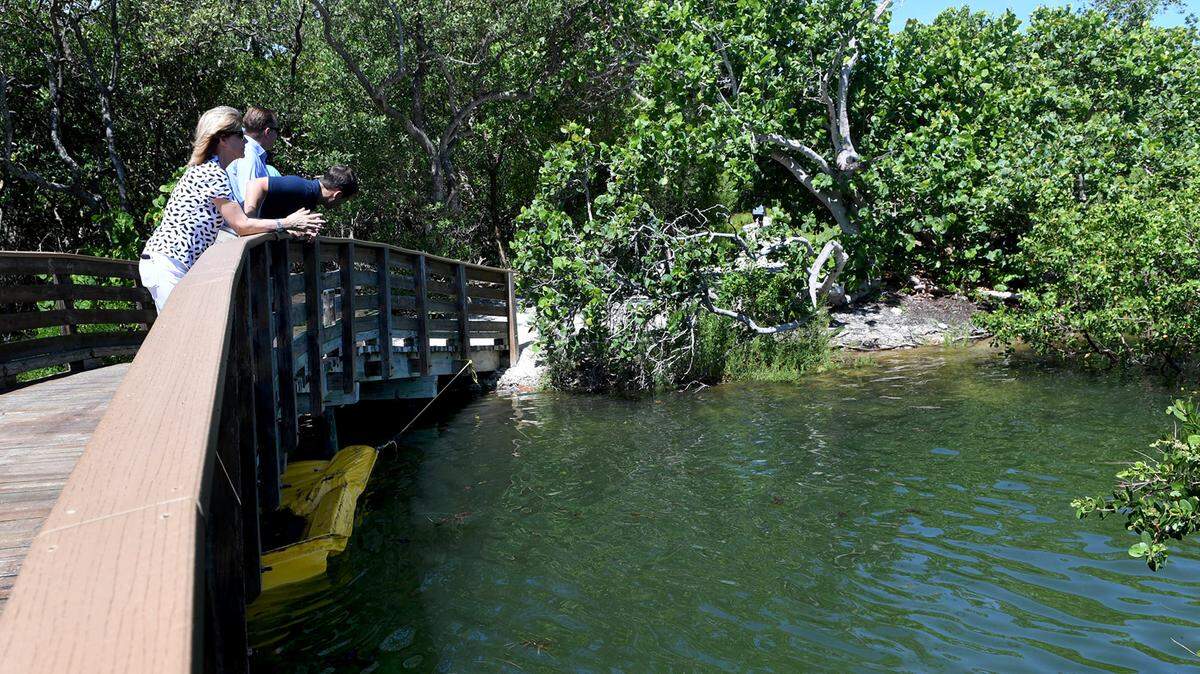
The golf cart carrying Buchanan, Robinson and Whitmore stopped along a bridge that overlooked an area that had algae last week. Monday, waters were mostly clear of algae, except for a few chunks caught in the mangroves.
After a short inspection of the water, the golf cart moved on to another area of water where algae had slightly accumulated near Tampa Bay before turning back to the parking lot.
After the tour, Buchanan said he doesn’t believe the problem is out of control. He stressed the importance of working together to minimize algae while offering his support at the federal level.
Last year, Buchanan backed legislation that would provide more than $100 million to combat algae blooms.
The U.S. House also passed an amendment instructing the National Institutes of Health to designate $6.25 million to research the long-term health affects of red tide and other algae blooms.
At the state level, Gov. Ron DeSantis signed Senate Bill 1552, establishing the Florida Red Tide Mitigation and Technology Development Initiative, along with $3 million in annual funding last month.
Robinson said he is encouraged by what he’s seen done in legislature but noted there’s still work to do.
“I’m just hopeful that with the funding we’ve gotten this past legislative session, what the federal government is doing, that we continue to advance the ball here because water quality is something we have to continuously make progress on day by day,” Robinson said.
“Government has stepped in where it can to acquire land first of all, and then manipulate that land the best we can to let Mother Nature bring the tides back in and change the whole environment and bring the improvements to offset,” Hunsicker said.