
Our History Matters: Reliving aquaculture’s once-prominent role in Manatee County
Aquaculture is not often thought about as being part of the agriculture industry; however, it is a big business in the Tampa Bay area.
Aquaculture includes shellfish farms, food fish, aquatic plants, ornamental tropical fish and more.
According to the 2012 Census of Agriculture, 40 percent of all aquaculture sales consisted of ornamental fish, with most farms concentrated in Hillsborough and Polk counties. Fish are often raised in large aquariums or earthen ponds lined with plastic.
Manatee County also has a history of ornamental tropical fish aquaculture. In the mid-late 20th century, there were several fish farms in the area. One was owned by Ross Socolof.
Socolof took over ownership of the Gulf Coast Fish Hatchery in 1956. The tropical fish farm was located in Palmetto.
Originally from New York, Socolof had been selling tropical fish with General Aquatic for many years and wanted to try his hand at raising the fish. The company was in poor financial condition upon purchase, but Socolof was able to profit.
He shipped tropical fish all over the United States via Tampa International Airport.
One of the challenges Socolof encountered through this process was how to keep the fish warm. He solved this problem by inventing a Styrofoam shipping box, the basic design is still used by tropical fish sellers today.
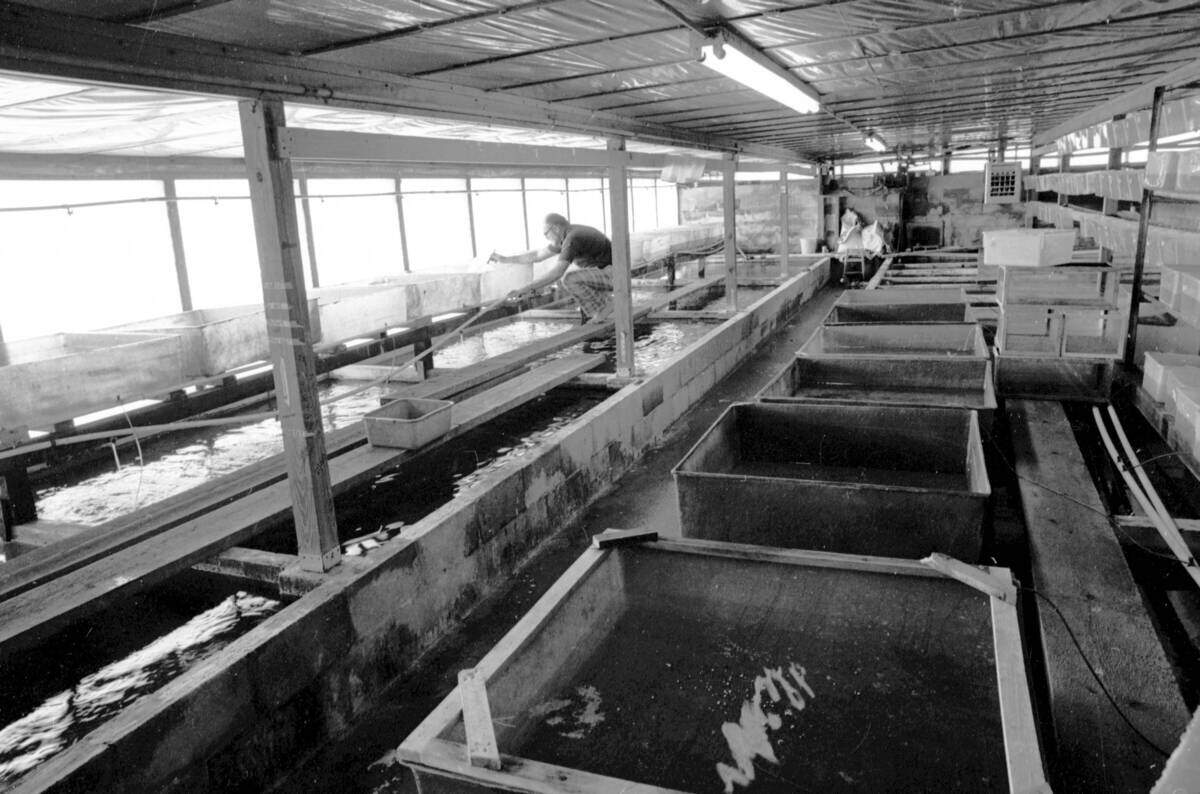
The hatchery used a combination of earthen ponds lined with plastic and covered metal framed breeding and holding aquariums called Cooley Tanks to raise the fish he was importing from Central and South America.
Despite Socolof’s best efforts, he sold Gulf Coast Fish Hatchery in 1963 due to an economic downturn.
Undeterred, Socolof established a new fish hatchery operation in partnership with PETCOA, a Toledo, Ohio-based pet store chain.
Socolof named his new farm Ross Socolof Farms and in 1966 he purchased 80 acres on Moccasin Wallow Road for his farm. He moved to this area because he had access to Manatee County’s untreated water pipeline.
Through water testing and research, Socolof determined that soft, acidic water was ideal for fish breeding, especially the imported species from Central and South America. He quickly built new earthen ponds and constructed a 6,500-square-foot building large enough house 1,200 Cooley Tanks.
Ross Socolof Farms became highly profitable and Socolof expanded with a new building solely for raising angel fish. At peak production, Socolof was shipping 12,000 angel fish per week.
Through the partnership with PETCOA, Socolof expanded the farming operations and increase fish production. At one point, PETCOA/Socolof owned and operated five separate fish farms.
The fish farm business began to decline for Socolof when PETCOA filed for bankruptcy in 1976. PETCOA gave Socolof the opportunity to buy out the five fish farms, but he declined to purchase all of them. Instead, he bought just one farm of 30 acres. He continued to operate that farm until 1982, when Ross Socolof Farms, Inc., was dissolved.
After downsizing his business, Socolof devoted time to the Florida Tropical Fish Farm Association (FTFFA). He served on the board of directors and helped promote Florida tropical fish.
Florida fish had gained a reputation of often being sick and of low quality, but that was no longer the case. Socolof’s idea to help remedy this problem was to create a showcase of Florida-produced fish by having 130 FTFFA members compete against each other at a large fish show. It was a success and Florida regained its reputation for producing the best tropical fish in the world.
Socolof retired in 1983 and went on to write a memoir published in 1996 entitled “Confessions of a Tropical Fish Addict,” which details his passion for tropical fish and the inner workings of his businesses.
Note: A special thanks to Mark Hanson for providing the research needed to write this article.
Melissa Morgan is the curator at the Manatee County Agricultural Museum. Our History Matters is an occasional series published in the Bradenton Herald.