
Tests showed red tide in Sarasota waters last week. Here’s what Manatee beaches are like
Bright blue skies, warm sand, gentle waves and beaming sun met beach-goers on Anna Maria Island on Monday, a welcome change from the recent months of red tide-affected shores.
Small crowds and families were making their way out to the beaches by 10 a.m., and they were greeted by plenty of sunshine and a cool breeze, making the 70-degree weather even more comfortable.
While most were sprawled out on colorful beach towels, a few people tested out the morning Gulf of Mexico waters.
There was no smell or sight of dead fish on the shores of Coquina Beach, Manatee Public Beach or by the Sandbar restaurant.
Mote Marine Laboratory reported moderate water color, no red drift or dead fish on Coquina or Manatee beaches as of shortly after 10 a.m. Scientists did report a slight respiratory irritation on both beaches.
There were no traces of the algae in any of the 13 water samples collected, according to the Florida Fish and Wildlife Conservation Commission’s update on statewide red tide conditions Friday.
No fish kills were reported by FWC but there were reports of respiratory irritation.
Though it hasn’t showed much of itself in Manatee County lately, red tide algae popped up again in water samples in Sarasota County last week.
FWC experts also noted red tide was back at high concentrations in Sarasota County after samples from Siesta Beach, Lido Beach Casino and Lido Key indicated heavy presence of the red tide algae, Kariena brevis, at more than 1,000,000 cells per liter.
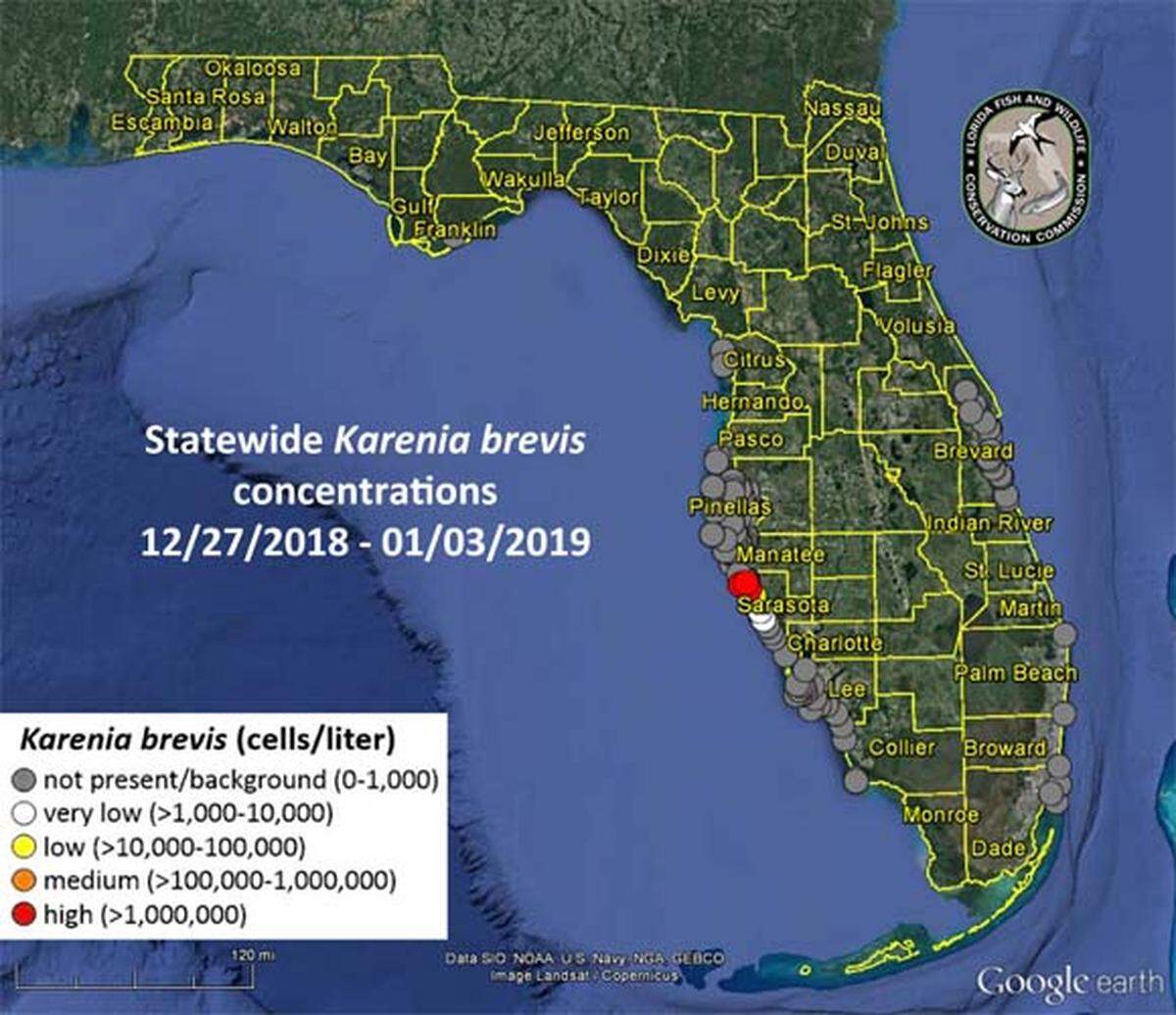
Medium concentrations of between 100,000 and 1,000,000 cells per liter to background concentrations were found at several other Sarasota County test sites.
FWC’s red tide current status map shows the sample results from last week.
Mote staff scientist and program manager Dr. Tracy Fanara tweeted Friday that red tide never left the area, but again increased intensity.
Because of the government shutdown, Fanara tweeted she was unable to see satellite images from Dec. 21 to Jan. 4 that could tell her how far offshore the algae bloom was.
This story was originally published January 7, 2019 at 1:29 PM.