
Our History Matters: You’ve probably never heard of Camp Murphy. That was the point.
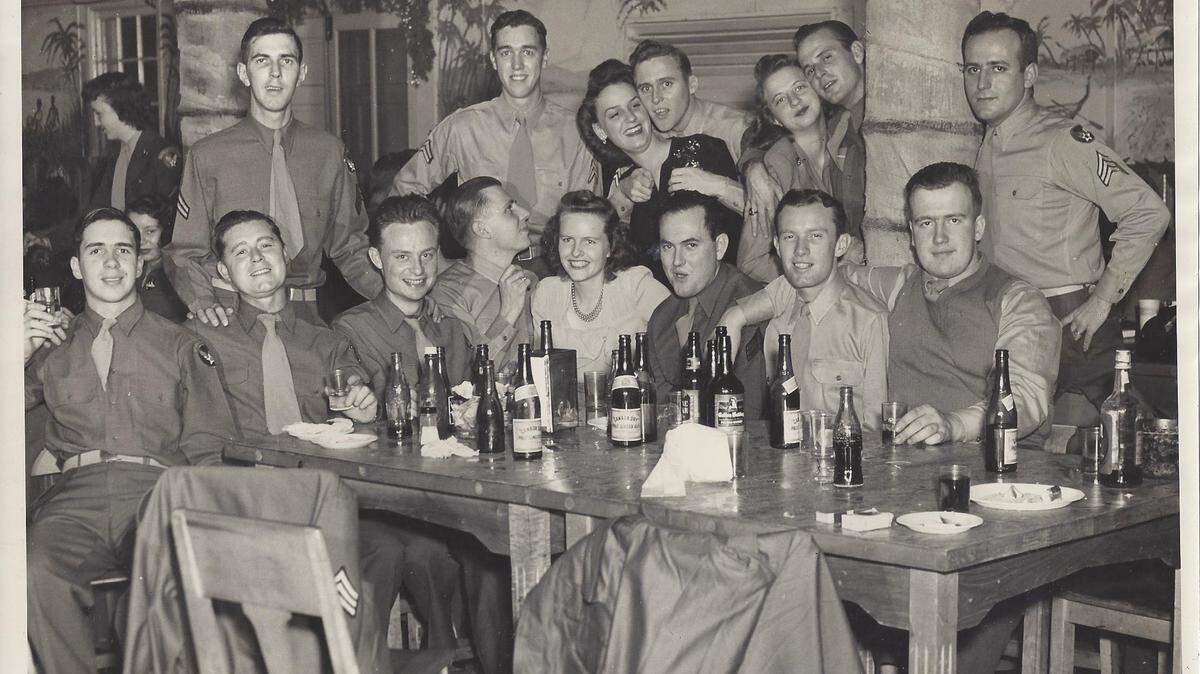
It’s rare for me to look at an image of people about 65 years older than me and think, “I want to party with them,” but that is what popped into my head when I came across a photo of World War II soldiers.
Part of a recent donation, the photo, official military records and other archives tell a story about Camp Murphy on the East Coast of Florida.
Never heard of Camp Murphy? Apparently, that was the point.
In April 1943, the Signal Training Section of the Warner Robins Air Service Command started to lay the groundwork for a much-needed technical school to train technicians in the installation and maintenance of radar.
The training facility was activated on Aug. 31, 1943, in a 200-square-foot fenced-off school area. By summer 1944, the area had grown to a plot of 390 feet by 690 feet.
Camp Murphy started out with 13 officers and grew to 365 in 10 months.
Electronic officers were a necessary and scarce resource in early 1941, so civilians with electrical engineering experience were sought. Graduates of Officer Candidate School who also had radio experience were sent for additional technical training.
This meant that most of these technicians were either officers with a good Army background but weak technical skills, or civilians with excellent technical skills but little understanding of the Army and its functions.
According to a written history of Camp Murphy, the direct appointment officers needed basic field training before being sent overseas because, “It has been demonstrated on the field of battle that technicians are not immune to bullets or bombs.”
They were given a four-week crash course covering a wide range of topics: bayonet assault, grenades, booby traps, infiltration, first aid, defense against enemy air attack, communications, military law and customs of the service.
“The course is concluded with a week’s bivouac, where battle conditions are simulated continuously with ‘enemy’ installations set up around the area to harass and attack the men. The climax is a mock battle, in which the men engage with great gusto, and which it is sometimes difficult to keep on a ‘mock’ basis. Well drilled in all the fundamentals, having fired and usually qualified with the MI Carbine, Thompson Submachine gun, and the Browning Automatic, the technicians of the I & M can do more than their technical jobs.”
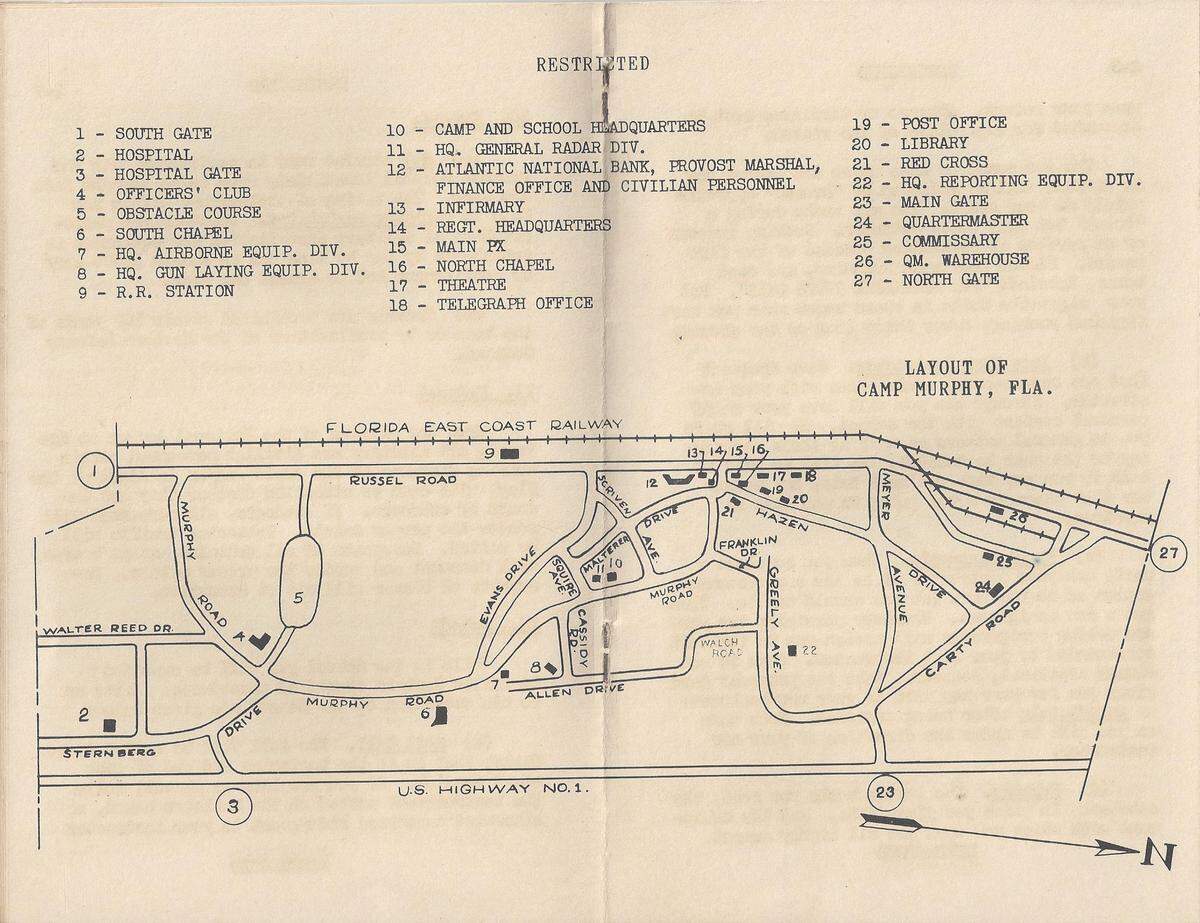
One of the most interesting things I found in this donation was a small handbook titled “Helpful hints for Enlisted Students: The Southern Signal Corps School, Camp Murphy, Florida.” These “helpful hints” cover everything from where you can buy goods, go fishing, attend church, go to the beach, find a library, etc. that is in close proximity to the Camp.
It’s interesting to note that every page has the word “RESTRICTED” stamped across the bottom in bold type. About halfway through, the publication addresses the issue of secrecy, “The lesson books you read, the notebooks in which you place data, and the equipment with which you work are all highly secret. Treat them as such.”
Taking notes on loose sheets of paper was prohibited. “Loose sheets may accidentally find their way into enemy hands,” warns the handbook. “Carelessness on your part may cost lives.”
The handbook opens with “a personal message from your commanding officer” Col. James W. Green, Jr.: “For the short time that you are at this School try to make it the most important thing in your life. No one expects you actually to devote every minute of your time and all of your thoughts to nothing but work.
“Have a good time when you are off duty, but never forget that we are in a War; that it is a terrible War and that as little as you may think your individual contribution will count, it is very important in the overall pattern of the conduct of this War.”
Tori Chasey, curator of the Palmetto Historical Park, enjoys horrifying schoolchildren by explaining the nature and use of chamber pots. She calls it education. Our History Matters is an occasional series published in the Bradenton Herald.