
Red tide remains at bay for Manatee beaches. But for how long?
While Siesta Key beach was uncharacteristically deserted this week due to recent outbreaks of red tide, umbrellas dotted the shoreline of Manatee County Public Beach on Friday morning.
A green flag flapped in the wind from the life guard’s stand at Manatee County beach, indicating low-hazard swim conditions. At Siesta Key, where the water was brown and reeked of decomposition, swimming was prohibited.
A bloom of algae known as Karenia brevis is what caused hundreds of dead fish to wash ashore Sarasota County beaches earlier this week.
In a report released Friday afternoon, the Florida Fish and Wildlife Conservation Commission reported very low background concentrations of the algae in two water samples collected from Manatee County. The report also mentioned two fish kills in Manatee, but Mote Marine’s beach condition report did not reflect any dead fish found on the county’s beaches.
However, forecasters predicted a northwestern movement of surface waters over the next three days, which could carry the fish-killing algae to Manatee County shores.
According to Mote Marine public relations manager Hayley Rutger, the laboratory developed an app called Citizen Science Information Collaboration, or CSIC, to allow beachgoers to report red tide conditions in their area. The app is available on both the App Store and Google Play.
Ron Creach, a longtime resident of the area, said he visited Turtle Beach in Sarasota on Thursday and left with a scratchy throat and sinus congestion — both common side effects of red tide exposure. On Friday, he went to Coquina Bayside Park, where no red tide was reported.
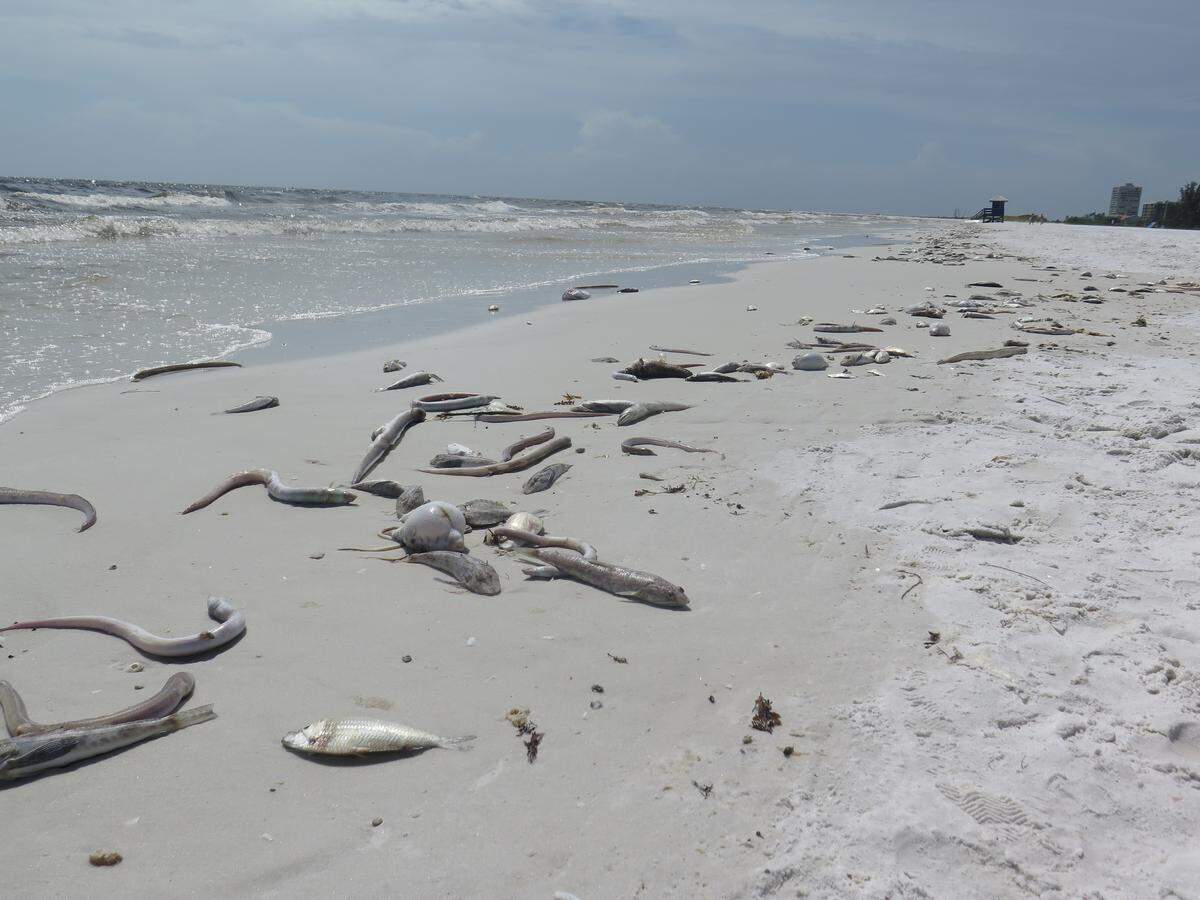
People with chronic respiratory issues like asthma are more susceptible to red tide-related symptoms, said Rutger. However, those without chronic problems may still experience coughing, sneezing, a scratchy throat and sore eyes.
Additionally, consuming shellfish that have red tide sickness could lead to neurotoxic shellfish poisoning, a gastrointestinal illness that causes nausea, vomiting and slurred speech in humans. However, most shellfish farms are shut down during instances of red tide, according to Rutger.
With all eyes on the algal bloom in Lake Okeechobee reported earlier this summer, it is easy for people to confuse the cynobacteria of that bloom with K. brevis, the species of algae associated with red tide, Rutger explained.
But “red tide doesn’t really like freshwater,” she said.
While most algal blooms can be attributed to excess nutrients in the water, most K. brevis blooms begin 10 to 40 miles offshore, away from human impact, Rutger said. Then, she said, the blooms are carried onshore by winds and currents.
K. brevis is “not a picky eater at all,” Rutger said. The algae can consume between 10 and 12 different types of nutrients, according to Rutger.
“The challenge is to know how given nutrient sources affect red tide,” she said.
This particular algal bloom is nothing new and has been pestering the Gulf Coast since last November, but experts say the intensity and persistence are troubling. Red tide isn’t the only bloom causing issues in Florida, though.
On Thursday, Sen. Bill Nelson. D-Fla., penned an open letter to concerned citizens addressing a different algae crisis plaguing Lake Okeechobee. In it, he urged state leaders to “take the steps needed to keep our waterways clean” instead of allowing them to become more polluted.
“There is no quick fix to this problem. There is no magical solution that will make this algae go away overnight,” the letter said.
Sen. Nelson also mentioned that he and Sen. Marco Rubio. R-Fla., are advocating Congressional approval of a “massive reservoir project” south of Lake Okeechobee “to help store and clean some of the water being released from the lake before it goes into our waterways.”
“It seems like the algae has never been this bad. It’s never been this thick. It’s never been this toxic. And that’s because it’s never been this polluted,” the letter said.
Creach first fell in love with Florida’s Gulf Coast at 6 years old. After serving in the U.S. Army and attending law school, Creach decided to make Florida his permanent home.
“No matter where I go, this places draws me back,” he said.
But in the 61 years since he first visited Manatee’s beaches, Creach says they’ve become almost unrecognizable due to development and pollution.
“I love it here when there’s nobody here but me,” he said. “I’m a third-generation Floridian. I love this ocean, but people just don’t respect it anymore.”
This story was originally published August 3, 2018 at 5:45 PM.