
A history of Manatee Memorial Hospital, from concept to community asset
EDITOR'S NOTE: This is the second of a series of articles on the history of Manatee Memorial Hospital. Part 1 can be read on Bradenton.com.
Manatee Memorial Hospital logged more than 9,000 admissions in 1962, far above the 3,400 in 1953. A $1.7 million addition approved in 1961 opened to great fanfare on Aug. 18, 1963, with another open house.
The five new floors at the southern part of the main building and a third floor added to the north side annex boosted the hospital’s bed capacity to 286. The annex was recently removed from our campus to make room for our new 50,000 soft Emergency Care Center.
On July 1, 1963, the state Legislature renamed the medical center to present-day Manatee Memorial Hospital. Confusion over the inclusion of “veterans” in the name led many to believe the hospital was a Veterans Administration facility — for military only. The hospital, however, kept its commitment to veterans.
In October 1963, the hospital installed a state-of-the-art piece of equipment in a special surgical room, technically designated as an “Explosion Proof Operating Room X-Ray” machine. New electronic equipment put Manatee Memorial into the “ultra-modern echelons of Atomic Age hospitals,” the Manatee County Call reported.

Just a month later, trustees began planning for another expansion due to overcrowding — with solarium lounge rooms converted to patient units. The following year, trustees barred winter tourists from scheduling elective surgeries from January to March, thus taking advantage of Manatee Memorial’s lower rates then hospitals in the North.
A September 1963 report stated: “The day of the 50-cent aspirin tablet is a thing of the past at Manatee Memorial Hospital … 85 drugs, including aspirin, are on the free list at the hospital now …” Patients enjoyed other cost reductions as well, but the daily room charge rose in October, ranging from $13 daily for ward care, a $1 increase, to $22 for a private room, a $2 hike.
Trustees adopted a balanced budget for fiscal 1964-65 that did not contain property tax dollars — the first such budget in the hospital’s history, sparing county taxpayers from subsidizing expenses. The second balanced budget came the following year. In 1965, the hospital increased room rates to compensate for personnel salary hikes of $5 to $10 a month.
Major expansions
With the number of hospital admissions, operations and emergency room treatments totaling more than 15,000 in the first six months of 1964, hospital Administrator Bentley Lang told trustees that figure would double in the final six months, rendering the present hospital inadequate in the coming years.
In 1964, voters approved a $2 million bond issue for the additional expansion project first proposed the previous year. But the state voided the referendum because the yes votes did not represent 50 percent of property owners in the county, as required by Florida law on bond issues involving taxes.
Even though 7,700 approved and almost 3,500 disapproved, a number of voters failed to vote either way on the issue in the May primary. Undeterred, county commissioners immediately placed an identical referendum on the November general election ballot.
Freeholders approved that measure, but the project sought federal funds in order to fully fund the $4.5 million project — which never came, so Manatee County commissioners returned to voters in November 1966 asking for a $2.5 million expansion bond issue.
Proponents cited hospital overcrowding and the likelihood of beds in hallways year-round. Once again, voters responded in the positive. With $330,000 coming from the federal government, the project’s total cost reached $4.8 million.
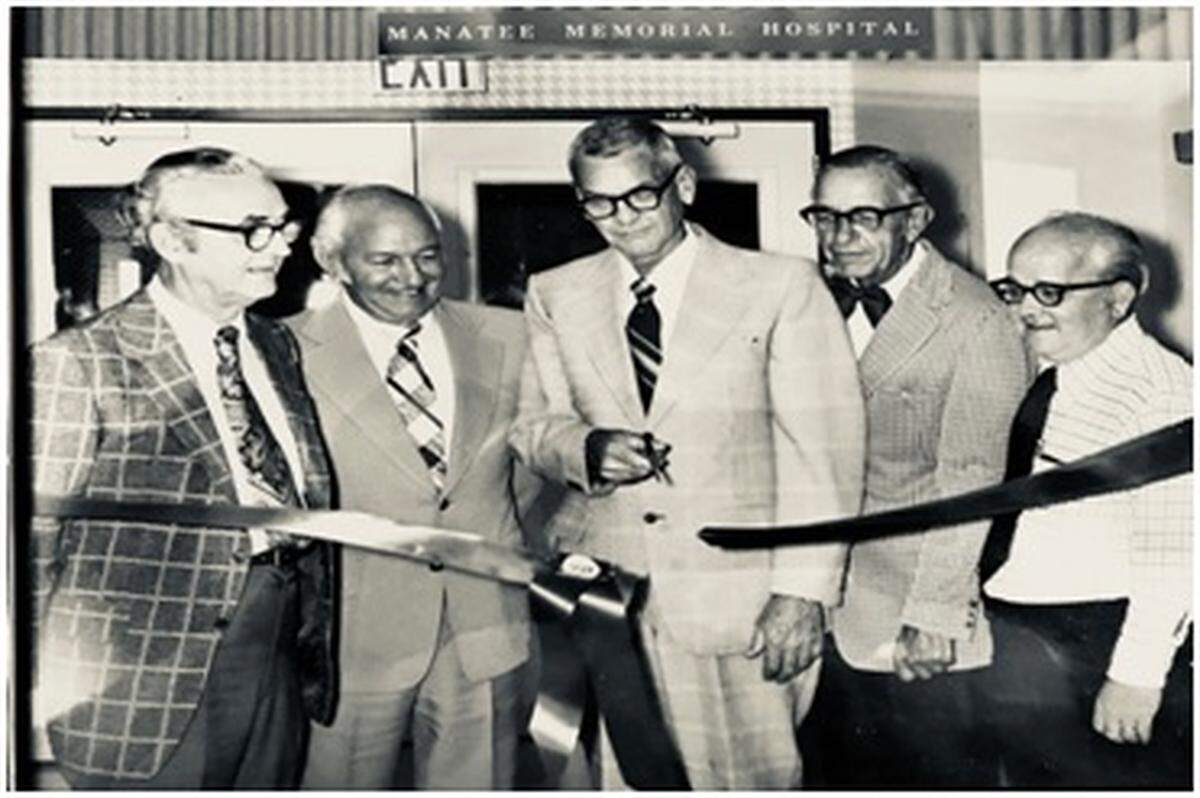
Even upon completion of the 214-bed addition, the medical center could fall short on space, Lang warned the board in July 1965. Passage of the Medicare program would further cramp the hospital, he warned the board, estimating a $140,000 loss serving patients 65 and older.
Of the hospital’s annual $4 million operating budget, seniors accounted for $2 million. The national social health insurance program, launched in July 1966, only reimbursed hospitals 91 percent of hospital charges to Medicare patients in comparison to today in which Manatee Memorial receives approximately 17 percent of hospital charges from Medicare patients.
At that time, Manatee County’s population reached 75,000 with 22 percent of residents age 65 or older, greatly exceeding the national average of 9.33 percent. In comparison, today Manatee County has a population of 322,833 with a senior population over 65 years old of 25 percent.
Finally, on Oct. 6, 1967, the groundbreaking ceremony took place, with gold shovels, described by one trustee as a “long awaited moment.” The $4.5 million expansion was expected to increase the number of beds to 500. The new behavioral health unit held another 25 beds in rooms described as more like hotel accommodations, a kitchen, music and craft rooms and an outdoor recreation area.
One of the most interesting and innovative attributes of the addition focused on improving care. Nurse’s stations were positioned in a then-modern concept called a “Radial Unit,” with patient rooms radiating around the station for quicker medical attention and much enhanced patient observation and monitoring.
Plus, the noise reduction from hallways let patients rest easier. Another new concept came to Manatee County with the opening of a coronary care unit, a specialized intensive care area that also featured a radial nurses’ station. Relatively few American hospitals offered this type of unit, but the idea was spreading quickly.
To this date, those same radial units are on our 2nd and 4th floors and accommodate our Pediatrics, post-Partum, and Oncology and Neurology units. A concept that is very unique to Manatee Memorial. The hospital was well positioned to meet the needs of the next decade as the tumultuous 60’s were ending and preparing for the decade of the 70’s.
Kevin DiLallo, CEO of Manatee Healthcare System, has been a Fellow of the American College of Healthcare Executives for more than 25 years and has a passion for providing health care to his community. Email him at Kevin.DiLallo@uhsinc.com.
This story was originally published June 1, 2018 at 11:02 AM with the headline "A history of Manatee Memorial Hospital, from concept to community asset."