
Manatee blood bank issues dire call for blood donors in anticipation of Zika quarantines
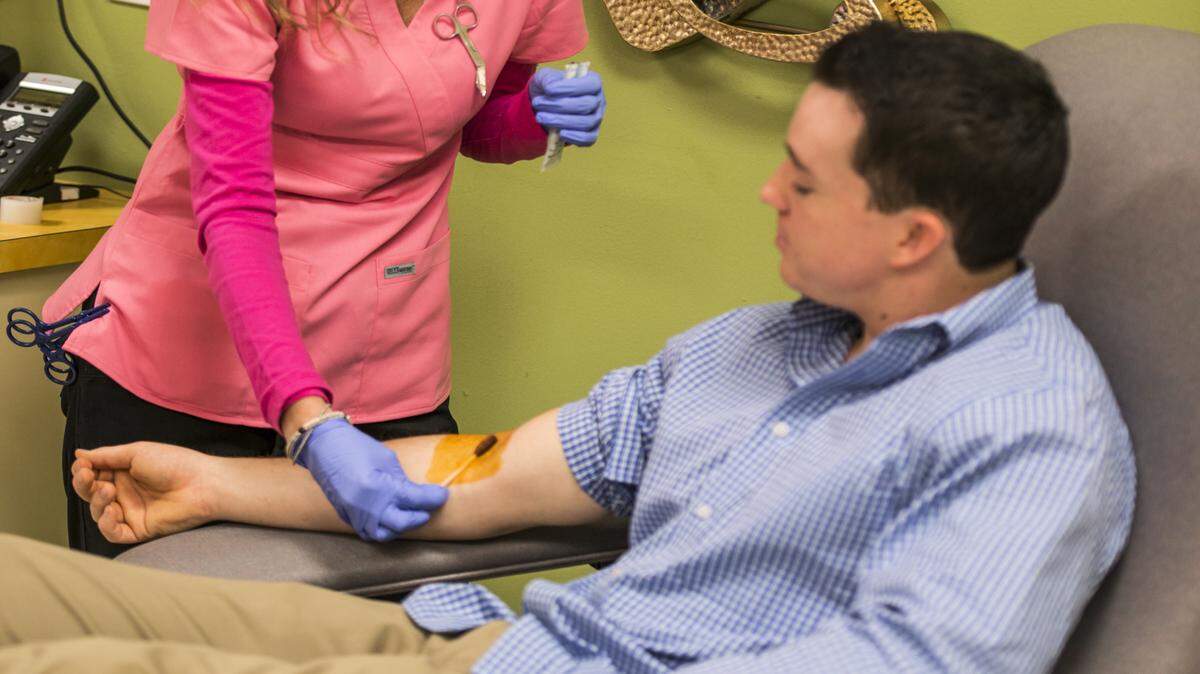
MANATEE -- A local blood bank is ramping up donation requests because officials believe the mosquito-born Zika is imminent in Manatee County and could lead to willing donors being unable to give blood since their zip codes might be in quarantine.
SunCoast Blood Bank's chief executive officer, Scott Bush, is appealing to Manatee residents to visit one of the bank's two donation centers in Manatee County before Zika hits, so SunCoast can stock its shelves in preparation for the virus. To date, it has ravaged countries south of Florida but hasn't hit the state with a home-grown case yet.
Florida leads the nation with 82 of the 314 cases of Zika that have been confirmed in the United States, according to the Centers for Disease Control. But all of Florida's cases are travel-related.
The first home-grown case in Manatee would come when a mosquito in Manatee bites someone who is infected with Zika and then bites someone else giving them the virus, Bush said.
"We have them," Bush said of the Aedes species mosquito, which are day-time biters and can carry the virus. "They are awake. It's just a matter of time before the vector will transmit. We think we will be one of the first areas in the country to experience it."
On Wednesday, the Obama administration announced it will use Ebola money to fight Zika. About $600 million in funds will be used, according to the Associated Press.
Bush said that when the first locally transmitted cases hit Florida and Manatee, perhaps within weeks, potential blood donors from the zip codes where the cases are discovered will all have to be quarantined by SunCoast for 30 days from giving blood because their blood may be tainted.
There is no approved Zika test yet for blood donors, so everyone in the zip code will have to be excluded from donating, Bush said. Zika was classified in February as a public health emergency of international concern by the World Health Organization.
"It's moving toward the tip of Florida," Bush said. "We feel in the blood bank industry that Zika is imminent here. We are hoping it won't be, but we expect it. We are right now trying to ramp up and get ready."
Asked if a case of locally transmitted Zika is imminent in Florida and eventually Manatee County, Mara Gambineri with the Florida Department of Health in Tallahassee on Wednesday replied by saying, "The Florida De
partment of Health has taken a very proactive approach to ensure Florida residents and visitors are informed and protected from Zika virus. The department issues a Zika virus update each weekday at 2 p.m. which includes a Zika case count by county and information to better keep Floridians prepared."
Gambineri also said, "Florida's experiences with successfully containing locally-transmitted Denque and Chikungunya -- which is spread by the same type of mosquitoes -- make us well prepared to manage Zika should it become locally transmitted."
Bush decided to be proactive because 4 percent of the population of Manatee and Sarasota counties donate 100 percent of SunCoast's blood, and zip code quarantines could eliminate large portions of those donors.
Blood lasts on the shelf for 42 days and if SunCoast gets enough stocked before Zika hits, it could stem the need until a new screening test for potential donors is available, said Jayne Giroux, a SunCoast spokeswoman.
"We anticipate that this could hit us any day, so we are trying to build a current blood supply large enough to hold us until a Zika test is ready," Giroux said. "If we can collect enough to get us through shut down by the time our blood all expires in 42 days, we should have the screening test for Zika."
If that "shut down" occurs and SunCoast isn't fully stocked, it will have to import blood from non-affected areas in the United States, which is costly, Bush said.
OneBlood, which also serves the Manatee area, anticipates the Food and Drug Administration will grant OneBlood approval to use the new investigational test to screen blood donations for the Zika virus in the coming months and likely sooner if there is an active outbreak of the virus in OneBlood's service area, said Dr. Rita Reik, chief medical officer for OneBlood.
"We are not waiting for the virus to appear, we are putting proactive plans in place now," Reik said Wednesday. "Once the FDA approves OneBlood to implement the Zika test we will begin testing a certain percentage of our inventory and have blood that has tested negative for the Zika virus available for hospitals to use for their high-risk patients, such as pregnant women, women of child-bearing age and immune-compromised patients."
Buchanan co-sponsored
In February, U.S. Rep. Vern Buchanan co-sponsored the Zika Response and Safety Act -- H.R. 4446 -- which would allow government agencies to use Ebola funding previously appropriated by Congress to prevent further outbreaks of the Zika virus, Buchanan said Wednesday.
"The number of Zika cases keeps growing," Buchanan said. "The mosquito-borne virus represents a growing health threat to Florida and the country so I'm hopeful this targeted funding will help stop its spread."
The Centers for Disease Control has declared that its emergency operations center has been put on a "Level 1" status -- its highest level of activation -- as a result of the Zika outbreak, Buchanan said. The CDC has only put its operations center at Level 1 three times in the past: during the Ebola outbreak in 2014; during the H1N1 pandemic in 2009; and after Hurricane Katrina in 2005, Buchanan added.
"The administration's move to help fund anti-Zika efforts is welcome," Buchanan said. "But, we must remain vigilant in keeping our friends and neighbors safe."
The most common symptoms of Zika are fever, rash, joint pain and conjunctivitis, or red eyes.
People usually don't get sick enough to go to the hospital, and they very rarely die of Zika, according to the Centers for Disease Control, also known as CDC. For this reason, many people might not realize they have been infected. Once a person has been infected, he or she is likely to be protected from future infections.
But pregnant women or women who intend to get pregnant face a more serious threat if they become infected, the CDC warns. Zika virus can be spread to a pregnant woman's fetus and has been linked to a serious birth defect of the brain called microcephaly in babies of mothers who had Zika virus while pregnant, according to the Centers for Disease Control. The birth defect causes newsborns to have abnormally small heads.
Three of Florida travel-associated Zika cases are in Hillsborough County and none were in Manatee or Sarasota counties.
Of the 80 cases confirmed in Florida, four cases are still exhibiting symptoms, which tend to last between seven and 10 days, according to the Florida Department of Health.
People who would like to give to SunCoast in Manatee may do so at Bayshore Gardens Shopping Center, 6026 14th St. W., Bradenton or 1731 Lakewood Ranch Plaza, Lakewood Ranch. To make an appointment or for information: 866-97BLOOD or 954-1600.
Richard Dymond, Herald reporter, can be reached at 941-745-7072 or contact him via Twitter@RichardDymond.
This story was originally published April 6, 2016 at 11:07 PM with the headline "Manatee blood bank issues dire call for blood donors in anticipation of Zika quarantines ."