
It’s not hip-hop. It’s not classical. It’s Black Violin. See them next week at Van Wezel
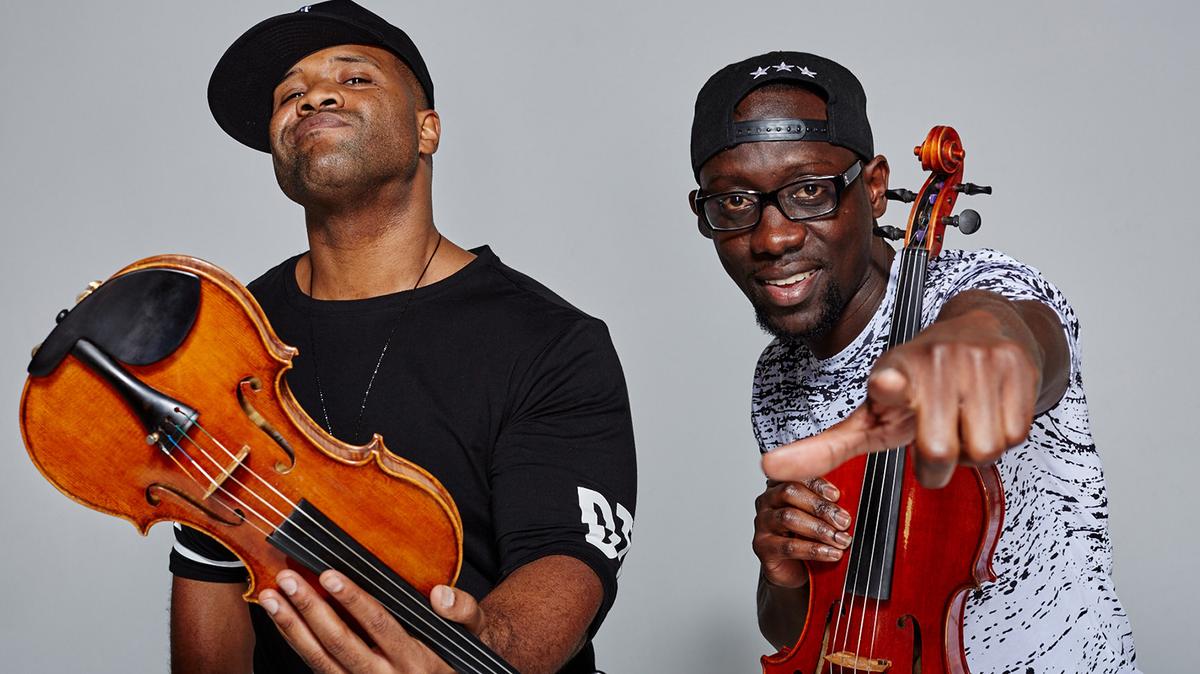
Black Violin has been mixing two unlikely genres for more than a decade.
Kev Marcus and Wil Baptiste’s blend of hip-hop and classical sounds has turned out to be infectious, endearing them to school-age children and adults everywhere.
The duo met in high school orchestra and reconnected after college.
Now, they seek to break down cultural barriers and stereotypes, one show at a time.
Baptiste, who plays viola in the project, spoke to the Bradenton Herald ahead of Black Violin’s Nov. 27 performance at Van Wezel Performing Arts Hall.
What attracted you to the viola?
Funny story. I wanted to play the saxophone, and they put me in the wrong class. This is when I was going into the eighth grade. I signed up for band and I was put in the wrong class. I didn’t find out until 2012 that it wasn’t an accident. The band teacher and the strings teacher actually had a bet, that whoever wins this golf game gets this kid in their class. Crazy. True story.
That’s basically what happened. And when I got to the class, everyone else was ignoring the viola. That’s literally why I picked it up. Everybody wanted to play the violin, or even the cello or bass. Everyone was just bypassing the viola. That’s why I picked it up.
So was it about being different for you?
Yeah. That’s just always been me. If everybody goes left, I question that. I’m like, why is everybody going left? That doesn’t make any sense. I’m going to go right. That’s always been me. And that’s what I did with the viola, and it’s paid off so far.
How does viola compare to the violin?
It’s basically a fifth lower than the violin. Most people don’t even know what a viola is. They just think it’s a fancy way of saying violin. They just think I’m mispronouncing it. I get that all the time.
You’re participating in the Turnaround Artists project this year?
Yes, we’ve been Turnaround Artists for about a year and half now. So we have a school that we’ve adopted here in South Florida, Bethune Elementary School, and we do a lot functions there. And everywhere that we go we try to collaborate with schools and give back as much as we can.
We occasionally go there, talk to the kids, try to really inspire them to be themselves and be great.
What’s the typical reaction from the school kids when you play for them?
Oh man, they’re excited. It’s the idea of classical and hip-hop. They love hip-hop, obviously. But classical has this boring and lame kind of connotation. So we kind of break that completely when they see us play. It’s a concert, it’s a party. So they’re just dancing and having a good time. It’s always fun to play for kids. And when we have their attention we try to plant some seeds along the way.
I bet you have inspired a lot of kids to pick up an instrument themselves.
Definitely.
So, how did you and Kev meet and begin to collaborate?
Him and I met in high school. I was freshman in high school and he was a sophomore. We were just typical kids playing classical music in high school. We went our separate ways in college. He went to Florida International and I went to Florida State. This whole hip-hop classical thing, it’s always really been in us. Not as much in high school, but just once in awhile. I would hear something on TV and try to mimic it.
It wasn’t really until after college we started really coming together and producing and working with artists. We wanted to be the next major producers, the next Neptunes. That’s kind of what started the whole thing. It kind of grew from there. The next thing you know, we’re touring, and we’re artists ourselves.
When did you start touring?
We sent a tape out to Apollo around 2002. We started really touring around 2006.
Do your performance and tour experiences shape the way you write music?
Definitely. It definitely does. And also we’re the type of group that can morph and be chameleon when it comes to music. Not only do we take inspiration from anywhere, but we collaborate with a lot of different producers as well. I can be messing around with something on stage and I record it on my loop station and it becomes a song.
What’s the writing process like for you and Kev?
It’s back and forth. I come up with something, he comes up with something, we come together and work it out. Same thing with producers. Producers come to us with a concept and we flesh it out. Even if a producer comes with a concept, we have to make it work for us.
Your music videos are very powerful and thematic. Are you involved in the creative process for those? How do you think them up?
We’re very involved in everything that we do. We really just try to portray this idea of don’t judge a book by its cover, think outside the box, be yourself, be you. Our videos really speak to what we are about. Which is unity. And just love, man. And respect. No matter who you are or where you’re from, everybody wants to be happy, everybody wants to be important. That’s pretty much it.
Was the song “Dreamers” referring to political events that were happening at the time of its release, or was that just coincidence?
Not really, not initially. But it kind of lends itself to it. Initially it was just a song that we came up with that spoke about dreamers. Just dreaming. Never stop dreaming. At the end of the day, it’s all the same thing.
A lot of popular music is trending towards digital sounds, but you’ve made the choice to play traditional stringed instruments. So it seems like you have a preference for that. Is there a reason why you favor and old-school instrument?
That’s very purposeful. For us, hip-hop and classical — the way we approach it is so different, and the two sides are such total opposites that we want to stay true to both sides. So whenever we play our instruments or record we want to make sure that we play acoustic instruments, and we’re doing it with a mic, and everything has to be pure and clean. Not synthesized. That’s what we’re about, the differences in these two genres and how we’re able to convey this message. The best way for us to convey this message is if we stay true to both forms as much as possible. That’s our sound, that’s how we approach it.
Are you trying to reach anyone in particular with your music?
Anybody. Everybody. We’re not trying to reach a certain demographic, because we don’t feel like we have a demographic, so to speak. We just want to reach anybody that will listen. And if you will listen and take in what we’re saying, hopefully it will not only inspire you, but make you see the world through someone else’s lens.
Everything is so divisive right now, politically and otherwise. Do you think music has a place in bridging that gap?
Absolutely. That’s the only thing. When it comes down to it, we can sit in a room and listen to a tune. That’s the only thing that can really bring us to together. That can really get us to calm down and put our guards down. Music. You can’t help the you feel. When you hear that song, it gets you going. And next thing you know, the person next to you is feeling the same thing that you’re feeling. But that person doesn’t look like you. It makes you think how a conversation could be had.
That’s what we see at our concerts. When you go to a Black Violin show there’s just different people everywhere. They’re coming together. They wouldn’t normally be in the same room together unless maybe they’re watching a football game or a baseball game. That’s what music does, and that’s what our music does.
Just for fun, can I ask you for some recommendations? A favorite classical piece and a favorite hip-hop track?
One of my favorite composers is Shostakovitch, which is funny because I actually hated his music at first. It was very hard. Particularly the chamber music.
It’s very different, but I like artists and music that tells a story. So when I understood his story, and I listened to the music based on Shostakovitch’s story and his life, I could hear everything in his music. I could hear the frustration. Even when he comes up with this very impressive and bright sounding symphony, there’s some darkness in there. But it’s very faint. You have to know his story to see that or hear that. I love artists that can do that.
Another favorite song — it’s not hip hop, it’s mostly jazz — is “Lush Life,” by Johnny Hartman and John Coltrane. Not a lot of people know who Johnny Hartman is. Dope voice. Nat King Cole did a version, but I love Johnny Hartman’s version. Beautiful song.
The first time I heard that I knew exactly what he was saying. It’s very symbolic, the way that it flows. What he says is very simple, but he says it in such a poetic way.
Info: Black Violin will perform at 7:30 p.m. on Nov. 27 at Van Wezel Performing Arts Hall, 777 N. Tamiami Trail, Sarasota. $32-$52. 941-953-3368. vanwezel.org.