
“Urinary leash”: Trans USC students say new bathroom restrictions impair daily life
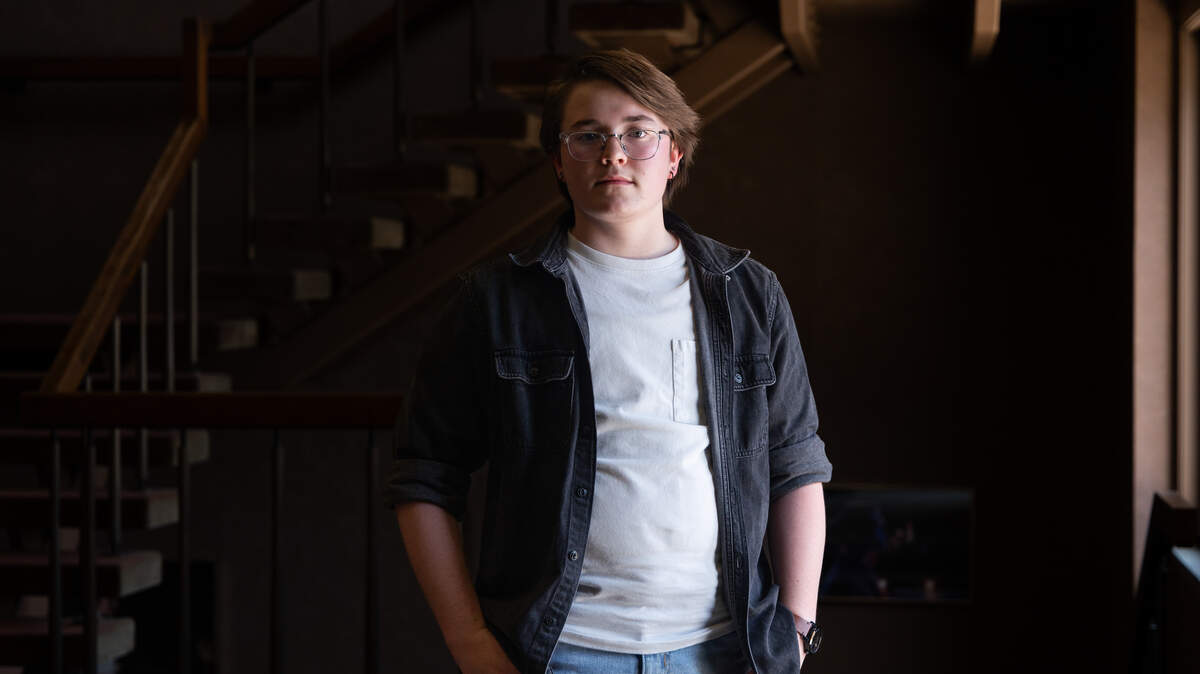
Elliot Naddell rattles off the locations of gender-netural bathrooms on the University of South Carolina campus like they’re speakeasies, each with its own closely guarded mode of entry.
There’s the one at the library that requires an employee passcode; the one at the student union you have to scan into the dining hall to use; and the one in the social sciences building behind a locked door.
As a transgender man, Naddell doesn’t have the luxury of only thinking about the location and accessibility of public toilets when he needs to use one. In light of a new state law that restricts which restrooms he can legally use on campus, Naddell has to plan his schedule around bathroom breaks.
“It’s miserable,” said the rising sophomore, who is studying theater design and technology. “It takes a lot of time, thought and effort out of my day.”
South Carolina’s new “bathroom law,” signed by the governor last month, extends existing restrictions on K-12 school bathrooms to public colleges and universities.
The law punishes public colleges that permit individuals to use bathrooms or locker rooms that don’t align with their sex assigned at birth by withholding a quarter of their state funding.
It also gives anyone who encounters someone of the opposite biological sex in a university bathroom the right to sue the institution if it did not take “reasonable steps” to prevent the prohibited use.
Supporters of the law say it’s intended to ensure privacy and safety for female students.
They point to a situation last fall at Tri-County Technical College, where the Upstate school argued it could not prevent a transgender student from using a womens’ bathroom due to the 14th Amendment and Title IX, the landmark civil rights law that prohibits sex-based discrimination in federally-funded education programs.
Tri-County Tech’s response did not sit well with state Rep. April Cromer, R-Anderson, who moved to strip the technical college’s funding over the episode.
While Cromer’s attempt to defund the school did not succeed, lawmakers have repeatedly cited the incident to justify extending bathroom restrictions to public colleges and universities.
Opponents of the bathroom law argue it’s a solution in search of a problem that stigmatizes trans people and creates new opportunities for bullying and harassment of individuals whose appearance doesn’t conform to gender norms.
“Everybody, transgender or not, has to use the restroom,” ACLU of South Carolina executive director Jace Woodrum, a transgender man, said on his organization’s podcast earlier this year. “And when we say that transgender people cannot use the restroom that reflects who they are, we are essentially telling them that they are not invited to be a part of public life.”
The bathroom law’s impact on SC colleges
For individuals like Naddell, who otherwise would have to use facilities that don’t align with their gender identity, schools must provide at least one single-user restroom and changing room on campus.
Many, if not all, of the state’s public colleges and universities already meet the requirement.
A fiscal impact summary prepared by the S.C. Department of Revenue and Fiscal Affairs found that none of the state’s public four-year colleges, including USC and Clemson, reported any anticipated costs associated with compliance.
“We do not see (the law) as anything that will have a large impact,” said USC spokesman Jeff Stensland, adding that the college had 276 single-occupancy restrooms spread across its Columbia campus. (He couldn’t say where they were located or what percentage of buildings had one).
But compliance doesn’t necessarily mean convenience for trans students and staff, who in some cases will have to travel out of their way to find a suitable commode.
Artemis Capece, a 20-year-old transgender student at USC, described the school’s gender-neutral bathrooms as “few and far between.”
“You might have to walk a while to find one,” said Capece, a rising senior pursuing a dual degree in sports media and the arts. “It can be like a five-to-10-minute walk between buildings, which obviously is not ideal.”
Finding a single-occupancy restroom on USC’s campus also takes more work than it used to.
Until this past school year, a map on the university’s Office of Multicultural Student Affairs website identified single-user and gender-neutral restrooms on campus as a resource for trans and non-binary students.
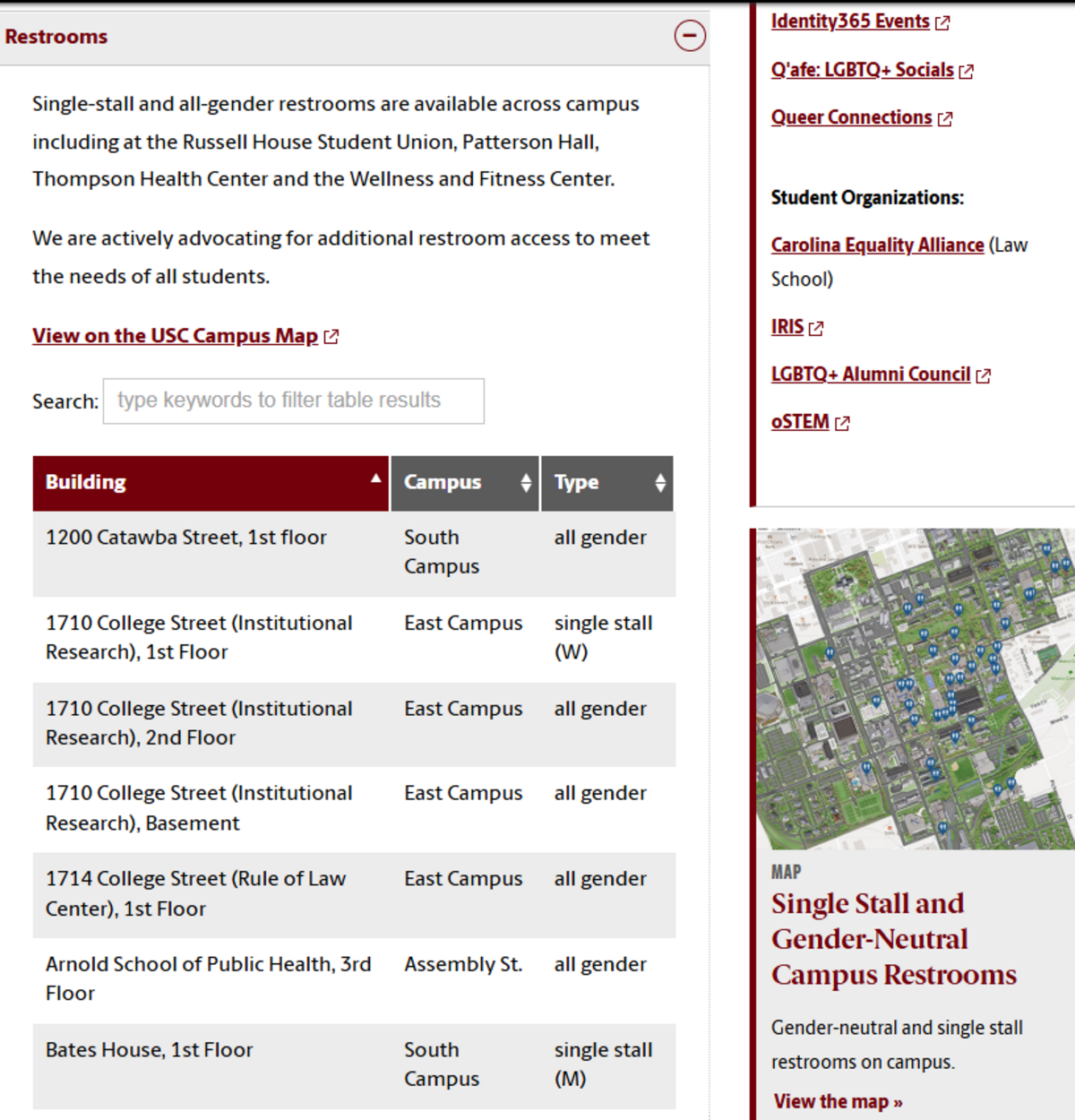
But the student-designed map, along with a trove of other on-campus resources for trans and non-binary students, disappeared from the university’s website around the time USC rebranded its multicultural student affairs office as the Center for Student Engagement.
Stensland said he didn’t know why the map was taken down, but denied USC had scrubbed the website of content that might be perceived as promoting diversity, equity and inclusion, in light of President Donald Trump’s crackdown on DEI in higher education.
An archived version of the map from early 2025 showed 75 single-stall and all-gender restrooms housed in 43 buildings on campus. USC has more than 200 structures it classifies as buildings, although some are just trailers, officials said.
When asked about the bathroom map’s disappearance at a recent Senate Faculty meeting, USC President Michael Amiridis didn’t answer directly, but expressed outrage that any students or staff members would be forced to leave a building to relieve themselves.
“That doesn’t make any sense to me,” he said. “It is torture.”
While the university hasn’t discussed putting gender-neutral bathrooms in every building, it does plan to restore a revised version of the bathroom map to its website at some point, Stensland said.
The bathroom law’s impact on trans students
If Naddell isn’t strategic about when he uses the bathroom, he could find himself stuck holding it for hours or forced to leave a lecture, rehearsal or study session early in search of a far-flung lavatory.
The 2025 Spring Valley High School graduate described the unenviable situation as being tethered to a “urinary leash.”
The evocative phrase, coined to describe the impact that a dearth of public toilets had on Victorian era women’s ability to travel, remains applicable to trans people today, he said.
“When you limit someone’s basic bodily functions,” Naddell said, “you limit their capacity to exist as a person in the world, basically.”
Trans individuals and advocates say that, contrary to the narrative frequently advanced by bathroom bill supporters, restrooms are often a source of extreme anxiety for trans and gender non-conforming people.
A peer-reviewed 2024 study involving more than 12,000 trans and non-binary people ages 13 to 24 found more than 90% of transgender boys and men and 85% of transgender girls and women sometimes, if not always, avoided public restrooms due to fears of having problems using them.
Two-thirds of respondents reported “holding it” rather than using public facilities and nearly 40% said they abstained from drinking or eating so they wouldn’t have to relieve themselves.
Research shows that bathroom avoidance by trans and non-binary people can have both psychological and physical impacts, including dehydration, urinary tract infections and kidney infections.
“We do see kids developing physical medical problems as a result of just not using the restroom at school all day,” said Shannon Minter, legal director of the National Center for LGBTQ Rights. “That is a very common issue for these young people in these states that have adopted these types of policies. It’s really heartbreaking.”
State Rep. Tommy Pope, R-York, who sponsored South Carolina’s bathroom legislation, said the law was not intended to ostracize or alienate transgender people.
The goal, he said, was to accommodate the majority of people, including young girls, who should be able to use the restroom without fear that they’ll encounter a biological male.
“I think we’re trying really hard to be respectful of the choices people choose to make, while not letting it affect everybody,” Pope said. “It’s not here to vilify the person with gender dysphoria, but again, we can’t sacrifice everyone else’s privacy to deal with the one.”
Everyone, he said, runs the risk of being inconvenienced by a bathroom that is squalid or out-of-order from time-to-time.
And while universities will need to figure out how to provide reasonable accommodations to all students and staff, Pope said trans people should recognize that, to some extent, this is a problem of their own making.
“I think at some point, when you make certain decisions, whatever those may be, you have to accept responsibility for those decisions,” he said.
How will enforcement and compliance work?
Regulation of the new bathroom law, which applies not just to the restrooms in academic buildings but also those in sporting venues, is still being worked out.
A spokesman for the South Carolina Commission on Higher Education, which is tasked with enforcing the law, said the agency was preparing to work with the General Assembly to identify its responsibilities and conduct additional analysis for policy development.
The agency earlier this year estimated that enforcing the law would cost anything from nothing — if colleges affirmed their own compliance — to $1.5 million annually, if CHE inspected the bathrooms of every public college building in the state.
When asked about enforcement, proponents of the law have mostly remained mum.
Compliance, they argue, will take care of itself, citing as evidence the lack of any violations in K-12 schools since the S.C. Department of Education issued identical bathroom guidance in 2024.
“The lion’s share of folks and the lion’s share of entities will do what needs to be done to provide the opportunities to have privacy,” Pope said.
Minter, the civil rights attorney, said the typical outcome of such laws is that trans people avoid using school restrooms altogether. In the event they do continue using public bathrooms, they’ll use ones that correspond to how they’re living, even if it violates the law and creates an extreme level of anxiety for them, he said.
“For a young person who has transitioned and is living in a sex different than their birth sex, it’s really not possible to use the restroom of their birth sex any more than it would be for any other girl to walk into a boys’ restroom or any other boy to walk in to a girls’ restroom,” Minter said. “It puts these young people into an impossible situation.”
Naddell, who is just a few months removed from top surgery, said he’s still working out his response to the state’s bathroom law.
“There’s no good solution to this,” said the rising sophomore, who still gets “ma’amed” by strangers and doesn’t feel completely comfortable using the mens’ restroom.
“I certainly would rather use the mens’ than the womens’, even if it is illegal,” he said. “But I would rather not be put in that spot, you know?”
This story was originally published June 9, 2026 at 5:00 AM with the headline "“Urinary leash”: Trans USC students say new bathroom restrictions impair daily life."